
ItInsightsWorld | Inside DeepSeek's second hundred-billion round: Tencent, CATL and state money at 27%

DeepSeek's investor list now stretches across chipmakers, platform firms, automakers and state financiers. According to The Information, the second round gathered 105.5 billion yuan, or roughly 15.8 billion dollars, from nearly 30 institutions. Tencent and Contemporary Amperex Technology (CATL), the battery maker also known as Ning Wang, were the two lead investors. China's state-backed investors supplied about 27% of the new funding, far above the 2% share in the first round, while the round itself was enlarged halfway through because Nvidia's high-end chips became more expensive and the company wanted to prepare for a possible AI bubble.
How the money was assembled
The Information's breakdown puts Tencent and CATL at the top. Tencent put in 10 billion yuan in each of the two rounds, while CATL and its chairman provided 5 billion yuan in one round and 10 billion yuan in the other. ChangXin Memory Technologies and its chairman Zhu Yiming joined, as did SMIC, the state-owned wafer foundry, though the exact amounts for the two firms were not disclosed.
The second round also pulled in companies from internet, smartphones, cars and manufacturing. The list included vivo, Meituan, Geely, Midea, Luxshare Precision, Ctrip and Xiaohongshu, each investing between 1 billion yuan and 3 billion yuan.
The most visible change was the weight of Chinese state capital. Of the 105.5 billion yuan raised, state investors contributed about 27%, compared with only 2% in DeepSeek's first round. China's National Artificial Intelligence Development Fund again committed 1 billion yuan, the same amount as in the first round. China Mobile, China Telecom, China International Capital Corporation, CITIC Securities and China Life also participated, each putting in 2 billion yuan to 8 billion yuan.
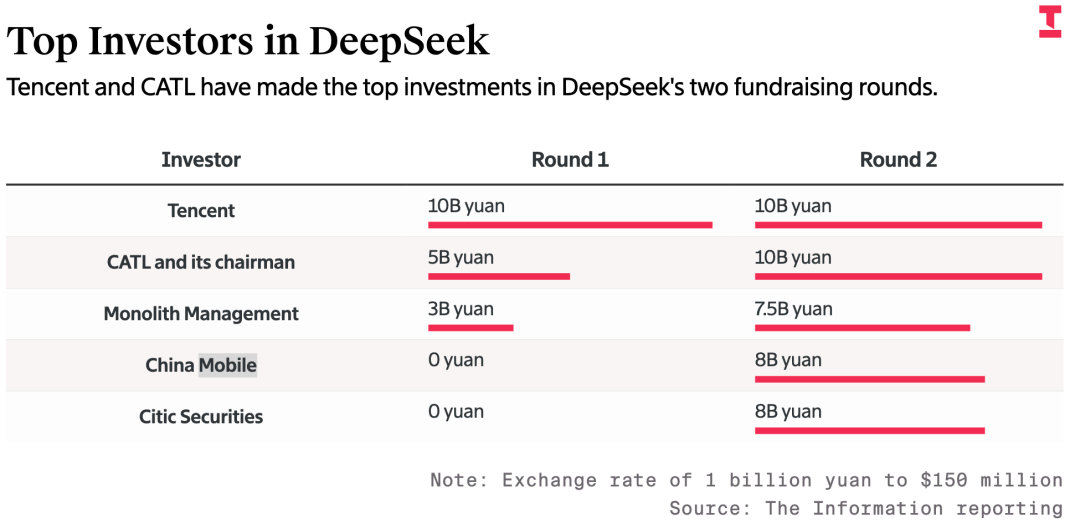
▲ Funding amounts across the two rounds (Source: The Information)
Across both rounds, technology companies supplied about 42% of DeepSeek's total financing, state investors accounted for about 19%, and venture capital and private equity funds formed the next-largest share.
Among venture investors, the Beijing-based fund Monolith Management invested 3 billion yuan in the first round and 7.5 billion yuan in the second. IDG Capital invested 6.5 billion yuan across the two rounds, and Boyu Capital put in 3.5 billion yuan in the second round.
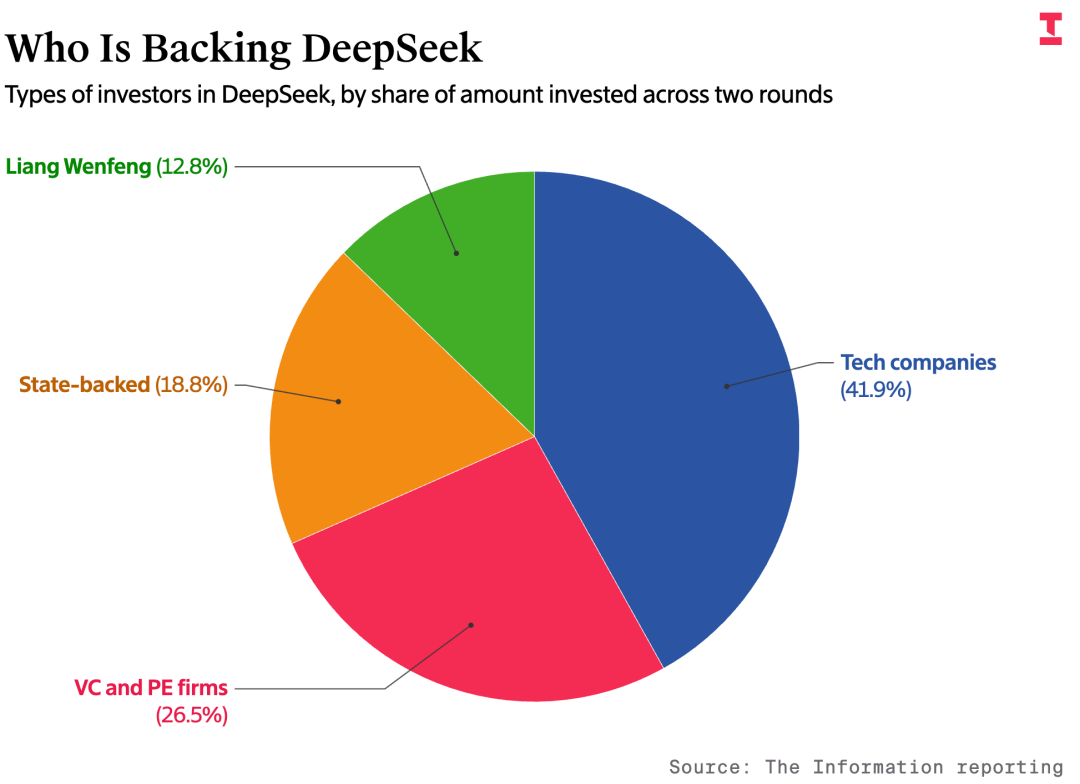
▲ Pie chart of DeepSeek's current funding commitments (Source: The Information)
The first round used an unusual structure. Apart from the National Artificial Intelligence Development Fund, other investors had to place money in an entity held by Liang Wenfeng, give up voting rights and accept a five-year lock-up unless the company listed earlier.
Why the raise doubled
Chip inflation and compute hoarding drove the decision. The Information cited two people familiar with the matter who said that during the four-month fundraising period the price of one server with 8 Nvidia B300 chips rose from about 15 million yuan to 19 million yuan. That price was already more than 5 times the cost of comparable servers in most countries.
The United States has restricted exports of advanced AI chips, and global memory supply has remained tight. DeepSeek needed money for model development, but also for rising chip procurement costs, so the company doubled the size of the round midway.
The Information said DeepSeek is also preparing for a possible AI bubble correction. MiniMax and Zhipu, both already public, saw their shares fall, partly because shares held by pre-IPO investors became freely tradable and selling pressure followed. Holding a larger cash reserve now gives the company room to absorb a future industry reset.
What the cap table implies
Compared with companies that rely mostly on venture capital and private equity, DeepSeek has built an investor base that spans internet platforms, advanced manufacturing, semiconductors, state capital and financial institutions. That combination may provide cash for model training and computing infrastructure, but it also gives the company closer links with firms in chips, manufacturing and telecom.
Those links matter when high-end computing is scarce and infrastructure spending keeps climbing. The remaining challenge is different: money does not erase the cost curve of advanced GPUs, nor the supply constraints imposed by export controls. As the financing pool expands, DeepSeek will still need to balance research spending, technical progress and what investors expect back.