
CXMT Targets HBM3E Volume Production by End of 2026 as China AI Memory Chain Gains Momentum
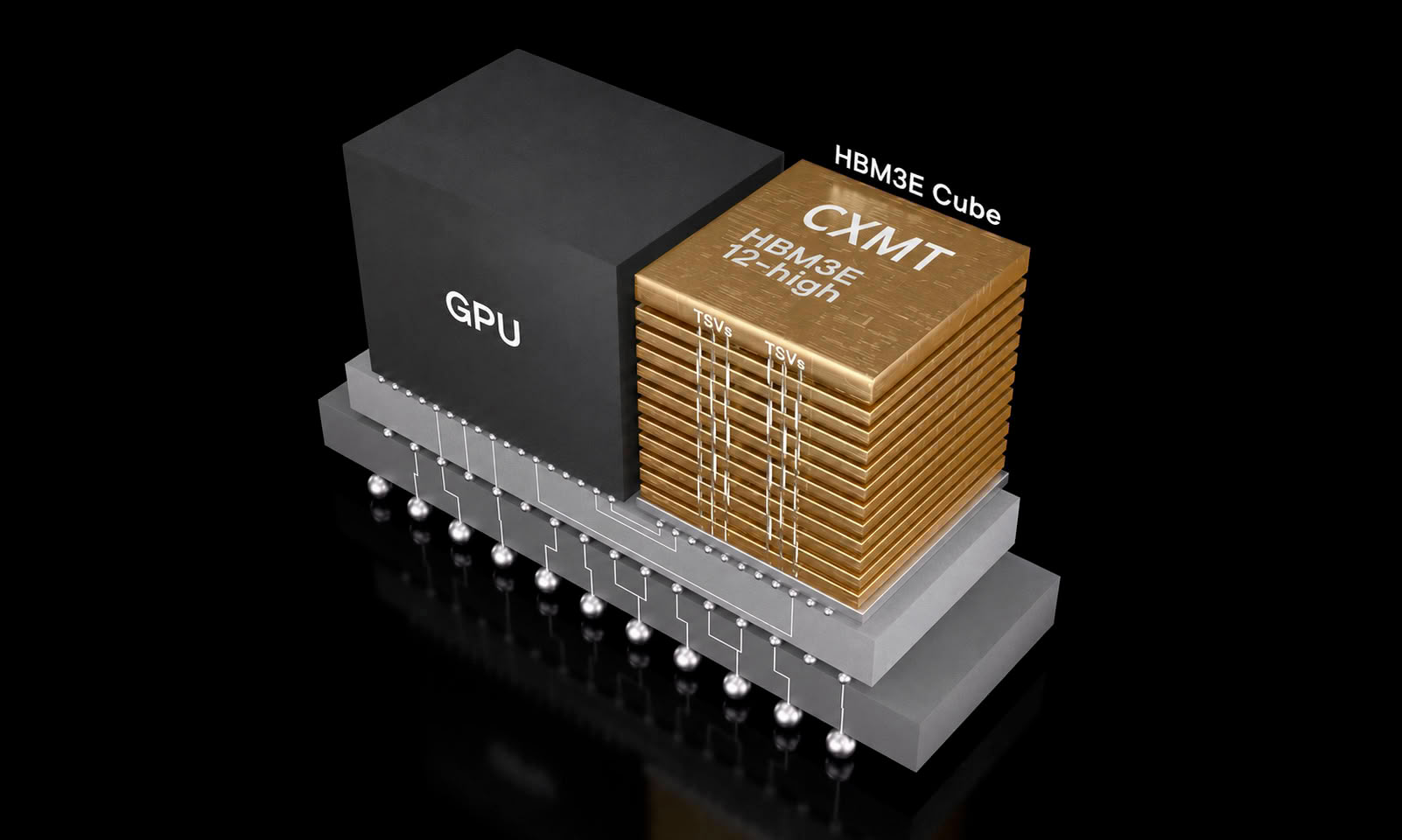
CXMT is preparing to move HBM3E from sample support into volume production within the next two months, according to the latest supply chain briefings, and the target window for formal output remains before the end of 2026. The effort follows a risk-production run this August and sample deliveries to selected customers, marking an important step for China’s domestic AI memory supply.
Why HBM3E matters for AI systems
In AI accelerators, data-center GPUs and high-performance computing platforms, HBM has become one of the most critical memory technologies. It provides far greater bandwidth than conventional DRAM, making it essential for training and running large AI models. The global HBM market remains dominated by SK hynix, Samsung Electronics and Micron.
Under the JEDEC specification, HBM3E uses a 1024-bit bus architecture. Per-pin data rates can range from 9.2Gbps to 12.4Gbps, with 9.6Gbps being a common setting. The resulting aggregate bandwidth is about 1.2TB/s, while capacity options span 24GB to 36GB. The mainstream form factors are an 8-layer stack and a 12-layer stack.
Yield and stacking remain the hard gates
Volume production is not simple for CXMT. Yield problems continue to constrain HBM3E. The process requires multiple DRAM dies to be vertically stacked through TSV technology, so manufacturing and packaging barriers remain high and yield is a key bottleneck for capacity expansion.
People close to the project estimate that CXMT’s overall HBM3E yield is currently around 20% to 30%, still behind leading international suppliers. Front-end wafer yield is said to be about 30%, and the pass rate after back-end packaging can improve by roughly 70%, yet the final combined yield must still be raised.
Industry analysis points to TSV maturity as the most visible challenge. Samsung reportedly used about 5000 TSV connections per layer during the HBM2 era, while SK hynix has exceeded 8000 TSV on HBM3 products. CXMT is trying to achieve an HBM3E design with about 3000 TSV, which raises demands on precision and reliability.
Short-term focus and customer validation
Because of these technical constraints, CXMT is expected to prioritize 8-layer HBM3E products in the short term and will not rapidly push larger-capacity 12-layer stack variants.
Separately, multiple reports say the company has sent two versions of HBM3E samples to Chinese AI chip designers: a standard version and a newer yield-optimized version. These samples are now undergoing customer testing and validation.
Market pressure supports the push despite gaps
Early performance data suggests the current product is closer to SK hynix’s previous-generation HBM3 than to the most advanced international HBM3E parts. Still, analysts say that for a late entrant, reaching mass production itself would be a major breakthrough.
Even with modest yield, CXMT has incentives to continue because demand for high-bandwidth memory from China’s AI chip developers is rising fast. Tight advanced AI memory supply and import-control pressure have created clear domestic demand for HBM products.
Recent AI chip price increases are widely linked in part to limited high-bandwidth memory supply. Alibaba T-Head and Cambricon have previously been reported to test domestic HBM solutions, seeking to reduce dependence on overseas suppliers.
What comes next
Industry estimates indicate that, if customer validation goes smoothly, AI accelerator products using CXMT HBM3E could enter the market as early as 2027. The gap versus global leaders remains one to two generations, but CXMT’s entry into HBM signals that China’s domestic AI hardware ecosystem is closing a key supply gap and starting to challenge the high-end AI memory market.