
A practical guide to COP31 climate finance: why public pledges fell more than 70%, and what to watch next
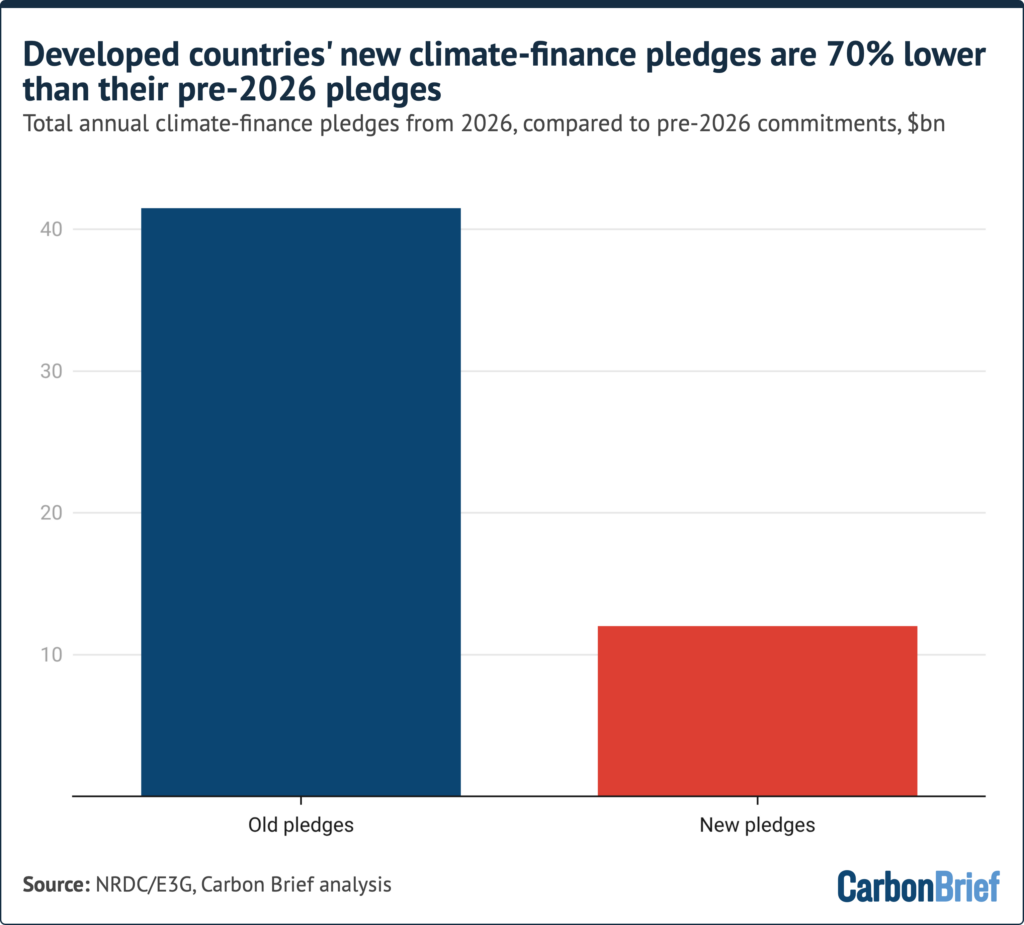
Short answer: what collapsed is the money promised, not necessarily the money already shipped. According to Carbon Brief analysis, the public climate finance pledged to developing countries fell by more than 70% in 2026, landing at $11.7bn a year, down from recent levels of around $40bn. The reason is administrative as much as political: nearly every donor's multi-year target expired in 2025 and hardly any replacements exist. That hole is what delegations carried into the COP31 summit, held in Antalya, Turkey, from 9 to 20 November 2026.
If you have ever sat through a budget review where last year's contract quietly lapsed and nobody in the room can say what next year's spend will be, you already understand the mood. Finance ministries are being asked to commit new money while defence budgets, debt service and an unfriendly opinion poll all pull in the other direction.
A protester held a sign that read make rich polluters pay. Credit: IISD/ENB – Kiara Worth
What actually fell: promises, not payments
Conclusion first: this is a commitment gap, and it is structural. Under the Paris Agreement, developed countries are obliged to provide climate finance so developing economies can cut emissions and prepare for climate disasters. Part of that support is channelled through multilateral development banks and UN climate funds, or mobilised from the private sector, but roughly a third still comes straight out of foreign-aid budgets.
Two years ago, the EU, the US and others agreed they would take the lead on scaling up annual climate finance from $100bn in the early 2020s to $300bn by 2035. Donors traditionally back such goals with multi-year spending targets, and nearly all of those targets expired in 2025. A civil-society tracker run by NRDC and E3G shows new multi-year pledges announced by only five nations, including just one major donor – the UK. Key contributors Germany, France and Japan have not set out plans, and none is expected from the US.
Annualising those commitments, developed countries had previously pledged around £42bn a year in public finance. On pledges currently in force that is down around 71%, to £11.8bn on average over the remainder of the 2020s. Experts tell Carbon Brief that the rise of the far right, global conflict and fiscal constraints are all making it harder for governments to sign new funds.
Two caveats before you quote this in a meeting. For the pre-2026 period, not every contributor announced targets in advance, and some missed or exceeded their stated numbers. Official data for 2025 is not yet available, but bilateral public finance reached £43.9bn in 2024, broadly in line with what was pledged.
The chart below shows the drop.
Why the pledge number looks worse than the flow number
Because the two measure different things, and both are quoted in the same news cycle. OECD tracking of climate finance provided and mobilised by developed countries shows the $100bn goal was first met in 2022 at $115.9bn and then exceeded for a third consecutive year, reaching a record $136.7bn in 2024; the agency says it will publish a final report on the goal in 2027 (OECD).
Those are reported flows: money disbursed or claimed in a given year, including loans counted at face value and private capital pulled in behind public instruments. The $11.7bn figure is the forward book — signed, multi-year public spending commitments. A donor can hit this year's reporting target on promises made three years ago and still have nothing on file for 2029. Read that way, the two datasets are not in conflict; they expose a timing problem.
| Lens | Reported flows (OECD) | New pledges (Carbon Brief, with the NRDC and E3G tracker) |
|---|---|---|
| Direction | Backward-looking: disbursed or claimed | Forward-looking: committed for future years |
| Headline figure | $136.7bn in 2024 | $11.7bn a year for the remainder of the 2020s |
| Instruments counted | Grants, loans, mobilised private finance | Mostly public budget lines, sometimes wider instruments |
| What it can hide | Tomorrow's gap, loan-heavy terms | Money already arriving through multilateral channels |
Who is still on the books
Five nations – Japan, Germany, France, the US and the UK – have consistently dominated international climate finance. Together with the EU, they have provided around 90% of all bilateral, public climate finance going to developing countries in recent years. Only one of them has a new pledge.
| Contributor | What is on the books now | Practical read |
|---|---|---|
| UK | £6bn ($8bn) of aid between 2026-27 and 2028-29, plus £6.7bn ($8.9bn) from outside its aid budget | Roughly half of all annual funds pledged from 2026 onwards, averaging $5.7bn a year |
| European Commission | An average annual contribution of $4.5bn out to 2027 | Not a new pledge: it reflects a promise to spend €28bn ($31.8bn) over the 2021-2027 budget period; the post-2027 share is still inside EU budget negotiations |
| Canada | CA$5.3bn ($4.1bn) by 2030 | About $860m a year |
| Netherlands, Switzerland, Belgium | Relatively small sums; the Dutch government has said at least €300m ($334m) of specific climate funding annually out to 2031 | The Hague also signals total public climate finance will likely be higher in 2026 and 2027 |
| US | Nothing expected | Under the Biden administration it committed to reaching $11.4bn in annual support by 2024; since Donald Trump took power the US has, for the second time, withdrawn from the Paris Agreement and shrunk its aid budget |
| Germany and France | No plan beyond €6bn ($6.8bn) per year by 2025 | Both cut aid budgets; Germany missed its 2025 climate-finance goal |
| Japan | No new multi-year pledge from either the public or the private sector | Largest overall contributor, but it bundles targets with finance mobilised from industry, so it sits outside this count |
Australia, which is jointly hosting the upcoming COP31 summit alongside Turkey, is another notable absence. Josie Lee, policy and advocacy lead at Oxfam Australia, tells Carbon Brief:
If Australia fails to announce a climate-finance pledge as president of negotiations, it would send a problematic message to those resisting action on climate change that might serve to embolden their agenda.
The Japanese government has not traditionally announced targets for this type of spending, which is why its public-finance ambitions are not included here.
Six steps to test any climate-finance headline before you trust it
- Find the expiry date. Ask what year the commitment stops. Nearly all the old targets lapsed in 2025, which is how a "we are delivering" story and a "nothing is pledged" story can both be true.
- Annualise it. A headline total over five years is not an annual budget. Convert multi-year figures to a per-year number, as Carbon Brief did to reach $11.7bn a year.
- Check what is being counted. The UK's number looks more ambitious because counting changed to include $8.9bn of additional public finance covering equity, debt, guarantees, insurance and export credit. Compare like-for-like aid components and the new pledge is a drop in ambition.
- Ask what share is loan. Oxfam's October 2025 analysis put around 65% of climate funding flowing to the Global South in loan form (Oxfam). Face value overstates relief when repayment is added.
- Separate bilateral from multilateral. Money routed through development banks and UN climate funds is real, but it is less traceable to one donor's budget line.
- Overlay the political calendar. Spain's centre-left government has triggered a snap election for the end of November; in Sweden a centre-left bloc is still forming a coalition; in France a presidential election looms. Pledges rarely land in that window.
Why donors keep saying no
Europe provides the majority of international climate finance, yet European governments have cut aid spending sharply, citing economic strain and defence needs. Dr Anja Carolin Gebel, senior policy advisor at Germanwatch, ties the German stall to the 2025 election, after the Christian Democratic Union (CDU) began leading a coalition government:
The issue of climate change – and, subsequently, climate finance – has taken a back seat in the current government coalition.
Gaïa Febvre, international policy coordinator at Réseau Action Climat, describes a similar shift in France and adds:
The upcoming presidential election and the growing influence of the far right are likely to make new international financial commitments politically more difficult.
Developing countries answer with process: they are championing a climate-finance work programme at COP31, which could open a standing space to discuss scaling up public climate finance. The EU has pushed back, stressing that its member states are the largest providers of public climate finance — the EU and its member states provided a record €32.3bn ($40bn) in 2025 — while calling on developing countries to submit overdue emissions plans. EU climate chief Wopke Hoekstra recently told Bloomberg that any conversation on new fresh money is dead in the water.
Joe Thwaites, international climate finance director at NRDC, who runs the commitment tracker, says developed countries would be wise to show how they are continuing to lead on climate finance. He tells Carbon Brief:
The lack of new announcements is making the finance negotiations tougher than they need to be. The debate around the climate-finance work programme is arising because developing countries have little clarity about how much public climate finance there will be in coming years.
Where the shortfall bites first
Adaptation. UNEP's Adaptation Gap Report series puts international public adaptation finance at US$28.2–31.7bn in 2024, against modelled needs of roughly $310bn a year in 2035 for developing countries (UNEP). Set that beside an annual pledge book averaging $11.7bn and the arithmetic is unforgiving.
Simon Stiell, executive secretary of UN Climate Change, framed COP31 as an implementation summit rather than a target-setting one, saying in his opening remarks that "this will be a COP that converts pledges and targets into concrete results" (UNFCCC). He also noted that 90% of large renewable projects now cost less than their fossil alternatives — which is exactly why finance arguments have moved from "clean energy is expensive" to "who pays for the switch, and who absorbs the physical risk". For the physical-risk side, see our practical checklist for reading Earth's accelerating heat buildup ahead of the Antalya talks.
Four misconceptions that keep resurfacing
- "The $100bn goal was met, so nothing changed." Meeting a goal with reported flows does not refill a pledge book that expires.
- "Pledges are just optimistic accounting." Some are, but the drop from around $40bn to $11.7bn is large enough to be a real signal, not a rounding argument.
- "Private money will close the gap." Private capital follows bankable projects, credit guarantees and predictable policy — the same things shrinking aid budgets make harder.
- "One new donor can hold the system." One major donor with $8.9bn of non-aid instruments cannot replace Germany, France, Japan and the US at once.
How the numbers were built
The analysis uses the climate-finance commitments tracker run by NRDC and E3G, plus additional research, and covers only the 23 developed countries obliged to provide climate finance, along with the EU: western Europe, the US, Australia, Canada and New Zealand. Japan and Norway provide substantial sums but have not announced specific public-finance pledges, so they are excluded. Multi-year pledges were converted into single years, using 2025 as the baseline pre-2026 year; Belgium, Switzerland and the US only set targets as far as 2024, so 2024 values were used. The comparison uses the average annual contribution for the latter half of the 2020s, based on new pledges from the UK, Canada, Belgium, Switzerland and the Netherlands, with earlier EU, Portugal and Greece pledges still running, though the latter two contribute very small amounts. Pledges to the Tropical Forest Forever Facility (TFFF) by countries including Germany and France are not included; they would shift the overall reduction from 71% to 70%.
Questions readers actually ask
How much public climate finance is pledged now?
$11.7bn a year in spending over the next few years, against recent levels of around $40bn — a fall of more than 70% in 2026, per Carbon Brief analysis.
Is climate finance the same thing as the $100bn goal?
No. The $100bn goal is a flow target, first met in 2022. The current headline is a forward pledge book, and new targets from only five nations cover the period out to 2030.
Why does the UK figure look like an increase?
Because counting rules changed to include $8.9bn of additional public finance. On like-for-like aid terms, it is less ambitious than before.
What would change the picture?
Any new multi-year pledge from Germany, France, Japan or the European Commission's post-2027 budget, plus clearer rules under the climate-finance work programme.
What to do next
Treat this like a vendor renewal you cannot afford to miss. First, log the expiry dates that actually matter: the EU budget talks that decide the commission's contribution beyond 2027, Spain's snap election at the end of November, and the OECD's final report on the $100bn goal planned for 2027. Second, separate pledges from flows in your own notes, otherwise every future headline will look contradictory. Third, before accepting any "record funding" claim, check the loan share and the counting rules — that single step settles most disputes. If the pledge book stays this thin, expect the fights at future summits to move away from targets and toward delivery proof: who disbursed, on what terms, and who is still waiting.
References
- Carbon Brief analysis of public climate-finance pledges, using the NRDC and E3G commitment tracker.
- UNFCCC, COP31, Antalya, 9–20 November 2026: unfccc.int/cop31
- OECD, climate finance and the USD 100 billion goal: oecd.org
- UNEP, Adaptation Gap Report 2026: unep.org
- Oxfam, loans and the terms of climate funding, October 2025: oxfam.org