
COP31 Attendance: An ItInsightsWorld Guide to 92,000 Registrants, Host Country Guests and Delegation Lists
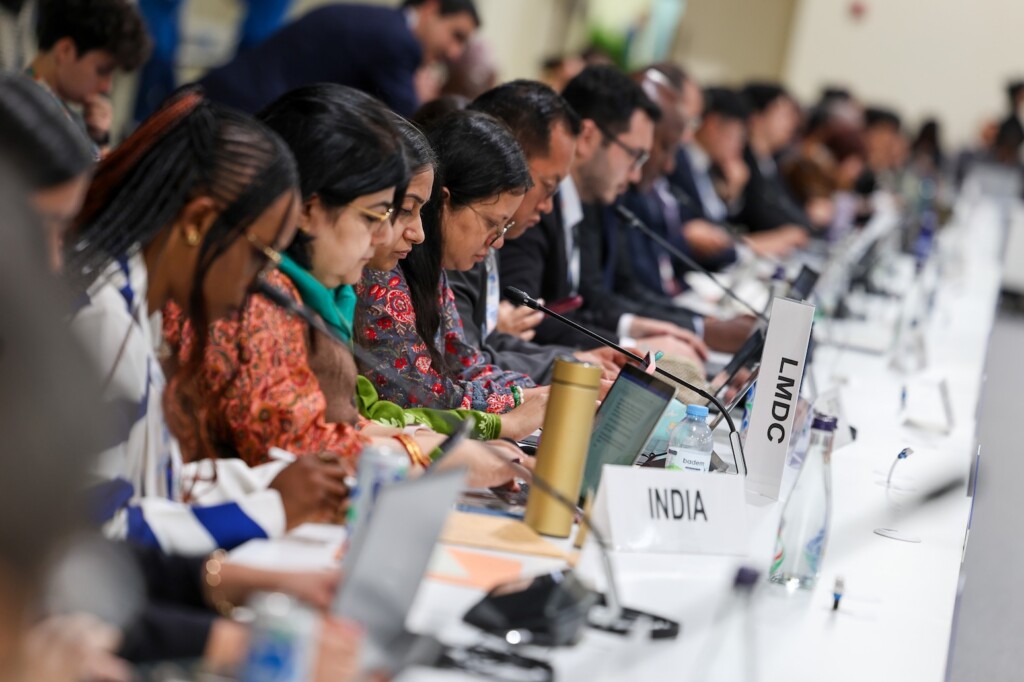
Delegates at COP31 on 9 November 2026. Credit: IISD/ENB – Mike Muzurakis
Short answer: COP31 attendance is best read as a host-city logistics story, not only a climate-ambition story. Carbon Brief’s provisional count shows more than 92,000 in-person registrants and more than 14,000 host country guests in Antalya, Turkey. Judge the summit by separating party badges, overflow, virtual delegates and local staffing, then comparing like with like.
What changed at COP31
The headline number is real, but the host-city effect is the story. Most organizations do not fail because they cannot see a trend; they misread the denominator. The COP31 climate summit in Antalya, Turkey, has attracted registrations from more than 92,000 people, which may make it the largest COP in history. That line is useful, but it is only the first cut of the data. The United Nations Framework Convention on Climate Change published provisional delegate lists; Carbon Brief’s analysis shows the “host country guests” category exceeds 14,000. At COP30 in Belém, Brazil, last year, only about 1,000 delegates fell into the same category. Two external data points explain why people watch the crowd: the WMO State of the Global Climate 2025 confirms 2015-2025 as the hottest 11-year period on record, while UN reporting around the Emissions Gap Report 2026 warns that current policies could put the world on a path toward about 2.8°C warming this century. Readers who want the weather-science backdrop can pair these numbers with our practical guide to the Cop31 climate summit and WMO heat data.
The absence list is equally important: Donald Trump’s US government has not dispatched a delegation, and Israel and Myanmar are also missing. Before the summit, reports said Taliban officials from Afghanistan had been entered as observers, yet the provisional lists include no delegates from observer states. This is why the count of “observers” in the chart below is 0.
How to separate in-person, virtual and total registrations
Counting is the first practical step: do not mix intent with physical presence. COP31 is provisionally the largest COP in history, with 92,934 participants registered, ahead of COP28 in Dubai, where more than 80,000 people attended. The event’s total registrations pass 95,000 because more than 3,000 delegates have signed up online as virtual participants. The UNFCCC issues final figures after the summit, using participants who collect a physical badge at the venue. That distinction matters: a badge is a floor-space fact; an online sign-up is an intent fact.
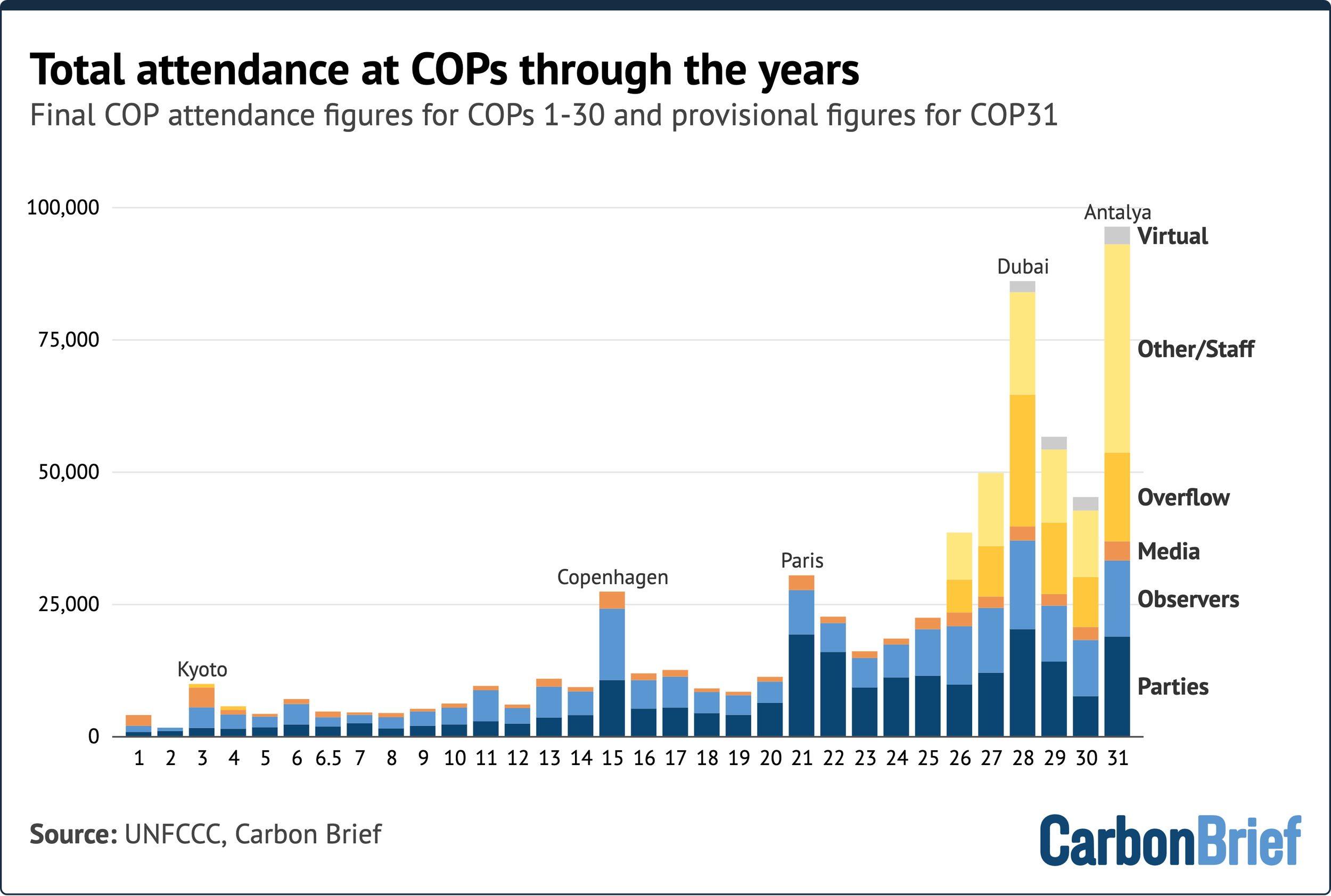
The UNFCCC-published overall totals cover delegates from parties, observers and the media for all COPs, going back to COP1 in Berlin in 1995. For COPs 1-30 the data are “final”, while COP31 data are “provisional”. COP31 breaks down as parties (18,812), observers (0), media (3,645), overflow (16,726), other/staff (39,400) and virtual (3,335). Chart by Carbon Brief.
Which categories carry negotiating weight
Party badges carry the negotiating weight; the rest describes the conference ecosystem. The largest group at COP31 comprises delegates representing parties: nation-states, plus the European Union, that have ratified the convention and take a full part in negotiations. This group totals 18,812 delegates, the second largest after COP28.
As in recent COPs, the UNFCCC has published spreadsheets naming every person registered for the summit, excluding support staff. In earlier COPs, thousands of “overflow” participants were typically included, allowing countries and UN agencies to nominate delegates without their names appearing on official lists. For consistency with Carbon Brief’s analysis of previous COPs, the chart treats overflow delegates as one group. The participant lists, however, split overflow delegates between parties and observer groups. Adding overflow numbers raises the total for party representatives to more than 34,000.
Country delegation sizes: what to notice
Delegation size tells you capacity and role, not climate policy. Host nation Turkey has the largest delegation for COP31. Brazil follows, with Nigeria, China and Indonesia behind it. The remaining members of the top 10 are Australia, Uganda, Italy, Japan and Kazakhstan. The UK sits further down the list. The smallest delegations are North Korea, followed by Eritrea and Nicaragua, and San Marino and Trinidad and Tobago.
| Country | Delegates |
|---|---|
| Turkey | 2,950 |
| Brazil | 1,994 |
| Nigeria | 1,506 |
| China | 1,021 |
| Indonesia | 978 |
| Australia | 835 |
| Uganda | 627 |
| Italy | 607 |
| Japan | 588 |
| Kazakhstan | 557 |
| UK | 255 |
| North Korea | two |
| Eritrea | three |
| Nicaragua | three |
| San Marino | four |
| Trinidad and Tobago | four |
Some countries, including Brazil, allocate party badges to NGOs, which can artificially inflate the size of their official delegation.
Five steps to judge the summit
Treat the list as evidence, not as a verdict.
- Wait for the final list before treating provisional counts as attendance. The UNFCCC final figure is based on physical badge collection, so it filters online sign-ups that may not arrive.
- Strip out host-country effects. More than 14,000 host country guests is a very different crowd from the about 1,000 in Belém, Brazil, last year. Antalya’s resort infrastructure helps explain the shift: Turkish reporting before the summit said the city had more than 600,000 hotel beds.
- Compare party delegates, not total crowd. The party group is 18,812; with overflow, the number of people linked to parties exceeds 34,000. Those two figures answer different questions.
- Track who is absent and how. Donald Trump’s US government is not represented by a delegation; Israel and Myanmar are also missing. The Afghanistan/Taliban observer question also shows why a name on a report is not the same as a name on a provisional list.
- Connect attendance to outcomes. COP31 President Murat Kurum has pushed the meeting as an “implementation COP” focused on closing the gap between commitments made in negotiating rooms and tangible improvements, according to his opening remarks carried by the UNFCCC.
Common mistakes
- Treating Turkey’s 2,950 as diplomatic influence rather than host footprint.
- Reading virtual participants (3,335) as if they were the same as badge-holders.
- Forgetting that overflow (16,726) and other/staff (39,400) shape the crowd around negotiators, not the voting bloc.
- Equating country delegation size with climate ambition, because some countries allocate party badges to NGOs.
- Using media (3,645) as a proxy for state presence; it measures reporting capacity, not policy support.
Frequently asked questions
Is COP31 the largest climate conference?
Provisionally, yes: 92,934 in-person registrations are ahead of COP28 in Dubai, where more than 80,000 people attended, and far above earlier totals that stretch back to COP1 in Berlin in 1995.
Why do host country guests matter?
Because the number can distort a simple “who came” story. More than 14,000 host country guests are far above the about 1,000 in Belém, Brazil, last year, reflecting venue capacity, local event staffing and the host city’s ability to absorb large numbers.
Do virtual participants count in the 95,000 figure?
They count toward total registrations, but not as people collecting an in-person badge. More than 3,000 virtual participants bring the event’s total registrations past 95,000.
What does the 0 in the observers row mean?
It reflects how the provisional list is treated in the chart, not proof that no observer organization exists. Earlier reports said Taliban officials from Afghanistan might be observers, yet the provisional list includes no delegates from observer states.
Reference sources
- UNFCCC: Information for COP31 participants
- Carbon Brief: Which countries have sent the most delegates to COP31?
- WMO: State of the Global Climate 2025
- UN News: Emissions Gap Report 2026 warning on warming
- Daily Sabah: Antalya hotel capacity context
- UNFCCC: COP31 president press-conference remarks