
AI in Climate Science, Decoded: A Practical ItInsightsWorld Guide to What Works, What to Check and What to Do Next
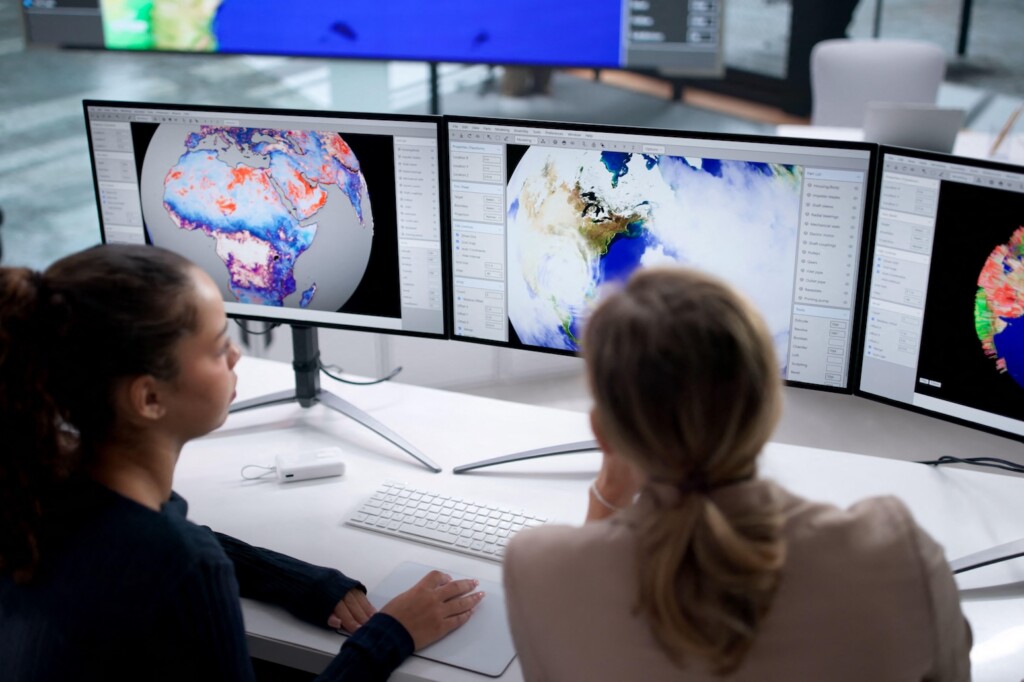
Computer screens displaying weather patterns. Credit: Andriy Popov / Alamy Stock Photo
Skip the hype and take the verdict first. Artificial intelligence has already earned a working role in climate science in three places: short-range weather prediction, turning satellite pixels into alerts somebody can act on, and squeezing far more scenarios out of expensive energy and policy models. It has not earned that role where the data does not yet exist — projections of future climates beyond the observations, and record-breaking extremes. Four failure modes follow every one of those successes: intensive energy use, overreliance on unverified results, unequal data, and the quieter danger that AI crowds out other climate action. That is the distilled reading of the interviews Carbon Brief conducted with 10 experts whose work spans climate-related fields, from developing climate forecasts to analysing changes in the energy grid. Below, ItInsightsWorld turns those answers into a working guide: what to check, in what order, before you cite, fund, buy or deploy an AI-for-climate claim.
The people behind the advice
Useful judgement starts with knowing who is talking. The panel is Dr Doug McNeall, science lead in data-driven climate modelling at the UK Met Office; Prof William Collins, professor of AI for climate science at the University of East Anglia; Dr Amirpasha Mozaffari, researcher in Earth artificial intelligence at the Barcelona Supercomputing Centre; Dr Stefano Materia, researcher in climate variability and change at the same centre; Dr Clare Eayrs, polar research scientist at the Environmental Fluid Dynamics Lab at New York University; Prof Cristiana Stan, vice-chair of the World Climate Research Programme (WCRP); Prof Priya Donti, assistant professor at the Massachusetts Institute of Technology and co-founder of Climate Change AI; Dr Carlos Rodriguez-Pardo, postdoctoral researcher at Politecnico di Milano and affiliated scientist at the European Institute on Economics and the Environment and at the Euro-Mediterranean Center on Climate Change; Dr David Rolnick, associate professor in the school of computer science at McGill University and cofounder of Climate Change AI; and Prof Detlef van Vuuren of the PBL Netherlands Environmental Assessment Agency. One naming note before you read on: AI is best known today through large language models such as ChatGPT, Claude and Gemini, but most of what these researchers actually use is narrower, older and much less photogenic than a chatbot.
Step 1: Name the job — weather forecasting is not climate prediction
Dr Doug McNeall singles out AI weather-prediction models as one of the most significant recent developments. They learn from large volumes of weather data to predict the next few hours ahead, then repeatedly feed those predictions back into themselves to generate forecasts up to two weeks into the future. Crucially, they have demonstrated that AI can produce accurate predictions while needing far less computing power than existing numerical models, which rely on mathematical equations to simulate the climate.
The catch is scope. Those models were built for relatively short timescales, where large amounts of observational data — temperature, rainfall or sea ice extent — are available and where performance can be evaluated quickly and rigorously. Climate prediction is fundamentally different: useful climate information requires projections of future states beyond observations, lying outside the observational record. McNeall's practical route forward is to let AI emulate or accelerate existing models rather than relying solely on purely data-driven approaches. That blended approach could make climate risk information far more accessible and affordable to produce, while retaining the physical understanding — grounded in mathematical and scientific principles — that underpins confidence in climate projections.
Prof William Collins describes "a really exciting renaissance in both weather and climate science", crediting machine learning — the subset of AI that uses algorithms to let computers learn from data and make predictions without being explicitly programmed — with having "had an enormous impact on numerical weather prediction". The European Center for Mid-Range Weather Forecasts now deploys an AI forecast system alongside the traditional system as part of official communication of weather predictions to the European community. In his view, these systems are good enough to be absolutely competitive with the world's leading numerical weather prediction. His warning is a data paradox worth memorising: climate is a future for which we have no observations, so asking where the training data comes from is the central challenge the climate community is trying to overcome.
Dr Amirpasha Mozaffari draws the boundary that matters most for adaptation decisions: AI forecast models perform well on typical weather, yet underperform physics-based models on record-breaking and unprecedented extremes — precisely the events that matter most. Solving that, through hybrid models that combine AI with traditional models, physical constraints that impose the laws of physics on what a model may output, or new ways of evaluating models on what they have not seen, is the central open problem for the field.
This caution now has independent numbers attached to it. A benchmark analysis published in Science Advances in 2026, led from the University of Geneva, reported that the AI models tested underestimated both the frequency and the intensity of record-breaking events, with heat, cold and wind records all smoothed toward the mean. The literature is not unanimous: a University of Chicago group reported in the same journal that AI models can predict unprecedented extremes when they learn transferable patterns from other regions. That disagreement is the guide's first rule of thumb — one accuracy headline is not evidence. Ask which variable, which region, which lead time, and whether extreme-event skill was reported separately from average skill.
Step 2: Match the model to the task
Most public confusion comes from treating "AI" as one product. The experts effectively sort the field into six jobs, each with a different verification burden.
| Job | What already works | What to verify before relying on it |
|---|---|---|
| Hour-to-two-week weather | AI models competitive with leading numerical systems | Skill on extremes, not just average error |
| Multi-year climate projection | AI emulators accelerating physics-based models | Whether physical understanding is retained |
| Satellite monitoring | Automated methane, logging and glacier alerts | Latency from alert to human confirmation |
| Seasonal sea ice | Deep-learning forecasts of concentration, thickness, drift | Skill in your sector and season |
| Power grids | Renewable output forecasting plus control optimisation | Whether it optimises cost only or emissions too |
| Policy analysis | Emulators, reinforcement learning, causal machine learning | Whether it answers "did it work", not "what next" |
On monitoring, Dr Stefano Materia explains that the proliferation of Earth-observation satellites has created a massive influx of geospatial data, and AI is being used to translate raw pixel data into actionable climate intelligence. Methane tracking and ecosystem monitoring are two examples of this kind of application. Methane is a potent greenhouse gas whose leaks are largely invisible and hard to track; AI algorithms now automatically scan hyperspectral imagery from satellites — data drawn from across the electromagnetic spectrum — to pinpoint specific industrial methane leaks globally, alerting operators in near real-time. At the same time, machine-learning models process thousands of satellite images daily to detect illegal logging, track land-use changes and monitor glacier retreat long before humans could manually review the footage.
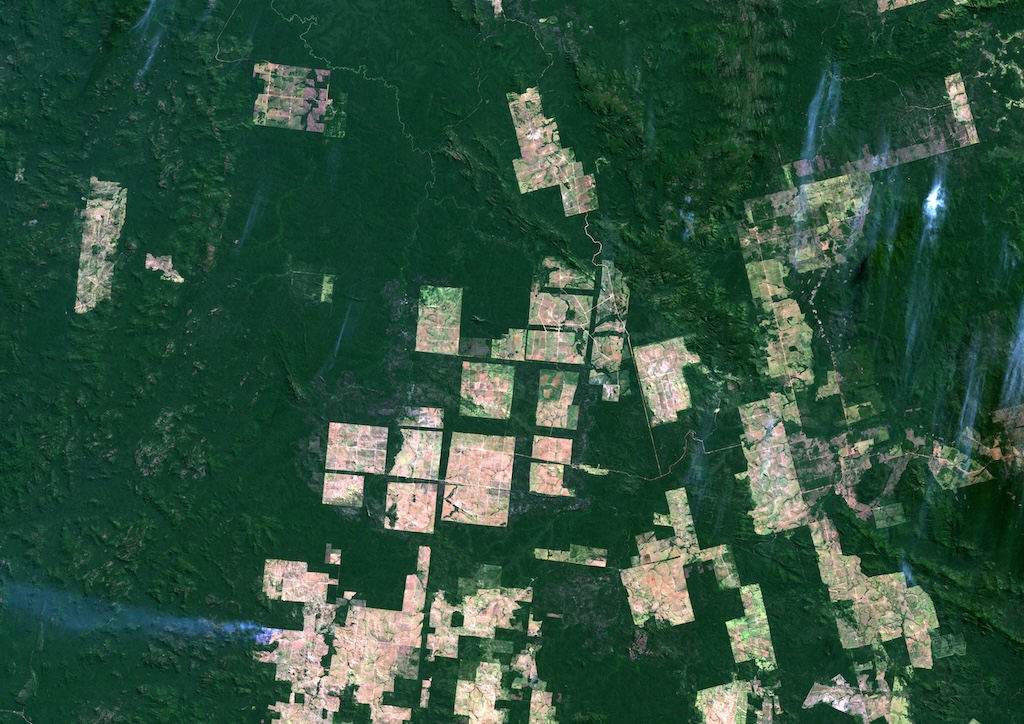 Satellite image showing deforestation in Para, Brazil. Credit: Universal Images Group North America LLC / Alamy Stock Photo
In sea ice research, Dr Clare Eayrs says machine learning is now used across the whole modelling workflow. The most mature application is extracting more information from observations: mapping fine-scale sea ice deformation from ship radar, or classifying snow layers in micropenetrometer profiles that measure the hardness or softness of different layers of snow. Forecasting is the most visible application. Ice Net, a sea ice forecasting system, was an early demonstration that a deep-learning system — built on models inspired by the layers of a human brain — could outperform a leading physical model in seasonal Arctic forecasts. Machine-learning systems are now used to predict variables such as sea ice concentration, thickness and drift.
Prof Cristiana Stan reports that AI now appears across all major parts of the WCRP. The "weather prediction model intercomparison project" — an initiative to create a centralised database of physics-based, machine-learning and hybrid model forecasts — brings together physics-based numerical weather prediction models, hybrid models and AI weather prediction models. Because it is focused on operational models, it offers a direct comparison between state-of-the-art systems, is intended to accelerate the deployment of the next generation of operational models, and contributes to development of metrics needed to assess the relative strengths and weaknesses of models. Downscaling, she adds, is another area harnessing AI power to refine coarse-resolution model output into high-resolution.
Dr William Collins flags an institutional milestone: the Intergovernmental Panel on Climate Change (IPCC) is performing its seventh assessment report (AR7), and this time, for the very first time, there is a model intercomparison project just for models using AI for weather and climate forecasting. He reads that as a real proof of principle — or proof of concept — and the harbinger of many more developments of this kind.
Speed is the other change practitioners notice. Dr Amirpasha Mozaffari recalls that a few years ago it took two or three years for a new architecture to travel from the machine-learning community into weather and climate work; today it is a matter of months, with diffusion models, foundation models and generative ensembles arriving almost as soon as they appear elsewhere. He also notes that the cost of running a global forecast has dropped by orders of magnitude, which in principle changes who can produce weather and climate information at all.
That last claim is testable by a small team today, and it is worth knowing exactly what the gate is. Public research code and pretrained weights for atmospheric models such as GraphCast and GenCast are released for non-commercial research use, typically initialised from ERA5 reanalysis data distributed by ECMWF; Microsoft's Aurora, a 1.3-billion-parameter foundation model of the atmosphere described in a 2025 Nature paper, likewise runs on modest hardware compared with a traditional forecast centre. So the cheap part is inference. The gating factors are licence terms, input-data access and the engineering skill to keep a pipeline honest — which is precisely the trade-off discussed under inequality below.
Step 3: Put it inside a workflow you already have — grids and the policy cycle
Prof Priya Donti reframes grid work as the near-term win. As more solar, wind and other renewable energy is introduced into the power grid, we need to rethink how we actually manage the various sources on it. AI enters at a few points. One is simply getting better predictions of solar and wind power production, to reduce uncertainty and let operators plan with a little more foresight.
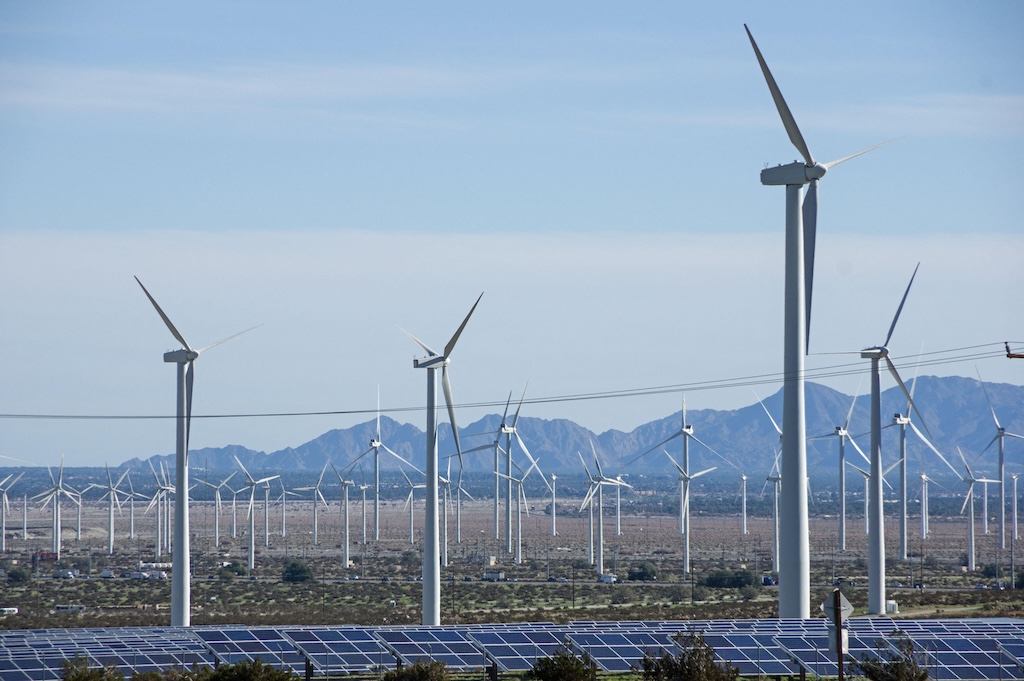 Wind turbines and solar panels in California. Credit: Tom Grundy / Alamy Stock Photo
Another major use, she says, is helping to optimise and control the various components already on power grids — the power generators, the batteries, flexible loads like industrial loads, or the batteries in your electric vehicles or heating and cooling systems.
Dr Carlos Rodriguez-Pardo argues that AI is already useful at every stage of the climate policy cycle, and his three-part map is the most transferable idea in the whole set of interviews. The first stage is measurement: understanding what is happening, what has been tried and who is exposed. Machine learning helps process satellite imagery to estimate emissions, improve air quality monitoring, harmonise fragmented policy databases, and map a scientific literature that has grown far beyond what any human team could read.
The second stage is modelling futures. The models used to explore climate and economic scenarios are computationally very expensive, so AI-based emulators — simple models that stand in for more complex mathematical ones — reproduce their behaviour at a small fraction of the cost. Instead of a handful of scenarios, teams can explore thousands and quantify uncertainties that were previously out of reach. Reinforcement learning, in which a computer programme learns to make decisions through trial and error, also allows study of how multiple actors such as countries or electricity producers compete and cooperate under different policy designs, revealing strategies that classical analysis misses.
The third stage is evaluation, where causal machine learning is extending the toolkit used to answer whether a policy actually worked. That is a different — and much harder — question than predicting what will happen next, and it is the stage where most automated dashboards quietly fail.
Step 4: Plan around the next few years
Prof Cristiana Stan says the WCRP has established a task team to address exactly how AI should be used going forward. Its focus areas include modelling and projections, data and observations, impacts and services, engagement with the private sector supporting development and integration of AI and machine learning into climate research and applications, and the scientific rigour and trustworthiness of AI and machine learning methods.
Dr William Collins goes further: he thinks the IPCC's eighth assessment, likely due in the late 2020s, may itself largely be written using large language models — the job of the people writing the report is to synthesise, and one could argue whether that needs to be done by people. His condition is that AI should be telling us the known unknowns, not the known knowns, because the value-added part of an assessment is saying what is not certain and what is not known well; that tells you where the science should be heading. Governance is already moving: in September 2026 the IPCC established an "informal group" on AI to "provide timely guidance on the responsible use of AI and emerging digital technologies in IPCC processes". He adds that AI will also be an integral part of the eighth Coupled Model Intercomparison Project, with machine-learning codes running alongside traditional climate models.
Dr Stefano Materia calls the inclusion of AI in climate and land-vegetation modelling a paradigm shift. Rather than replacing physical models entirely, hybrid modelling merges the mathematical rigour and physical consistency of traditional process-based Earth system models — advanced computer models combining physical, chemical and biological processes to simulate the climate — with the pattern-recognition power and speed of machine learning. He expects it to overcome computational bottlenecks, replace unresolved subgrid processes too small to be captured by a model's grid cells, improve the terrestrial biosphere, narrow the uncertainties on the terrestrial carbon sink, and accurately pinpoint emergent constraints and non-linear tipping points.
Dr Clare Eayrs points to the least glamorous and possibly highest-return fix: the data itself. Much of what we know about Antarctic sea ice comes from the satellite era, which begins in 1979 — a short record for a system with strong decadal variability. A great deal of information about earlier conditions sits in ship logs, whaling records, expedition photographs and early aerial and pre-1979 satellite imagery, and machine learning is well suited to extracting it. Lengthening the observational record would improve almost everything else we do, including training and testing AI systems.
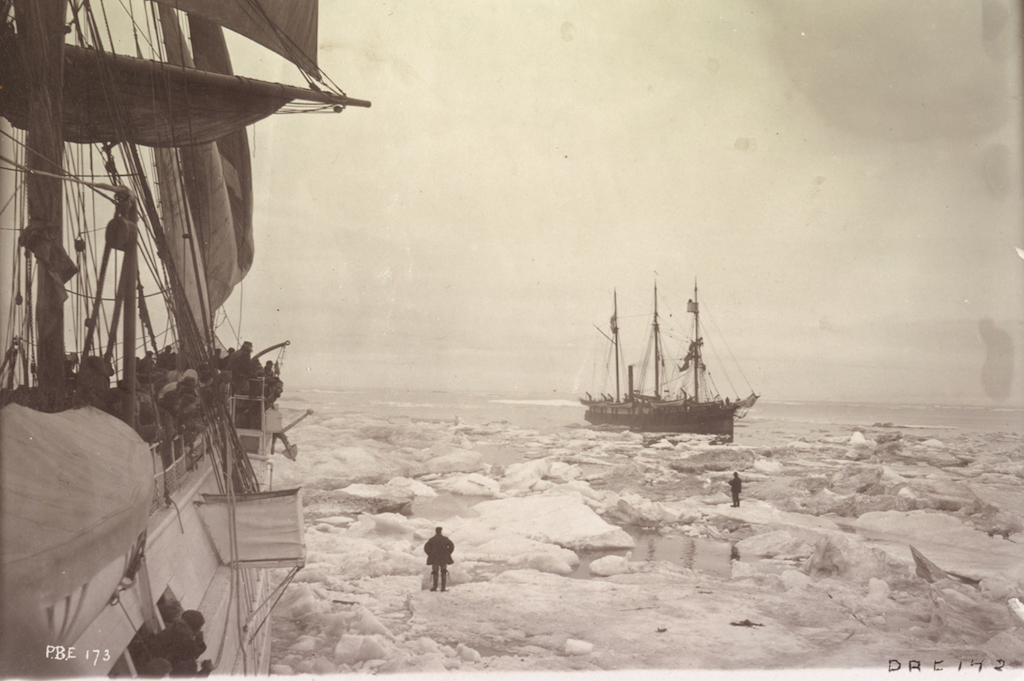 "The Bear" whaling ship getting free from the ice pack. Credit: New Bedford Whaling Museum
Common misconceptions to unlearn
- "AI for climate means a chatbot." Dr David Rolnick says AI is frequently thought of as large generative models like those developed by large tech companies, but that is not mostly what is useful in AI for tackling climate change.
- "AI's energy bill condemns all of it." Rolnick calls the worries about energy use, water use and their knock-on effects on the climate very real — but notes they refer to large-scale generative and agentic systems, not mostly the kinds of AI systems actually used to fight climate change.
- "Better models mean fewer instruments." See the trust section below; the experts say the opposite.
- "Funders know what they are buying." Prof Priya Donti thinks the general public sees AI as one specific thing, often large language models, chatbots and similar tools — and that people making allocation decisions about who funds scientists can carry that mismatched understanding, which means the right science does not necessarily get funded.
For anyone doing the arithmetic, the footprint debate has become far more concrete since the interviews. The International Energy Agency's Energy and AI analysis projects global data centre electricity consumption growing at roughly 15% a year between 2024 and 2030 — several times faster than total electricity demand growth — and more than doubling to about 945 TWh by 2030. A June 2026 assessment published under the United Nations University (UNU-INWEH) banner, "Environmental Cost of Artificial Intelligence: Carbon, Water and Land Footprints", pushed the accounting further by insisting that water and land sit alongside carbon in the ledger. The practical implication is narrow but firm: judge the footprint of the deployment you are actually buying, not the abstract idea of AI.
The inequality check: who trained it, and who is scored by it
Dr Amirpasha Mozzafari warns that frontier models — the systems at the cutting edge of AI research — are built almost exclusively in the global north, trained on data that is densest where observations are richest and validated against benchmarks that reflect the same regions. Cheap inference, in which a trained model applies its learned patterns to new data, does not fix that on its own: being able to run someone else's model is not the same as having a say in what it is trained on, how it is evaluated, or whether it serves your decisions. Without deliberate effort to share data infrastructure, adopt evaluation metrics that centre on people's wellbeing, and genuinely co-produce knowledge, AI risks automating and amplifying the existing divide in the global climate information system rather than closing it.
Dr Carlos Rodriguez-Pardo offers the optimistic version of the same mechanics: if done well, developing AI-based Earth system models could dramatically lower barriers to entry, letting a small research group or an agency in a data-poor region adapt a pre-trained model on modest hardware rather than building bespoke systems from scratch. That matters because the data is thinnest and the resolution gap is largest exactly where vulnerability to climate change is highest.
Dr David Rolnick insists the goal is political as much as technical: climate action should fundamentally be about democratisation of action and equitable response to climate change, in both mitigation and adaptation. The consolidation of large-scale AI can work against those goals by consolidating power in certain geographies and stakeholders, and by defining action based upon the goals of those stakeholders — technology built inside specific institutions does not necessarily understand the needs of the majority of the world's population or of local stakeholders elsewhere.
There is a measurable target here. The World Meteorological Organization's 2025 global status report on multi-hazard early warning systems records Africa as the region with the greatest progress since 2015 — a 72% increase in comprehensiveness — while still scoring lowest overall. WMO has since paired that gap-filling work with AI: an AI forecasting pilot in Africa launched in June 2025, and support for Regional Climate Centres in Africa, the Caribbean and the Pacific applying AI to sub-seasonal forecasting. If cheap inference were the whole story, those programmes would not need observation networks, metrics and co-production alongside it.
The risk gate: trust, observations and attention
Dr Clare Eayrs names the biggest challenge as trust. Good performance is necessary but not enough; independent evaluation, physical credibility, process-based validation, robustness and some degree of interpretability are also required. Her worst worry is that the apparent success of these systems could be read as a reason to invest less in observations. AI is not a substitute for observation, physical understanding or careful evaluation — and especially for Antarctic sea ice, where observations of sea ice and snow thickness remain sparse and understanding of snow-ice processes remains limited, we need more targeted observations, not fewer, plus better documentation of them and their uncertainties than we do now.
Dr William Collins puts it as an epistemological test: the challenge is always making sure you are getting the right answer for the right reason, and the risk is getting a plausible answer that is "truthy", but not the truth. Ask a computer for an answer and it will give you one; it is very good and it will always obey. The question is whether that answer is valid.
Dr David Rolnick adds the opportunity-cost warning: the first and foremost risk is AI diverging attention from other forms of climate action — money, staff and political bandwidth that adaptation finance, grid upgrades and emissions regulation still badly need.
Six steps to evaluate any AI-for-climate claim
- Identify the timescale. Hours to two weeks is where AI has proven operational skill; multi-year climate projection is where it does not. A vendor claiming both in one sentence is hedging.
- Ask how extremes were scored. Request performance on record-breaking heat, cold and wind separately from mean error.
- Ask what replaced human review. Satellite alerting systems need a stated path from near real-time detection to verified action.
- Ask what was not measured. If energy, water and licensing terms are absent from the product sheet, assume they were not tracked.
- Ask who decided the training data and the benchmark. If it was not you or your region, the tool's priorities may not be yours.
- Compare against the cheapest credible alternative. A hybrid of an existing physics model plus an AI emulator often beats a purely data-driven product on both trust and cost.
FAQ
Is AI already better than traditional weather models?
On average skill at typical weather, it is competitive: the European Center for Mid-Range Weather Forecasts runs an AI system alongside its traditional one for official European forecasts, and Prof William Collins calls the AI systems absolutely competitive with the world's leading numerical weather prediction. On unprecedented extremes, physics-based models still hold the advantage.
Can AI predict the climate, not just next week's weather?
Not on its own. Useful climate information requires future states beyond observations, and there are no observations to learn from. The credible route is hybrid: AI emulating or accelerating physics-based models so that physical understanding, and therefore confidence, is retained.
Should the energy use stop me from supporting AI in climate work?
Separate the workloads. The heavy footprints documented by the IEA and by the 2026 UNU-INWEH footprint assessment belong mainly to large-scale generative and agentic systems. A model that finds a methane leak or trims curtailment on a wind-heavy grid sits in a different cost bracket — but ask for the numbers anyway.
Can a small institute in a data-poor country take part?
Partly, today: adapting a pre-trained Earth system or forecast model on modest hardware is far more realistic than it was. The unresolved part is control — training data, evaluation metrics and priorities are still set almost exclusively in the global north.
Does a good forecast mean we can cut weather stations?
Every expert who addressed observations said the opposite. AI is not a substitute for observation; sparse records such as Antarctic sea ice need more targeted measurements and better archiving, including machine learning applied to centuries of ship logs and whaling records.
What to do next
Three actions per reader, in rough order of usefulness:
- As a reader: treat a forecast product's extreme-event skill, its energy disclosure and its provenance as three separate questions; stop trusting any single "more accurate than the old model" headline.
- As a practitioner or buyer: pilot AI where a workflow already exists — alert triage, renewable output forecasting, scenario emulation — and require independent evaluation, physical credibility and interpretability in the contract, not just accuracy.
- As a funder or citizen: watch the two governance dates that matter — AR7's first AI-focused model intercomparison project, and the IPCC informal group created in September 2026 — and keep pressure on the unglamorous line items: observations, archives, and regional co-production of the metrics.
Compiled and analysed for ItInsightsWorld's General desk by James Hartley, IT Insights. Spotted an error or want the source list: contact@itinsights.com. Coverage of this topic continues at https://itinsightsworld.com.