
Electric vs Plug-in vs Petrol: Reading China's Record Two-Thirds September Share as a Buyer's Decision Guide
By James Hartley · IT Insights — General
Bottom line first: the showroom has stopped rewarding the middle option. New-energy vehicles took 67% of new car sales in China in September — two-thirds of every invoice written, a historic first per the China Passenger Car Association (CPCA). But that record is not proof of an electric surge. It is arithmetic: the petrol half of the lot contracted far faster than the plug-in half, so the share line went up even while two out of every three buyers still faced falling prices and thinner order books. If you are choosing between a battery car, a plug-in hybrid and a combustion model in 2026, the useful question is not "who is winning the share race" but "who is losing customers most slowly".
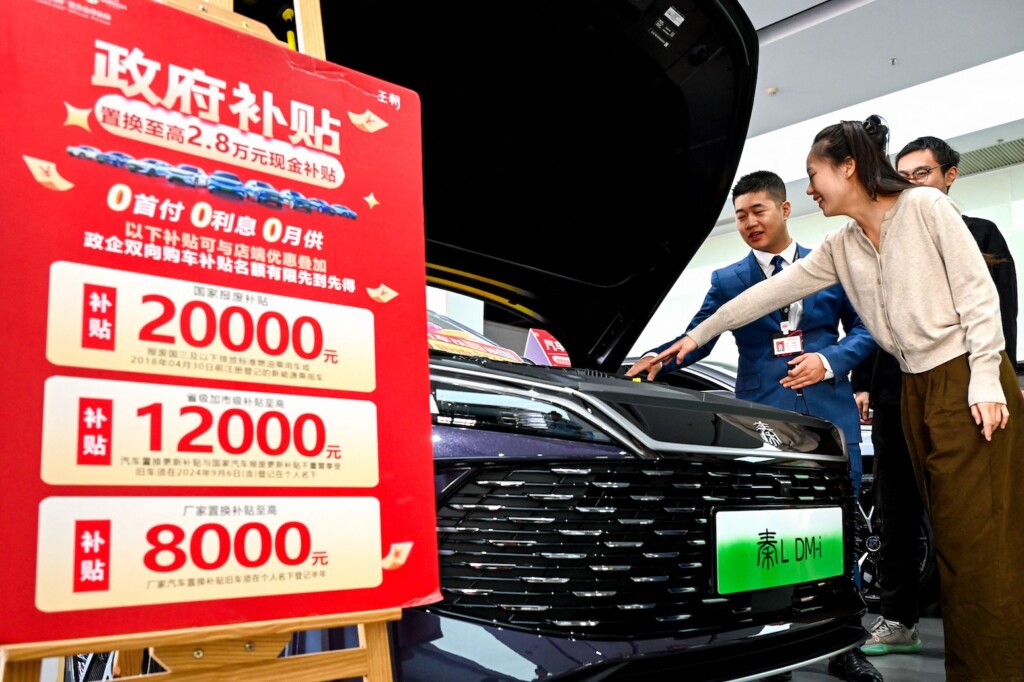 Citizens purchase new energy vehicles through a trade in promotion event at a BYD 4S dealership in Nanchang, Jiangxi province. The image is credited to Cynthia Lee / Alamy Stock Photo.
Scoreboard: three drivetrains, three different slopes
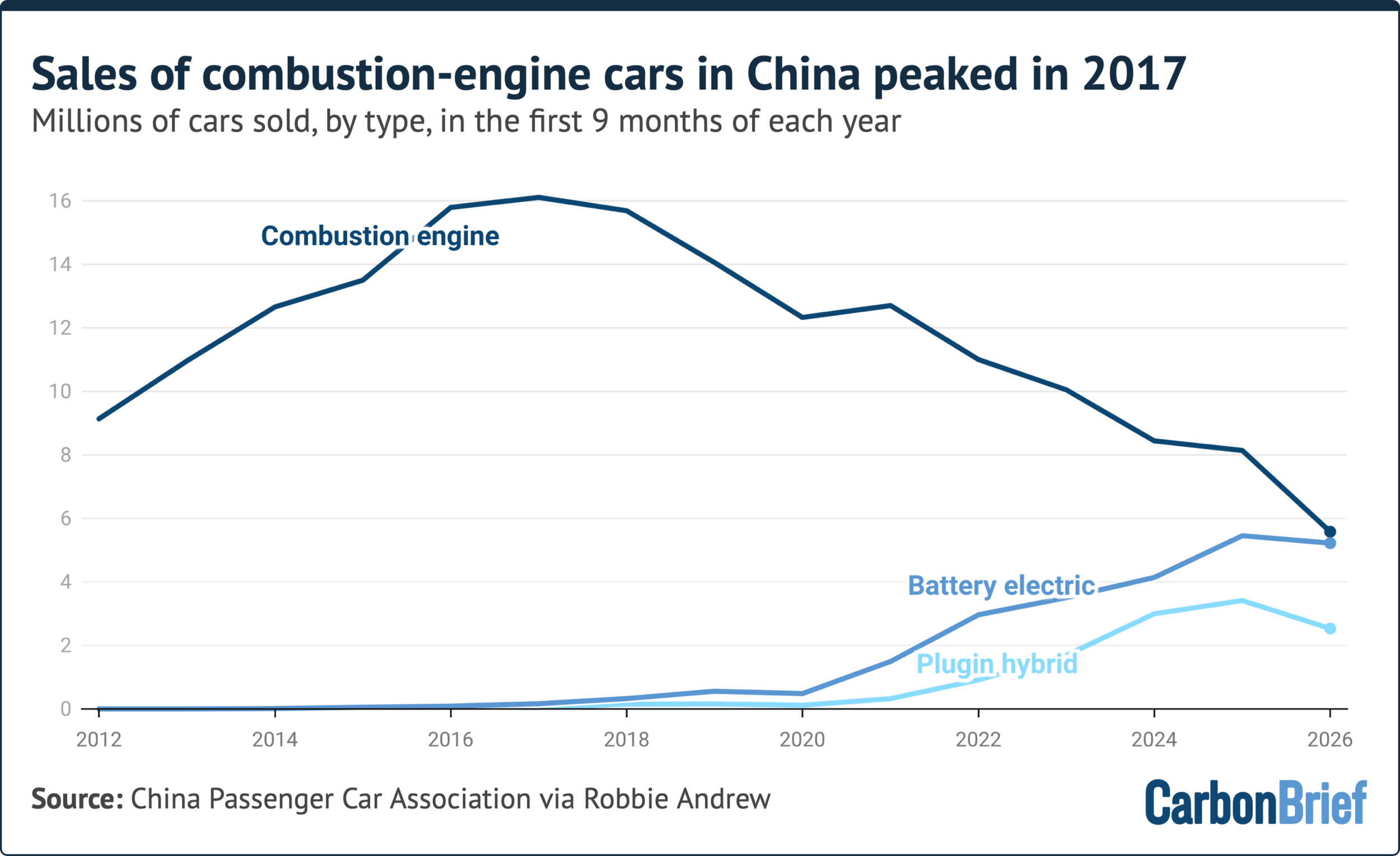
Read the CPCA release as a comparison table, not as a ranking. Fewer electrified cars changed hands than last year, yet the mix shift was still record-setting. Sales of fuel-only cars were down 31% year-on-year in the first nine months of 2026, with plug-in hybrid sales down 26% – whereas battery EV sales were only down 4%.
| Drivetrain | September, vs a year earlier | 2026 to date | Buyer's reading |
|---|---|---|---|
| Battery electric (BEV) | declined 8.5% from a year earlier | only 4% in 2026 to date | Retains customers best; the sensible default where charging is solved |
| Plug-in hybrid (PHEV) | fell by 36% year-on-year | down by 26% in 2026 to date | The hedge is thinning — its savings only appear if the car is actually plugged in |
| Petrol-only | fall 43% year-on-year | 31% in 2026 to date | Structural retreat, not a cyclical dip; resale risk grows each year |
| All NEVs combined | fell by 17% | 13% in 2026 to date | Record share, shrinking units — expect fierce discounting and fast model turnover |
| Total passenger-car retail | overall volumes falling 28% year-on-year | every category declined | A smaller pie for everyone; negotiating power sits with the buyer |
How a record share gets built on a shrinking base
A record two out of every three cars sold in China in September were NEVs, CPCA data show. (NEVs predominantly include battery electric vehicles – BEVs – and plug-in hybrids – PHEVs. BEVs only run on electricity, whereas PHEVs also have a combustion engine.)
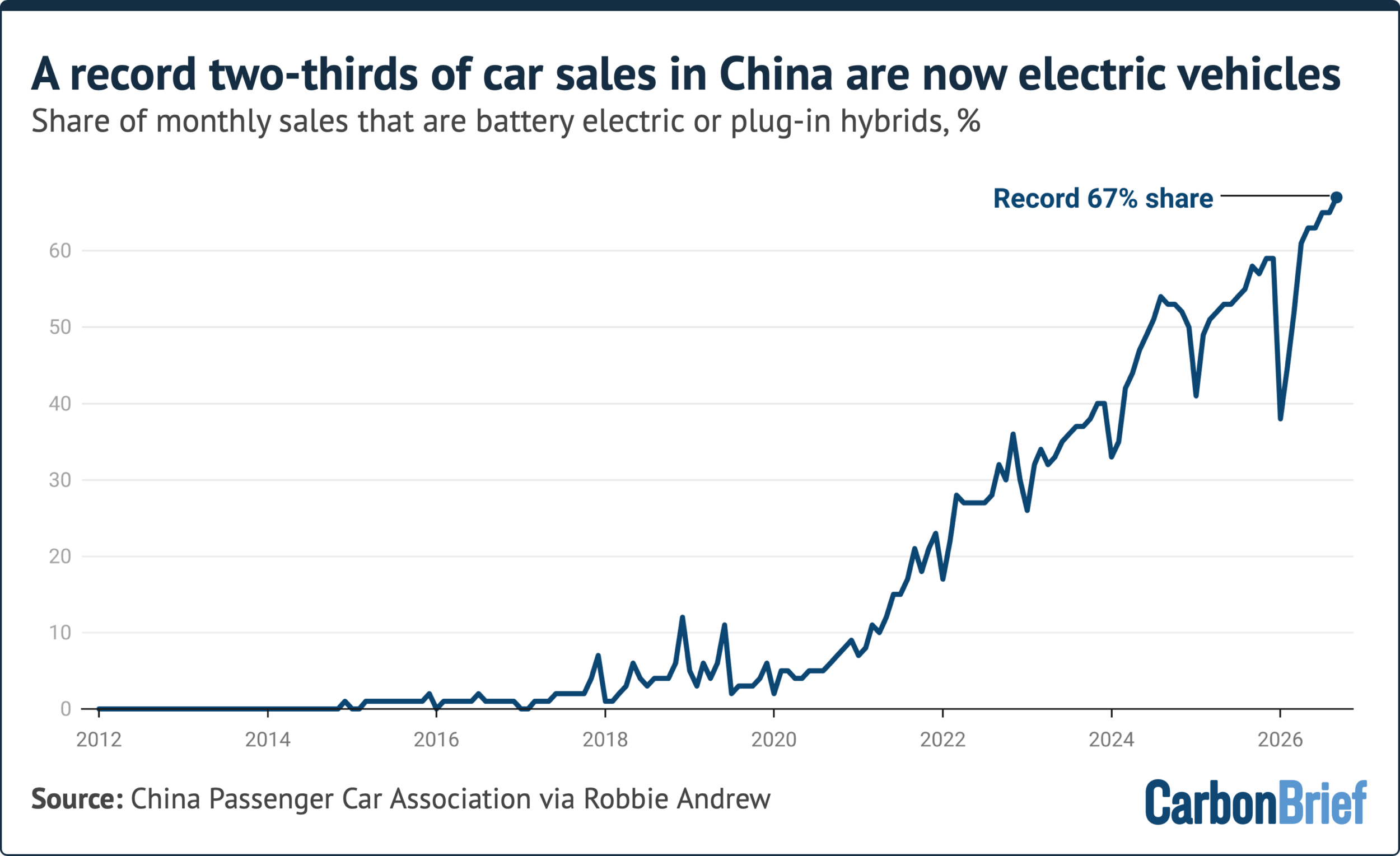
Scaled back, the arc is hard to overstate: from just 6% of new car sales in 2020, up to 58% 2026 to date, and 67% in the month of September.
This year, the ratio also clawed its way back from a low of 39% in January, when the full purchase tax exemption that had been in place for more than a decade ended in December 2025.
That January wobble is the most instructive data point for ordinary buyers, because it shows how much of the decision is still money rather than ideology. The exemption did not simply vanish: under the schedule the Ministry of Finance set out in 2023, NEV purchases in 2026 and 2027 attract a halved levy, with the relief capped at 15,000 yuan per car — as reported by Reuters and restated on the State Council's English portal (english.www.gov.cn). Once shoppers worked out that the incentive had been discounted instead of deleted, demand steadied and then set a record.
This September, the wider passenger-car market contracted, led by combustion-engine vehicles. Zoom out and 2026 is not a rupture but the continuation of the past decade: sales of combustion-engine cars in China peaked in 2017 and have been sliding ever since.
The Hormuz variable: petrol prices as the invisible salesperson
Chinese technology outlet OFweek credited part of the 2026 advance to petrol cars "giving up market share" once they were outperformed by electric alternatives. Cui Dongshu, secretary-general of the CPCA, told financial outlet National Business Daily that higher petrol prices explained September's soft combustion-car numbers.
The energy backdrop gives that claim weight. Oil imports into China in January-September have fallen 15% compared with 2025, equivalent to 470m barrels, as the conflict tightened supply and pushed prices up.
Two independent estimates size the electric contribution. Euan Graham, senior energy analyst at thinktank Ember, told Carbon Brief that China's passenger-car NEV fleet has displaced 143m barrels of oil so far during the strait of Hormuz crisis. An estimate that an unnamed analyst provided to the Brookings Institute holds that EVs "accounted for 12% of the decrease in China's oil use post-Hormuz". Put together: a car parc large enough to have offset demand for 143m barrels of oil since the start of the Hormuz crisis — and a Hormuz shock is now doing part of the marketing for it.
Erica Downs, senior research scholar at Columbia University's Center on Global Energy Policy, argues that the "world's largest oil supply disruption" vindicates China's early EV bet, which was partly rooted in oil-supply anxiety, and is "reinforcing China's electrification of road transport".
Where the growth actually went: the export counterweight
Domestic NEV retail sales fell 17% in September 2026, while overseas shipments more than doubled, increasing 164% year-on-year, the CPCA reports — the same direction of travel holds in 2026 to date / in September versus a year earlier. In September, 1,084,000 NEVs were sold domestically in China and 558,000 were exported, so roughly one electrified unit in three found its buyer abroad.
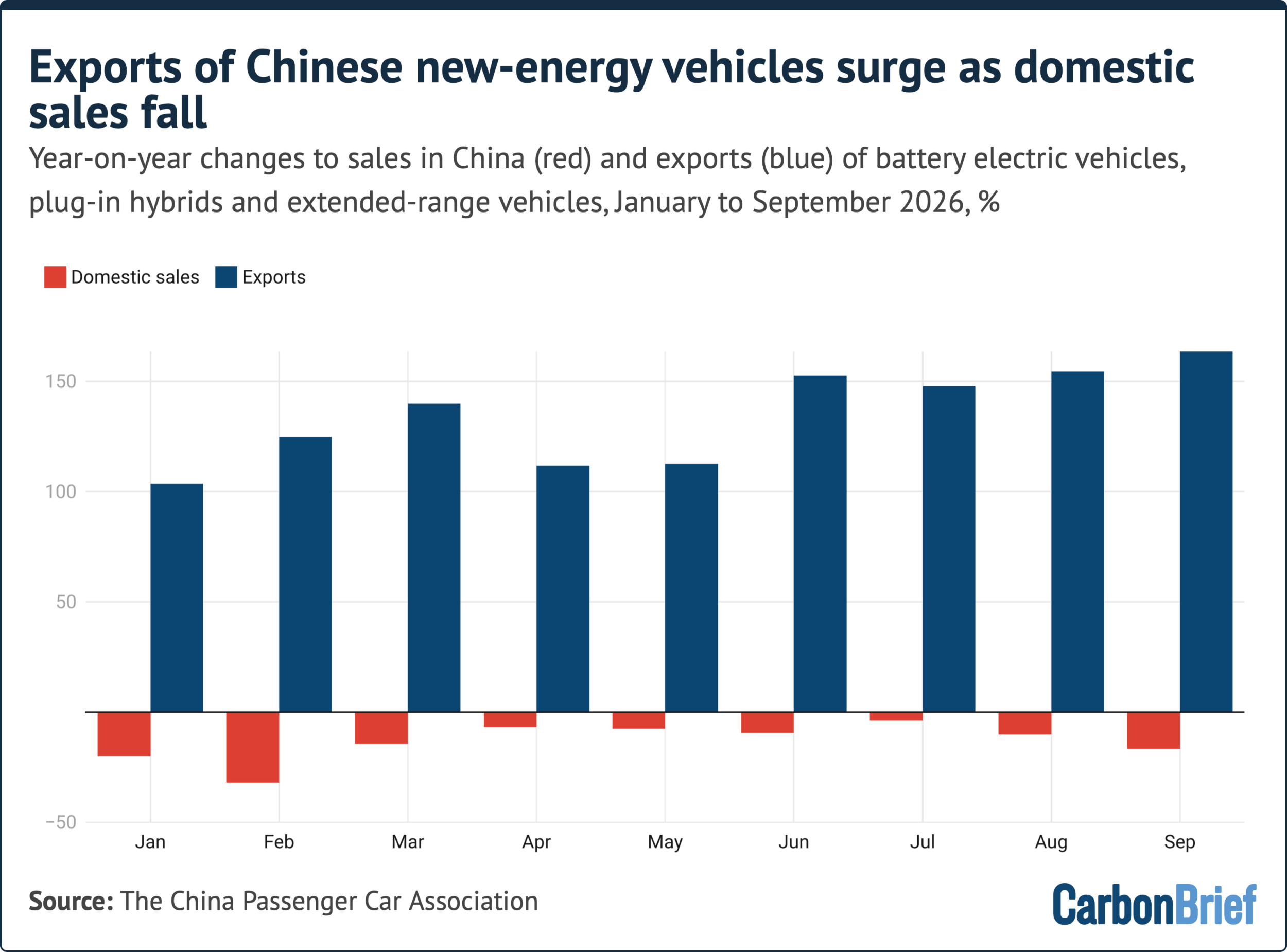
Exports are becoming increasingly important to Chinese carmakers facing weaker home demand and cut-throat competition; the CPCA says shipments have become "a core priority" for some of them. Barriers are rising in response: the EU has placed tariffs on imported EVs from China and recently agreed plans to cut imports of hybrids, while Mexico and Turkey have imposed duties of their own. At the same time the Chinese government is trimming VAT export rebates, a policy some analysts expect to nudge export prices upward and others see as limited in effect.
One mechanism worth adding to any comparison, because it changes what "tariff risk" means in practice: on 12 January 2026 the European Commission issued guidance allowing Chinese BEV exporters to submit price-undertaking offers — minimum-price floors per model and configuration — as an alternative to paying duties (policy.trade.ec.europa.eu). Bruegel's assessment of that route is sceptical: it could widen margins for Chinese producers and prices for EU consumers rather than simply opening the door. For readers outside China, the takeaway is blunt — the growth in these statistics is being exported, and price floors plus duties will shape which cars eventually reach your market and at what sticker.
Common misconceptions
- "A record share means a record year for electric cars." It does not. NEV sales fell in absolute terms; the share line rose because the petrol baseline collapsed faster.
- "Plug-in hybrids are the safe middle ground." Their September drop was steeper than the electric one — and China's 2026 trade-in rules make the bias explicit: scrapping an old car and buying an NEV earns 12% of the new price up to 20,000 yuan, versus 10% and 15,000 yuan for a petrol car of 2.0 litres or less, according to the Ministry of Commerce implementation rules reported by Car News China.
- "Weak domestic sales mean Chinese makers are stalling." Volume at home softened while 558,000 units shipped abroad in a single month.
- "Incentive changes reverse the trend." The 39% January reading was recovered within the same year, to 67%.
- "Petrol cars always keep their value." That held while they were the default; it is a harder claim after a decline that began with the 2017 peak.
Decision framework: which drivetrain fits which life
| Your situation | Reasonable pick | Trade-off to accept |
|---|---|---|
| Fixed parking spot, home charger, commute under 60 km a day | BEV | Holiday-trip charging planning; battery-size premium at purchase |
| Rented flat or shared lot, no meter upgrade possible | PHEV or conventional hybrid | Without regular plug-in, a PHEV behaves like a lightly optimised petrol car |
| Long rural runs, towing, harsh winters | PHEV / petrol | Cold weather cuts usable electric range and slows charging |
| Low annual mileage, car kept under four years | Whatever is cheapest to buy and insure | Fuel savings may never repay an EV purchase premium |
| Dealer or importer watching these volumes | Track policy, not just demand | EU price floors, duties in Mexico and Turkey and trimmed VAT rebates reset landed costs |
Charging scarcity, the classic objection, is thinning in cities but not everywhere. China's national charging network reached 23.68 million points by the end of July 2026, including 5.099 million public facilities — up about 42% year on year, according to statistics published on the State Council portal (english.www.gov.cn). The IEA's Global EV Outlook 2026 likewise records China's public network passing 4.7 million charge points at the end of 2025. That build-out is precisely why BEVs held up while PHEVs slid: the hedge loses value as the plug becomes easy to find.
How much runway is left
Zhang Yichao, a partner at consulting firm AlixPartners, tells Carbon Brief that electrified models are cushioned by trade-in policy and a "strong pipeline" of new, genuinely innovative models — which is why their volumes fell less steeply than combustion ones. Cui told state-run China National Radio that September's slide also owed much to a very high base from the same month in 2025, plus shifts in trade-in rules and holiday timing. Consultant Wood Mackenzie points to "demand pull-forward" in 2025 before subsidies changed and to "tighter financing conditions". Even so, Zhang does not "see much more room ahead": in his view the NEV share in China is unlikely to exceed 80%, because premium niches and specific duty cycles will keep combustion engines on the list.
FAQ
How can a record 67% share coexist with falling sales? Share is a ratio. With total retail contracting fastest on the petrol side, the electrified slice grows even as its own volume declines by 13% year to date.
So which should an ordinary buyer choose in 2026? Decide by charging access and mileage first, technology second. If you can install or reach a charger cheaply, a BEV is the most resilient segment in these numbers. If you cannot, the PHEV is the hedge — but only if you actually plug it in.
Does the end of the full tax exemption mean demand will fall back? The evidence so far says the step-down, not the removal, was the shock: a halved levy with a 15,000-yuan cap kept the economics favourable, and the share recovered from 39% in January to a record.
Will Chinese-made EVs get more expensive overseas? Analysts are split. Cutting VAT export rebates may raise prices on some export models, while EU minimum-price undertakings would lift the floor rather than the ceiling; duties in Mexico and Turkey add further cost risk.
Why should a reader with no interest in cars care? Because a fleet big enough to displace 143m barrels of oil in one crisis is also a fleet big enough to cap petrol demand, reshape refinery economics and move the oil price that shows up at every pump.
Checklist: settle these six things before you buy
- Confirm charging in writing — parking rights, meter capacity, strata or landlord approval — before committing to a BEV.
- Log your real annual mileage for twelve months; low use weakens the electric cost case more than any spec sheet suggests.
- Price the incentive as it will be in twelve months, not today: China's purchase-tax relief steps down again after 2027.
- Compare insurance and three-year resale for the specific model, not the drivetrain category.
- Add fuel-price volatility to your running-cost model as an explicit risk line — the Hormuz shock moved demand, not just sentiment.
- If you follow a non-Chinese market, read tariff and price-undertaking rules as product specifications: they determine the trim, battery size and price you will actually be offered.
Strip the week's reporting to its decision-relevant core and the message is uncomfortable for both camps: electrification in China has already won the argument about direction, and is now shedding units without losing momentum; meanwhile the combustion car is not being banned, it is simply being outpriced, out-serviced and out-supplied by a charging network that grows faster than the objections to it. Whoever you are and wherever you drive, the practical question for the next model year is no longer whether the plug wins, but which charging reality — yours — decides the winner in your driveway. For corrections or to challenge this comparison, reach the IT Insights editorial desk at contact@itinsights.com.
Written by James Hartley · IT Insights (itinsightsworld.com) · General