
Buyer-Side AI Agents vs. Marketer Tools: Which Martech for 2026 Shift Should You Fund First? | ItInsightsWorld
The disruption that reorders marketing is not the agent on your team's desk — it is the agent on your customer's phone. The Martech for 2026 report, scheduled for release on December 2, records 90.3% adoption inside the AI & Data in Marketing study, yet grades most of it as efficiency. The buyer-controlled side is what the authors call the genuine break.
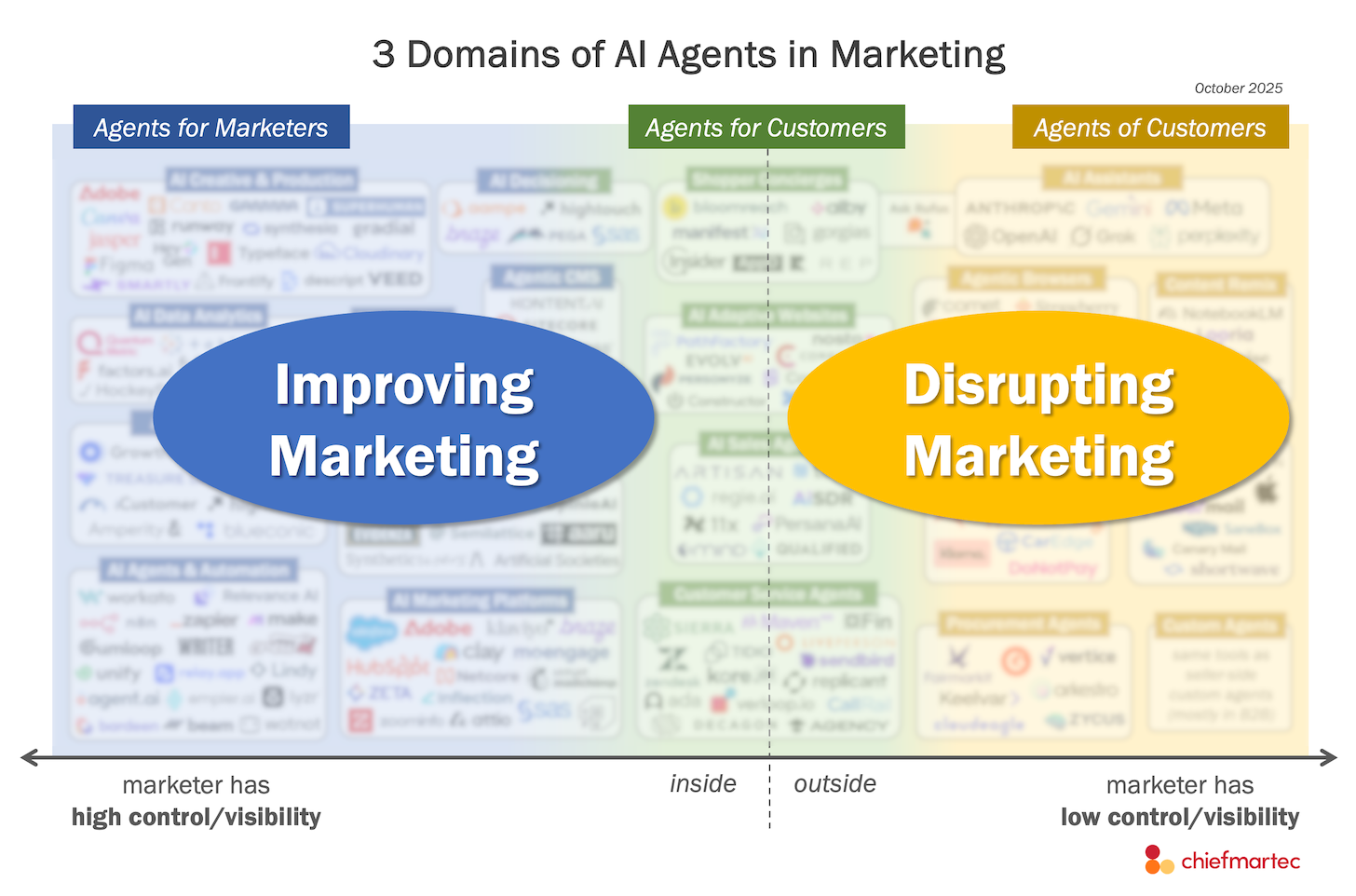
Most trade coverage treats agentic marketing as a procurement question: which copilot to licence, which agent builder to pilot, what a seat costs. The research behind the December release reframes it as a loyalty question — whose side the agent is on. That one reframe changes how an ordinary reader, a founder and a CMO should each plan the coming year.
What counts as an AI agent in marketing — and where does the definition fork?
Short answer: the fork is not technical. It is about who the agent works for, interacts with and benefits. In the AI & Data in Marketing study, 90.3% of participants reported using agents somewhere in their martech stack, counting experimentation and narrow production use cases as readily as full deployment.
Two caveats travel with that number. The respondents are more tech-savvy than the average marketing team, and they run martech and marketing operations at major B2C and B2B brands — pragmatic, responsible people competing at the top of their game. So 90.3% measures the leading edge, not the market.
On the marketer's side of the fork, hundreds of new agentic tools plus hundreds of agents added to existing martech platforms brainstorm, produce, distribute and analyze campaigns and programs. Their mission is to improve marketing, and the improvement they reliably deliver is efficiency — the cliché executives lean on is do more with less, often dressed up as strategy. In the best cases they lift effectiveness too. The report's verdict is blunt: almost all of these gains remain incremental, even when they are significant.
Independent research sets a ceiling on that incrementalism. G2's 2026 AI Agents Report, published on October 14, found that 66% of B2B software buyers now run agents in production, while 45% say oversight and rework consume more than a quarter of the expected returns and 31% report employees spending six or more hours a week supervising them. Efficiency that has to be policed by hand is a discount, not a strategy.
Why is buyer-side AI the bigger threat than better marketing tools?
Because it erodes the channel your playbook was built for, not the labour you wanted to save. The clearest example is the displacement of classic Google search — and the SEO playbooks marketers have spent the past 25 years honing to win it — by AI assistants such as ChatGPT, Claude, Perplexity and Google's own Gemini platform.
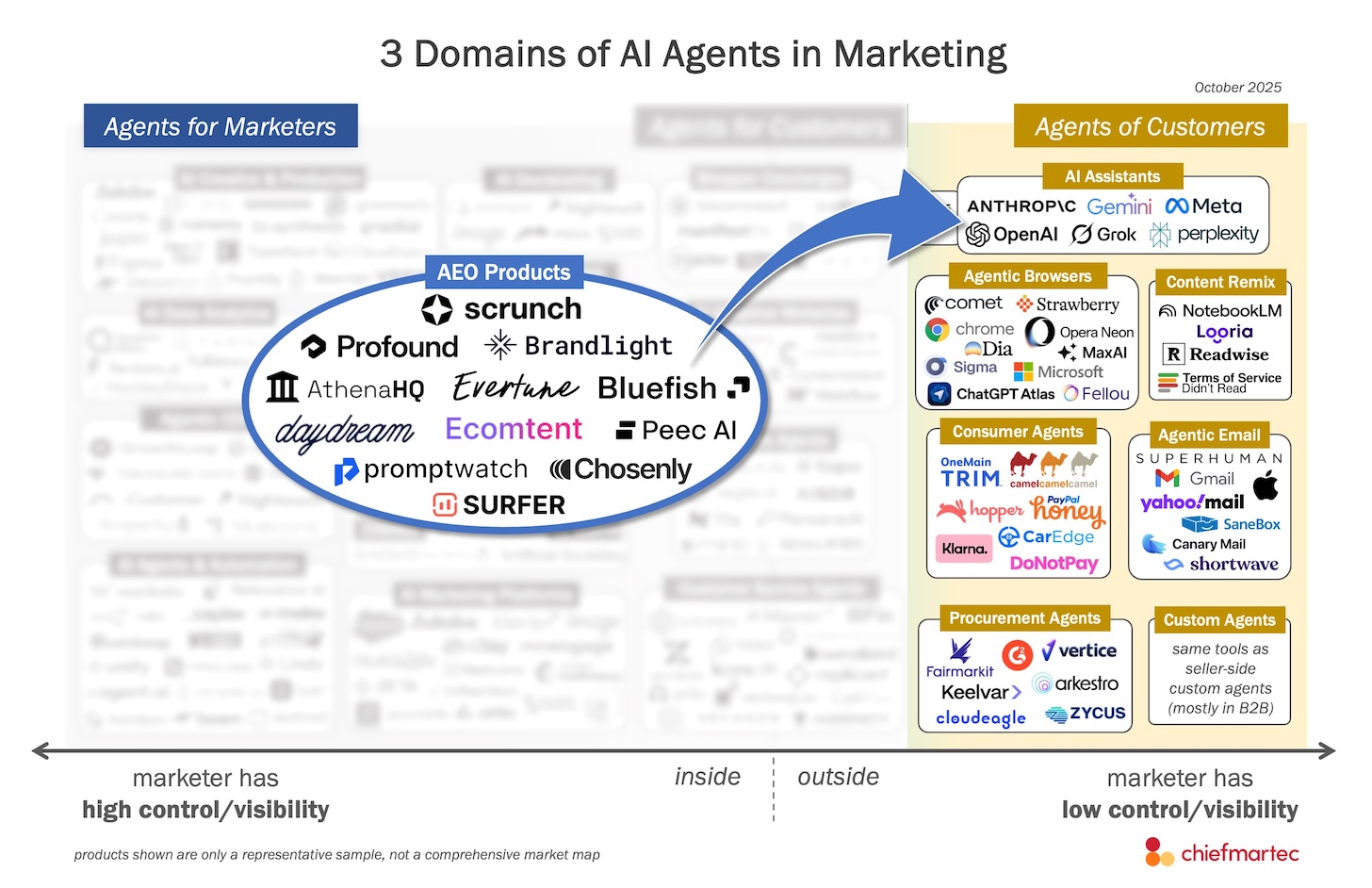
Buyer-side agents are true disruptors because they change how people find, evaluate and engage with B2C brands and B2B vendors. Marketers lose visibility and control in what the report calls the Great Rewiring of the Buyer's Journey. An entire category of AEO products has appeared to answer the challenge and is growing fast, but those tools are early in their evolution while the buyer-side environment moves faster still — the report's own image is chasing a bullet train with a bicycle.
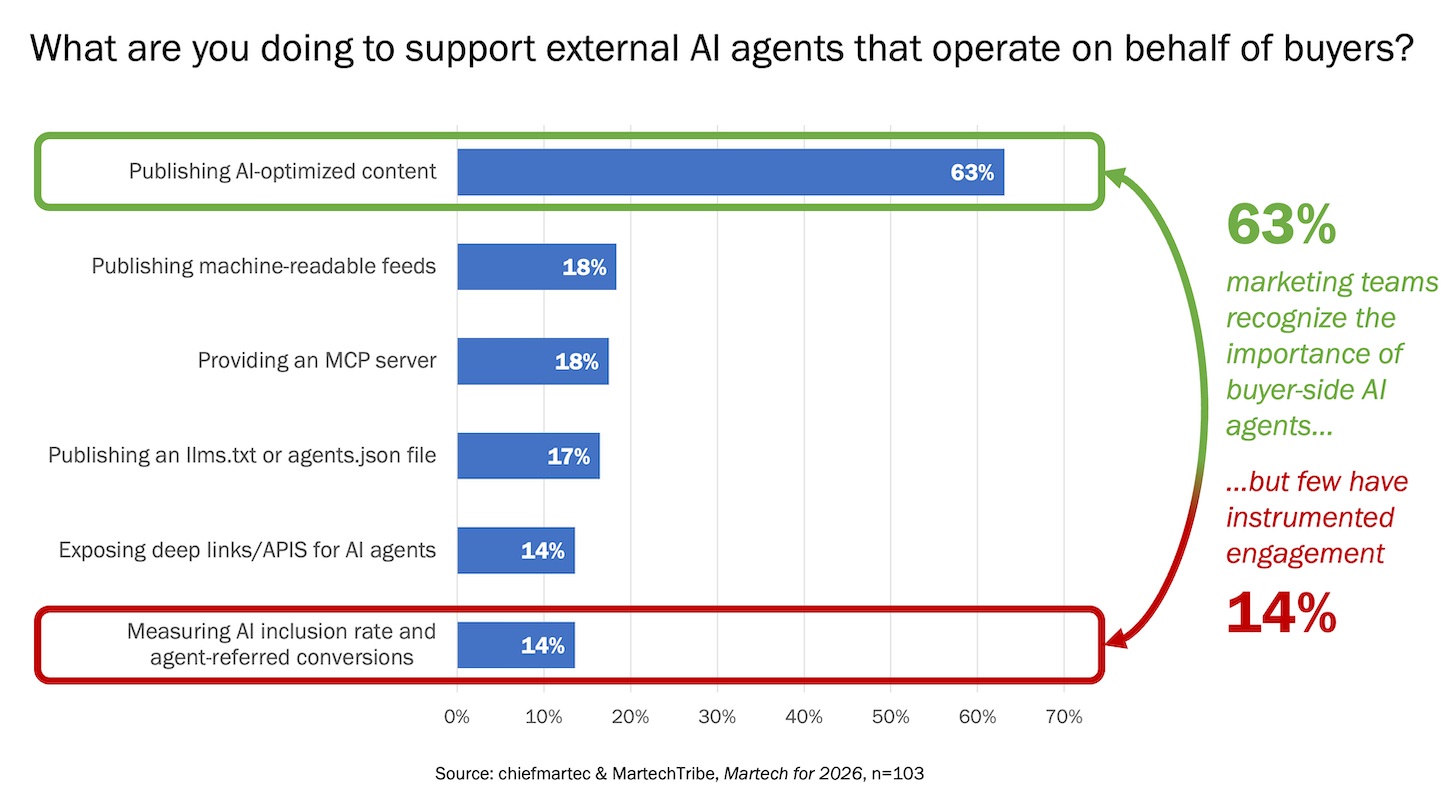
Inside the research, 63% of marketing teams recognise the shift in buyer search channels and behaviours and are deliberately adapting content strategy. Only 14% have instrumented it. Awareness is mainstream; measurement is still a rounding error, and instrumentation is expected to be prioritised in 2026.
Market data corroborates the direction. Bain, in its "Marketing's New Middleman" line of research, describes a zero-click journey in which agents run discovery, evaluation and short-listing inside their own models before a brand is ever visited, and notes that agents reward distinctive, concrete, review-backed attributes rather than broad brand equity. Adobe's retail telemetry gives the scale: AI-referred traffic to U.S. retail sites grew 71% year over year in September 2026, and Adobe reports those visits carry 83% higher revenue per visit. Fewer sessions, higher intent, almost no attribution — that is the trade the buyer side imposes.
Answer engines vs. action engines: what actually changed in the buyer's toolkit?
The change is that assistants stopped answering and started transacting. Buyer-side disruption is expected to accelerate over the next 6-12 months, with AI assistants moving from informational answer engines to agentic action engines that engage with agents or humans on the seller's side in service of a customer's goal.
| Buyer-side entry point | What it does | What the shopper sees | What the brand keeps / loses |
|---|---|---|---|
| OpenAI — Instant Checkout | Lets users buy from Etsy and Shopify stores inside the conversation; a matching arrangement with Walmart was announced a few weeks later | One tap, no storefront | Keeps the product feed; loses the checkout page, the pixel and the upsell moment |
| ChatGPT Apps | Embeds 3rd-party services directly in ChatGPT's interface, with Booking.com, Canva, Coursera, Figma, Spotify and Zillow among the first | The service invoked inside one thread | Keeps the brand named in the answer; loses the app-open and the session |
| Google agentic checkout | Tracks a desired purchase until price falls inside a stated budget, then buys automatically with Google Pay | A completed order and no browsing at all | Keeps the transaction record; loses impulse, promo windows and price-anchoring |
| Gemini AI agent | Calls local stores, questions the humans who pick up on the user's behalf, reports offers and answers by email | A shortlist of verified local offers | Keeps the stock truth on the phone line; loses the sales conversation |
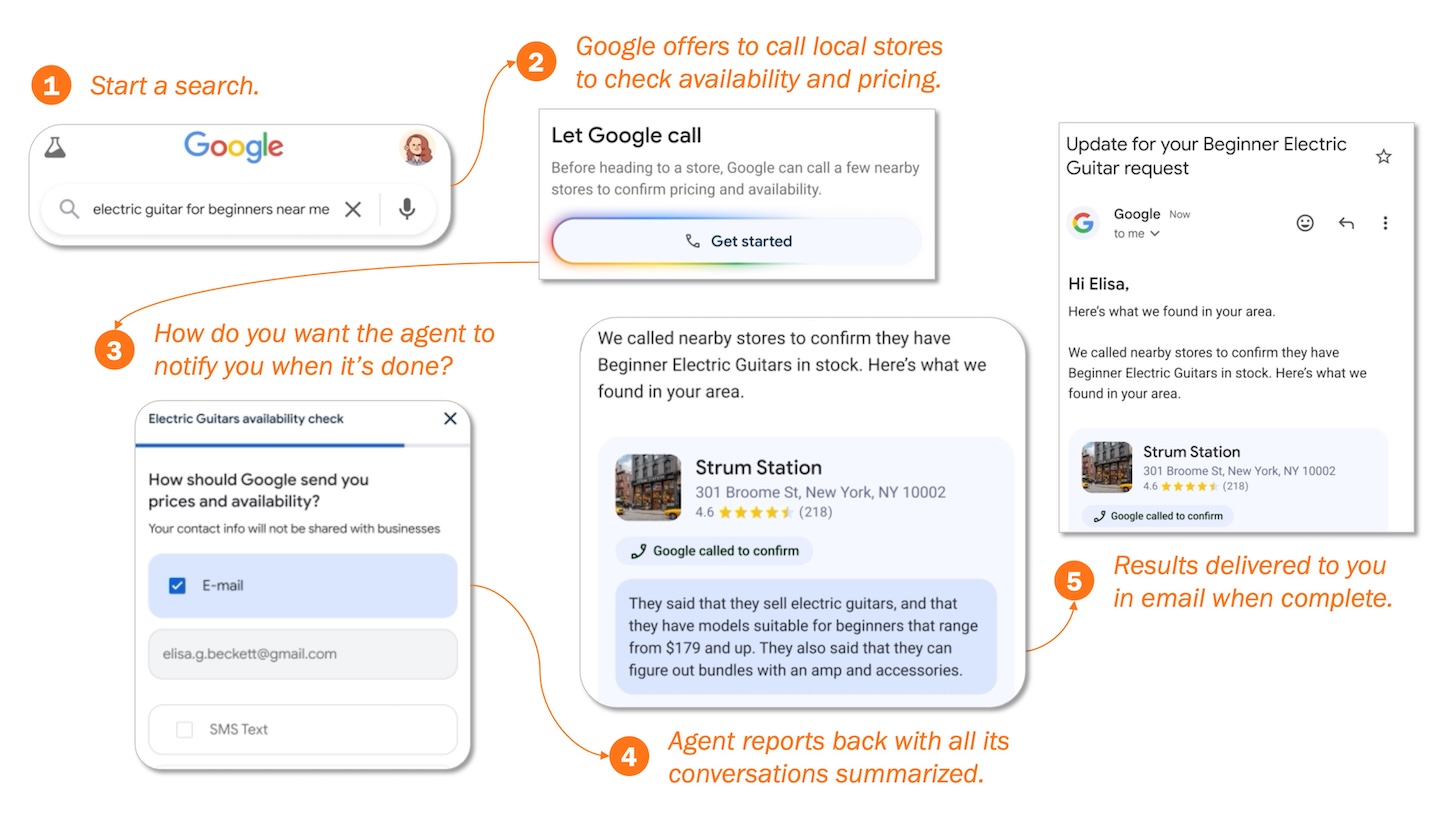
The plumbing matters as much as the demos. OpenAI and Stripe published the Agentic Commerce Protocol on September 29, 2025, an open standard built to work across platforms, payment processors and business types; Google countered the same month with its Agent Payments Protocol (AP2), designed to prove that a human authorised a payment when no human is standing at the checkout. McKinsey estimates that AI agents could intermediate $3 trillion to $5 trillion of global consumer commerce by 2030. Read together, those three facts say the same thing: buying without visiting is being standardised, not merely showcased.
Outbound AI SDRs vs. inbound buyer agents: how the tables turned
The irony is structural, not incidental. Over the past year many B2B sellers deployed outbound AI SDRs to reach prospects tirelessly and alert a human rep only when the machine spotted a promising opportunity. The cost — human prospects wading through more personalized but actually impersonal emails, texts and calls — was treated as secondary, because the goal was efficiency for reps, not for customers.
Now the buyer can sit back while an agent calls human salespeople on their behalf. Efficiency moves to the customer and away from the seller, who faces a rising volume of incoming calls from machines. Reps may hang up, but risk forfeiting a sale to a competitor willing to take it. Neither direction is efficient, which is why this is expected to be a very brief intermediate state that hastens adoption of agent-to-agent interaction. The resulting question for marketers is new: how do you market to and serve AI agents acting as intelligent intermediaries for your target audience?
Which side deserves your budget first: trade-offs by scenario
| Decision dimension | Marketer-side agents | Buyer-side agents |
|---|---|---|
| Primary payoff | Cheaper output: faster briefs, more variants, lower production cost | Access to demand: being found, shortlisted and bought inside someone else's interface |
| Speed to value | Weeks; the tooling is mature and purchasable | Uncertain; the environment shifts over the next 6-12 months |
| Hidden cost | Oversight labour — G2 puts it at 45% of expected gains consumed by review and rework | Measurement debt — only 14% of teams have instrumented the channel |
| Failure mode | You produce more, slightly cheaper, of the same marginal asset | Your category disappears from an answer you never see |
| Best fit if… | Your bottleneck is production volume or campaign turnaround | Your bottleneck is discovery, evaluation or first-contact conversion |
For a consumer brand with a deep catalogue, the priority is feed parity: price, stock and policy facts that Instant Checkout and agentic checkout can read, because those agents buy on specifications, not on slogans. For a B2B vendor with a long evaluation cycle, the priority is claim verifiability — third-party reviews, benchmarks and named customers, the exact evidence agents prefer over brand equity. For a small business, the honest trade is different still: buy none of the tooling yet, and spend the hour making your products, prices and service area machine-readable.
Four misreadings that cost teams a year
- Confusing adoption with advantage. A 90.3% usage rate across a sophisticated sample means agents are table stakes, not differentiation.
- Treating efficiency as strategy. Do more with less funds the next experiment; it does not create a new route to demand.
- Assuming an AEO licence solves the problem. The tooling is early while the buyer-side environment advances faster — instrumentation, not subscription, is the bottleneck.
- Expecting the bot-call phase to last. Agent-to-agent exchange is the end state; optimising for human-style phone pitches to machines is wasted spend.
What to do now: a seven-step action list
- Baseline the shift: pull your traffic and ask which sessions now originate from assistants, and what share of leads mention "my AI told me".
- Run one journey as a machine: let ChatGPT, Claude, Perplexity and the Gemini platform plan a purchase in your category and record where you vanish.
- Publish machine-readable facts — price, availability, compatibility, returns, service area — as structured data, not gated PDFs.
- Instrument before you buy: close the gap between the 63% who recognise the change and the 14% who measure it.
- Write an agent-contact policy for sales: who answers machine callers, what may be quoted, and when a human must be pulled in.
- Keep one human-only asset: the proof (reviews, benchmarks, named customers) that an intermediary can cite without being paid.
- Re-test on a 6-12 month cadence, since that is the window in which action engines are expected to compound.
The full 100+ page Martech for 2026 report, supported by GrowthLoop, Hightouch, Intuit Mailchimp, MetaRouter, Progress, SAS, and Treasure Data, examines the first pragmatic steps of that journey — including how to be legible to an intermediary that never loads your homepage.
FAQ: buyer-controlled AI agents, answered plainly
Is a buyer-side AI agent just a chatbot?
No. A chatbot answers; an agent acts. The distinction the report draws is that assistants now research, compare, call stores and complete purchases with Google Pay or Instant Checkout on the user's instructions.
Does this mean SEO is dead?
It means SEO is no longer the whole answer. Classic Google search is being displaced for many queries by ChatGPT, Claude, Perplexity and Google's Gemini platform, and the playbooks refined over the past 25 years no longer cover every route to a buyer.
Should we buy an AEO tool this quarter?
Only after you can say what you will measure. AEO products are growing quickly but remain early, and the environment they observe moves faster than the dashboards.
Will our sales team end up fielding calls from robots?
Temporarily, yes — that is the intermediate state. Expect pressure toward agent-to-agent negotiation, which changes the marketing job to serving intelligent intermediaries.
Where can the underlying numbers be checked?
In the Martech for 2026 report itself and in the public datasets cited above; the links are listed in the source section.
Sources and further reading
- Martech for 2026 — report summary and research findings, release scheduled December 2 (publisher announcement).
- G2, 2026 AI Agents Report: https://company.g2.com/news/2026-ai-agents-report
- Bain & Company, "Marketing's New Middleman: AI Agents": https://www.bain.com/insights/marketings-new-middleman-ai-agents/
- McKinsey & Company, "The agentic commerce opportunity": https://www.mckinsey.com/capabilities/quantumblack/our-insights/the-agentic-commerce-opportunity-how-ai-agents-are-ushering-in-a-new-era-for-consumers-and-merchants
- Adobe, AI Traffic Trends (revenue per visit and referral growth): https://business.adobe.com/blog/ai-traffic-higher-revenue-per-visit-retail-holiday
- OpenAI, "Buy it in ChatGPT: Instant Checkout and the Agentic Commerce Protocol": https://openai.com/index/buy-it-in-chatgpt/
- Stripe newsroom on the Agentic Commerce Protocol: https://stripe.com/newsroom/news/stripe-openai-instant-checkout
- Google Cloud, Agent Payments Protocol announcement: https://cloud.google.com/blog/products/ai-machine-learning/announcing-agents-to-payments-ap2-protocol
By James Hartley, IT Insights. Corrections and reader questions: contact@itinsights.com.