
Brazil roadmap before COP31: a comparison guide to fossil fuel transition
Short answer: this roadmap is a voluntary operating system, not a binding exit clock. Brazil asks governments to diagnose readiness, choose tailored levers and land the work by 2033 - 10 years after COP28 in Dubai called for transitioning away from fossil fuels. It avoids a one-size-fits-all promise, but it does not replace national policy. It arrives just a week before COP31 begins next week in Turkey.
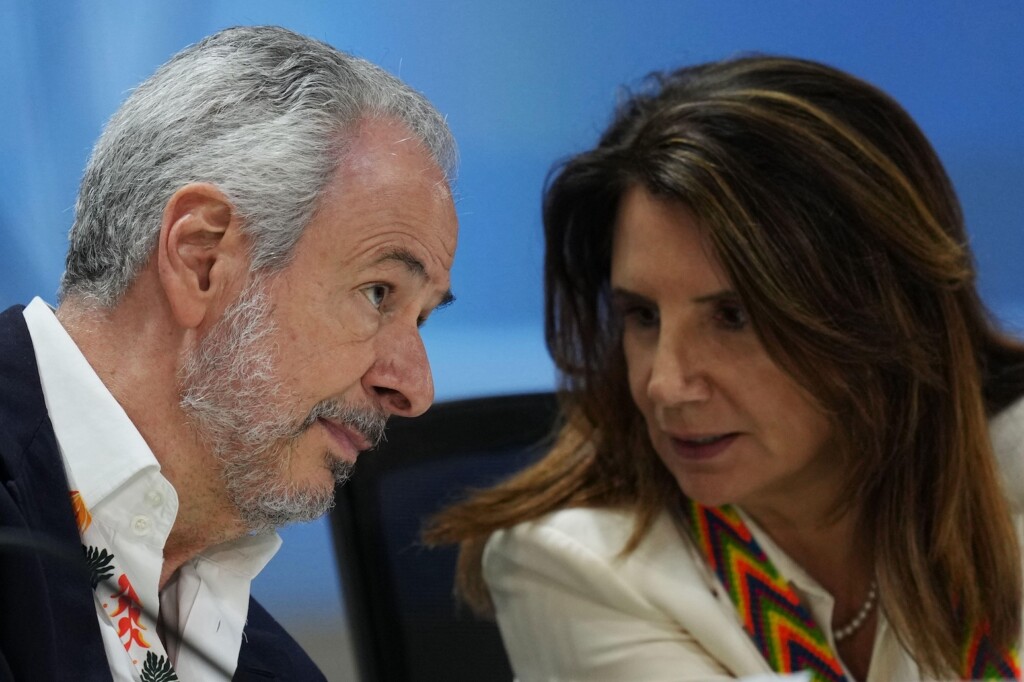
At a news conference on 22 November 2025 in Belem, COP30 president André Corrêa do Lago and COP30 CEO Ana Toni speak after a summit dominated by fossil fuel debate. Credit: Andre Penner / Alamy Stock Photo
What the roadmap decides — and what it does not
The COP30 presidency describes the shift as “urgent, inevitable and, yet, possible”. It says decades of delay make it impossible to hold 1.5C without first overshooting; at the same time, the tools already exist and the global clean-energy move is underway.
The plan’s logic is to avoid a one-size-fits-all demand and let each country diagnose its readiness first. Ana Toni called this the diagnosis stage, “instead of imagining there is a one-size-fits-all answer”.
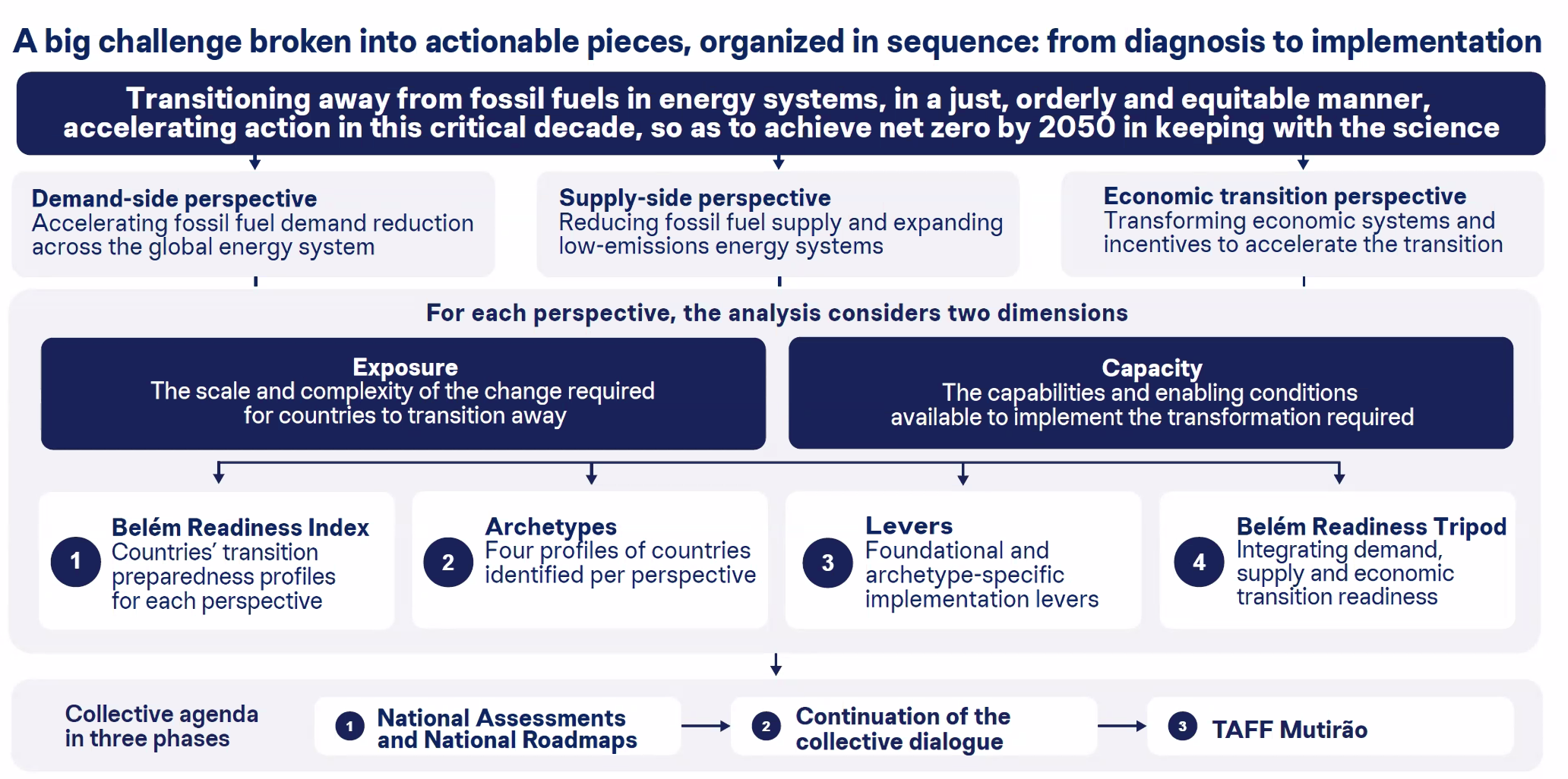
The Belém readiness index is a voluntary self-assessment tool for measuring fossil-fuel dependency and transition capacity. Once a country places itself among the four archetypes, it can select tailored levers.
The roadmap frames the shift as “as much a development question as a climate one, especially for emerging markets and developing economies”.
The three-phase timetable, read as a decision tree
Power is organised into three phases; the word levers matters more than the word deadline. The schedule is:
| Window | Political deadline | Work that should happen |
|---|---|---|
| now to 2028 | ends when the second global stocktake under the Paris Agreement concludes at COP33 | efforts focus on institutions and long-term signals |
| 2028-2030 | the next round of nationally determined contributions (NDCs) arrives; by 2030 plans must be ready | physical transformation of energy systems begins |
| 2031-2033 | starts in 2031, ends in 2033, 10 years after COP28 in Dubai called this critical decade action on transitioning away from fossil fuels | the transition must be scaled up |
The graphic below, shown to journalists and civil society, summarises the elements.
Credit: COP30 presidency
Toni said each stage was designed to be “extremely pragmatic and easy for countries to take a look at it”. That framing is useful for readers: it is a checklist, not a verdict.
Why the plan sits outside the UN text
COP30 was held in Belém, and the summit debate turned on whether a roadmap should be written into the UN climate outcome. A group of 85 countries pushed for a new roadmap, following the first global stocktake agreed in 2023. Another bloc opposed the reference; Carbon Brief found the informal list naming 84 countries contained inconsistencies, so the final opposing count was likely smaller.
After two weeks, the COP30 presidency announced that the roadmap would not be in the negotiated outcome but would be developed outside the formal UN process. At the same time, the presidency pointed to a first-of-its-kind conference in Santa Marta, Colombia, co-hosted with the Netherlands in April. A Dutch government report on that meeting records 57 countries attending from 24 to 29 April.
The voluntary roadmap is therefore a parallel instrument: it can shape pressure, but it cannot rewrite treaty text.
How it compares with national exit plans
Read alone, the roadmap can look abstract. The clearest test is to compare it with country plans that already name dates.
| Model | What it commits to | Strength for readers | Limits to watch |
|---|---|---|---|
| Brazil global roadmap | diagnosis, archetypes, levers, completion by 2033 | tailored, low friction, easy to adapt | voluntary, no treaty enforcement |
| France national roadmap | coal by 2030, oil by 2045, gas by 2050, reported by Le Monde and France 24 | fuel-by-fuel clarity and investor signals | needs grid, industry, social back-up |
| Denmark North Sea decision | future licensing rounds cancelled, with production ending in 2050 | producer state stops expanding | existing fields remain, so decline is slow |
Expert verdicts: what changes now
Experts see the roadmap less as a ban on fossil fuels and more as a political repair mechanism. Dr Natalie Jones, senior policy adviser at the International Institute for Sustainable Development, or IISD, told Carbon Brief the roadmap gives an important political signal that the transition away from fossil fuels remains firmly on the international agenda.
She added: “It also gives governments practical guidance to plan that transition in ways that reflect their national circumstances, strengthen energy security and protect livelihoods.”
For Avantika Goswami, climate policy expert at the Centre for Science and Environment in New Delhi, India, the roadmap is a “unique and consultative method of multilateralism”. She said: “[The roadmap] is one that is put forth by a developing country, via a consultative process that invited submissions from all parties and civil society.
“The analytical framework proposed captures the complexity of the fossil-fuel transition. Countries must now use it to chart out pathways in line with their historical responsibility and current capacity.”
On LinkedIn, Ploy Achakulwisut, a former UN adviser on fossil fuels, said she was “deeply impressed” with the approach, including its readiness index. She wrote: “[The index] provides a method for identifying countries that face similar transition conditions and for understanding how different exposure-capacity ‘archetypes’ can generate distinct implementation needs and opportunities.
“The latter can ‘support more targeted international cooperation’, helping the international community to align finance, technology, capacity-building, and technical assistance with country-specific needs and existing capabilities.”
COP31 in Antalya: what to watch
The roadmap lands just a week before COP31 begins next week in Turkey; the UNFCCC schedule puts the conference in Antalya from 9 to 20 November 2026.
COP31 co-presidents Turkey and Australia have set a wide agenda, including an electricity target that lifts the share of final energy consumption from almost 24% in 2023 - a figure often rounded as 24% - to 35% by 2035. André Aranha Corrêa do Lago said this goal was complementary to the roadmap. Corrêa do Lago declined to answer how governments that opposed the roadmap would react, but said: “Let’s remind ourselves we already have a consensus [on transitioning away from fossil fuels, agreed at COP28] and we already have the instruments.”
Toni said the presidency was hoping for the best, while Carbon Brief understands some parties see the focus on electrification as a way to avoid repeating the long COP30 fight.
Jones said the task now is to build on that signal with action: “At COP31, more governments should announce national fossil-fuel transition roadmaps and explain how these will inform their national climate plans. The conference should also [formally] recognise the global roadmap and establish a route for its findings to inform the second global stocktake.
“For vulnerable countries dependent on fossil-fuel revenues, credible plans must be matched by international finance and support to diversify their economies and sustain public services. This roadmap can help turn a shared commitment into practical progress.”
Common misconceptions, corrected
- It is not a global coal, oil and gas ban. It is a voluntary self-assessment tool and policy sequence.
- It does not mean every country exits on the same date. The four archetypes exist to stop one-size-fits-all judgments.
- It does not erase the 1.5C problem. The roadmap accepts overshooting, while still asking for levers now.
Action checklist for readers and officials
- Start with the Belém readiness index, not with slogan arithmetic.
- Classify the country into one of the four archetypes, then list feasible levers.
- Use the first phase to build institutions and send long-term signals before 2028.
- Put physical transformation into the next NDCs due in the 2028-2030 window.
- Make the 2031-2033 phase measurable: jobs, revenue, grid investment, social protection.
FAQ: quick questions before COP31
Does the roadmap force countries to quit fossil fuels?
No. It is voluntary and asks countries to diagnose their own readiness.
Why 2033?
It marks 10 years after the COP28 Dubai call on transitioning away from fossil fuels.
Is electrification a substitute for phase-out?
It helps, but only if power demand grows clean and fossil-fuel demand falls. The roadmap’s levers must do the second job.
Who criticises the approach?
Critics say voluntary tools can drift; supporters say a pragmatic diagnosis may be the only way to keep 85 countries, 84 countries and undecided states in the same conversation.