
ItInsightsWorld General Playbook: Turning the Microsoft 365 Outage Into Real-Time Marketing—13 Brands, Steps and Pitfalls
A regional social lead with a dead Outlook and a locked content calendar has one defensible move: ship a small, product-linked joke fast, and pre-commit to the lines you will never cross. That is the usable lesson from last Friday, when Microsoft Outlook went dark and inboxes fell silent. For office workers it was lost time; for brand teams it was an unscripted test of judgment, and the best answers came from teams that could get a post approved in under an hour.
According to the Associated Press, a global disruption to Microsoft 365 stretched from Thursday into Friday the 13th, leaving hundreds of millions of users cut off from Outlook, Teams, Copilot and SharePoint. On Friday, Microsoft apologised and attributed the incident to a recent network change that followed a capacity upgrade, ruling out a cyberattack or AI agents as the cause. Later reporting put the reach at 74 countries and said Microsoft declared services fully restored by Saturday.
What happened—and why did a software failure turn into a marketing moment?
Short answer: the outage killed the coordination layer, so stranded workers were already scrolling. That handed a captive, irritated audience to anyone with a fast approval path.
The Associated Press documented the Thursday-to-Friday disruption; separate coverage reported disruption across 74 countries and a full-restoration notice on Saturday. When the inbox is down, social media is the only place left to speak. That is why so many teams treated the incident as an opening rather than a crisis to ignore.
What is the one rule that keeps a joke from becoming a crisis?
Conclusion first: speed is necessary but not sufficient; three pre-flight checks decide whether you post at all.
David Meerman Scott, who coined "newsjacking", describes it as injecting your ideas into a breaking news story, and notes it demands the speed most organisations reserve for crisis communications. The Forbes Agency Council checklist is blunter: think fast, but remember speed can kill—ask whether the topic is relevant to your brand, whether anyone got hurt, and whether you are reading the room. Those three questions are more useful than any joke template.
How did the 13 brands play it? A field guide you can copy
There were three repeatable lanes: empathy, product-as-punchline, and the bounded competitive jab. Almost every post below fits one. The measured response is noted where the record has it; treat likes as attention, not revenue.
Burger King: the "take your time" invite
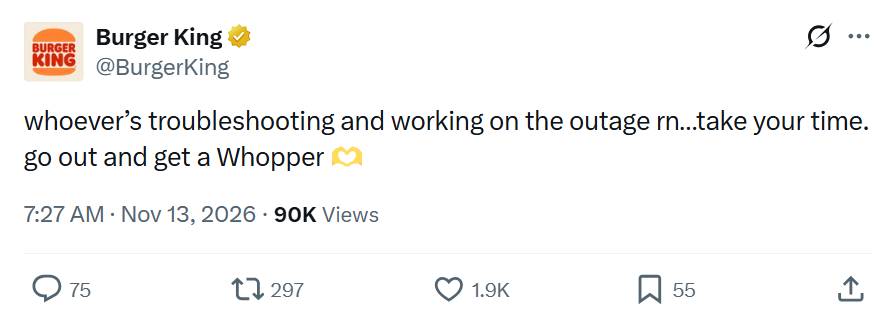
Burger King told whoever was troubleshooting the outage to take their time—and perhaps enjoy a Whopper. It sided with the tired employee rather than the IT team, which is why the joke travelled.
Chili's: the offer bolted onto the joke
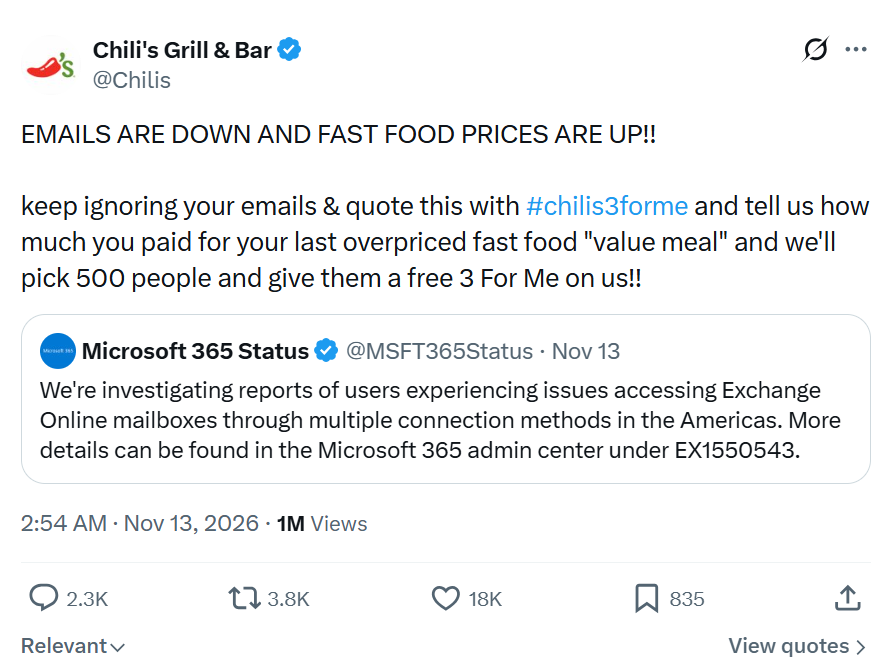
Chili's replied to the official Microsoft 365 Status account: "EMAILS ARE DOWN AND FAST FOOD PRICES ARE UP!!" It followed with: "Keep ignoring your emails & quote this with #chilis3forme and tell us how much you paid for your last overpriced fast food "value meal" and we'll pick 500 people and give them a free 3 For Me on us!!" The post drew over 16,000 likes. The giveaway made the attention measurable.
IKEA Singapore: the soft-toy pun
IKEA Singapore posted its jerboa soft toy with the line "Thank god there's no outage on this micro-soft." and the caption "Phew, that almost caused widespread panic." It gathered over 21,900 likes. A product pun beat a press release.
Kinder Bueno: the coworker wink
Kinder Bueno called its chocolate biscuit and wafer treat "The only thing you and your coworker are opening today." and told fans to "forget the emails" and tag a favourite coworker to open something "better".
KitKat: the slogan that already fit
KitKat leaned on "Have a break, have a KitKat". Its global Instagram video had a man say "I'm just going for a break" with the caption "Microsoft 🤝 KitKat 🤝 Having a Break". In Malaysia, a KitKat poked out of the Outlook logo: "The universe blocked your emails so you can have a break!" No new idea was needed; the old one was already on-message.
McDonald's: the meme shortcut
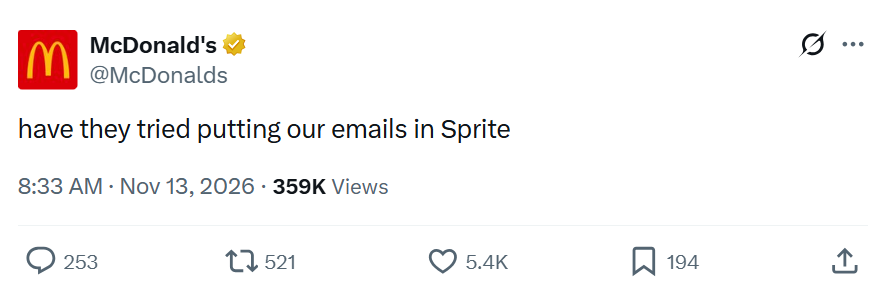
McDonald's asked "have they tried putting our emails in Sprite", spoofing the "have you tried putting it in rice" meme about drying waterlogged devices. It reused a joke the audience already knew, with Sprite as the only new ingredient.
Nando's Malaysia: the local-language signal
Nando's Malaysia showed the Outlook logo being grilled, captioned "cooked", plus "kalau korang kat opis lagi, here's your sign to balik." — "If you're still in the office, here's your sign to go home". Local language is not decoration; a team that can turn a celebrity food trail into a followable dining guide already has the muscle memory for this.
OATSIDE: the mascot route
Singaporean oat-milk brand OATSIDE poured a carton over a laptop in its Instagram post: "Microsoft left Teams running, but we got you covered." Mascot-first humour keeps the product in frame without a hard sell.
Oreo: two-panel timing
Oreo's Malaysia and Singapore account ran a carousel: "Something went wrong" over a glass of milk, then "Everything just feels right," once the biscuit landed. A simple before-and-after structure did the work.
Pizza Hut Malaysia and Pizza Hut Singapore: utility plus offer
Pizza Hut Malaysia told users "Korang tak perlukan Outlook untuk order Pizza Hut" — "You don't need Outlook to order Pizza Hut" — and pushed a RM5 promo. Across the causeway, Pizza Hut Singapore used "Someone wished a little too hard on our Starizo," to plug its new Starizo pizza. One post solved a problem; the other sold a product.
Subway Malaysia: the numbers pun
Subway Malaysia wrote "Microsoft 365 is down," then "Our subs? Fresh 365 days a year." with "No downtime, just good bites". A numeral reused is cheaper than a new concept.
Wendy's: the rival jab
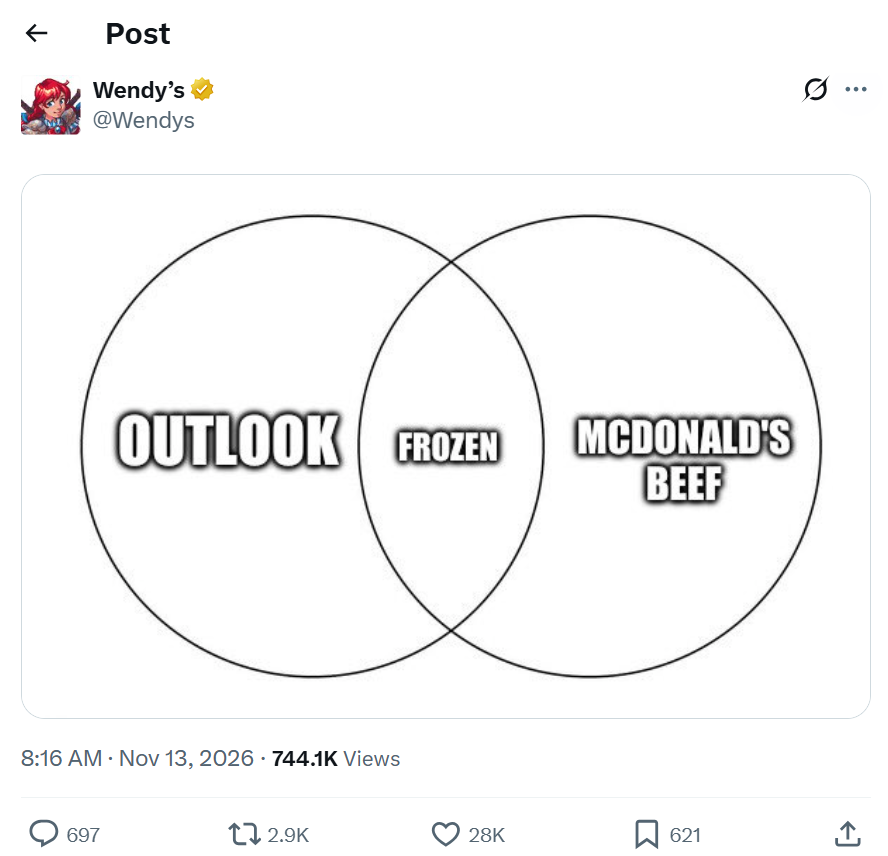
Wendy's posted a Venn diagram with Outlook on one side and "McDonald's beef" on the other; the overlap was "Frozen." It is the sharpest example here and the one most likely to invite a reply you cannot control.
Yahoo: the rival's text-only swing
Yahoo, as a competitor, skipped naming Outlook and posted: "Work email down? Great! Now time for your 346,538 unread personal emails." The 346,538 joke drew over 102,000 likes—the largest response in this set—proving a plain sentence can beat a produced asset.
Which pattern won? A quick comparison
| Lane | Example | Recorded signal | Risk to watch |
|---|---|---|---|
| Empathy / product pun | Burger King, IKEA Singapore, KitKat, Subway Malaysia | IKEA Singapore over 21,900 likes | Too generic to be remembered |
| Offer attached | Chili's, Pizza Hut Malaysia | Chili's over 16,000 likes; 500 people picked; RM5 promo | Looks opportunistic if the offer leads |
| Local language | Nando's Malaysia, Pizza Hut Malaysia, Oreo | "cooked"; "Korang tak perlukan Outlook untuk order Pizza Hut" | HQ translation kills the joke |
| Competitive jab | Wendy's, Yahoo | Yahoo over 102,000 likes | Escalation you cannot moderate |
What are the steps? A five-step approval path
You cannot invent an approval process during an outage. You can only pre-authorise one. Here is the sequence that fits most teams.
- Watch the right signal. Track the vendor status account, not just the trending tab; Chili's replied straight to Microsoft 365 Status.
- Choose one lane. Empathy, product-as-punchline, or a bounded competitive jab. Do not mix them.
- Run three checks. Relevant to us? Did anyone get hurt? Are we reading the room? If any answer is uncomfortable, hold.
- Ship inside the first wave. The news cycle peaks quickly; a day-late joke is a rerun.
- Log the outcome. Record likes, clicks and complaints. The durable version looks less like a stunt and more like a playbook that turns fan knowledge into a repeatable campaign.
What does it cost? An operating ledger, not a price tag
The real cost is approval latency, not creative time. No credible public figure covers what these posts cost, so treat this as an analysis checklist rather than a budget.
- People: one local writer plus one decision-maker who can say yes in minutes.
- Rights: images and logos need clearance even when the joke is friendly.
- Attention: every minute spent on the post is a minute not spent answering customers who cannot send email.
- Risk: a competitive jab can outlive the outage; assign a response owner.
The practical read on this incident is that outages sit outside a brand's control while communication sits inside it. Spend the budget there.
Common mistakes, and the fix
- Copy-pasting the global joke. The Malay lines carried the posts in Malaysia; use local writers.
- Joking about harm. If services with real consequences are affected, run the "did anyone get hurt" check first.
- Leading with the discount. Chili's led with empathy, then gave 500 people a free meal.
- Waiting for polish. Yahoo's best-performing post was text only.
- Punching without a boundary. The Wendy's Venn diagram works because it ends at "Frozen." — stop there.
FAQ: the questions a social lead actually asks
Was this a cyberattack?
No. Microsoft ruled out a cyberattack or AI agents as the cause and pointed to a recent network change after a capacity upgrade.
Did the posts drive sales?
Public records show attention, not revenue. The Chili's giveaway to 500 people is the only clearly trackable action; the rest are engagement signals.
Can a small brand do this?
Yes, if it has a named approver and a local writer. Without those, speed becomes risk.
What should we do this week?
Write a one-page rule: three checks, one approver, one lane, one log. Then rehearse it on a quiet news day.
Reference sources
- Associated Press — Microsoft says services fully restored after hourslong global outage
- Forbes Agency Council — Managing The Risks And Rewards Of Newsjacking
- David Meerman Scott — Newsjacking excerpt
- Al Jazeera — Microsoft hit by global outages, 74 countries
- Customer Experience Dive — handling the CX aftermath