
ItInsightsWorld Breakdown: BrainChip Sequora and Akida Edge IP for Local Generative AI
BrainChip pairs Sequora processor IP with Akida neural processor IP to bring generative AI and large language model (LLM) workloads onto battery-powered edge hardware, including earbuds and sensor nodes. Each core targets a different class of task: Sequora focuses on generative and sequential AI, while Akida is used for streaming sensor data.
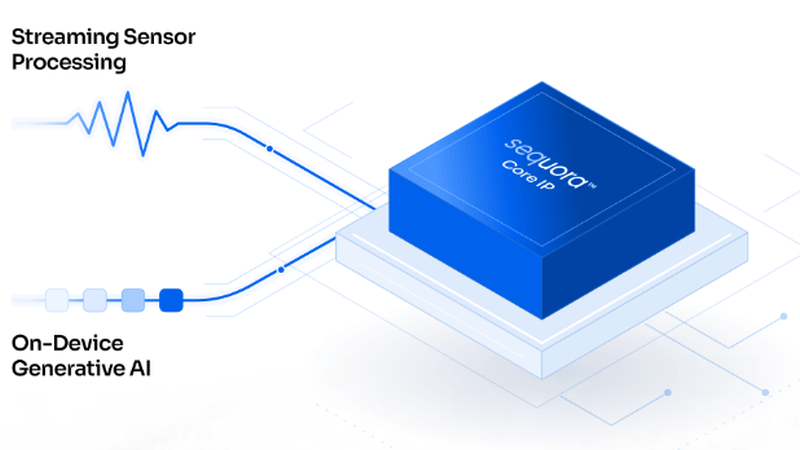
Task Split Across the Two IP Cores
| IP core | Primary role | Workload examples |
|---|---|---|
| Akida | Processes streaming sensor inputs | Vibration, audio, radar, raw RF IQ data, and biological signals |
| Sequora | Runs generative and sequential AI | On-device LLM inference, voice-to-voice interaction, and AI agents |
State-Space Model Support
Sequora is optimized for state-space models (SSMs). Because these models use a fixed-size state to represent input history, memory requirements remain constant regardless of sequence length. That characteristic supports generative AI deployment on resource-constrained edge devices.
Unified Compute Array and Software Updates
Sequora uses a unified multiply-accumulate (MAC) array for signal processing and neural-network computation, removing the need for a separate DSP preprocessing stage. The instruction-set architecture (ISA) is also presented as enabling new algorithms to be delivered through software updates.
IP Availability and Deliverables
Sequora is currently available as licensable semiconductor IP from Brainchip Holdings. Delivery is described as process-portable, fully synthesizable RTL, accompanied by verification IP, synthesis scripts, and an SDK containing a compiler, C++ runtime library, and model zoo.