
Stretch Gen 2 Deep Dive: Why Boston Dynamics Rebuilt Its Dock Robot Around Downtime, Not Speed
Written for ItInsightsWorld by James Hartley, IT Insights
Boston Dynamics rebuilt Stretch Gen 2 to lose fewer working hours, not to print a bigger headline number. The machine still unloads up to 1,000 cases per hour, but every material change — connectors, cabling, joints, gripper, diagnostics — attacks the gap between a demo rate and the rate a dock actually collects over five days of mixed freight. That gap is where most warehouse robots quietly fail.
The launch was announced from Boston on 3 November 2026, and the design brief came from the field rather than the lab: the team mined logs from more than 100,000 operating hours and tens of millions of boxes already moved by first-generation Stretch, then re-engineered the parts those logs kept blaming. For readers outside logistics, this is the more interesting half of the story — the speed claim is easy to read, the serviceability claim is the one that decides whether the speed ever happens.
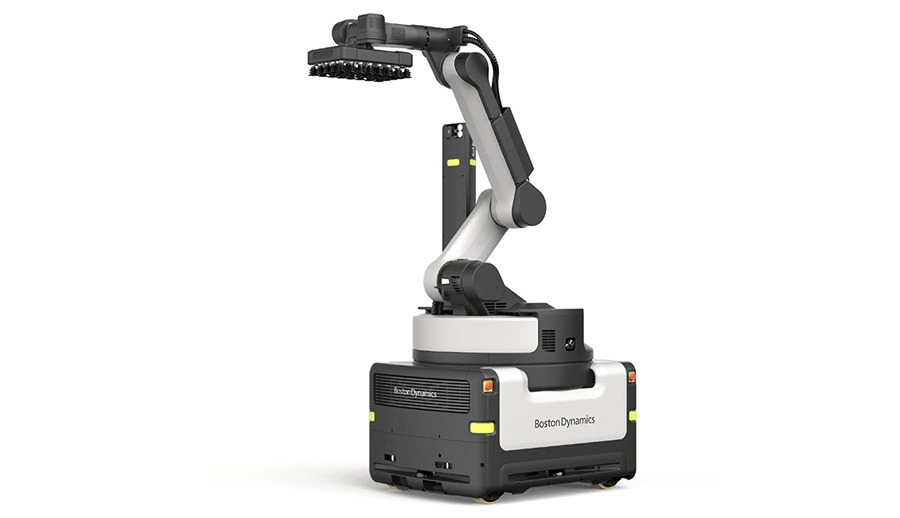
Stretch Gen 2.
What actually changed, part by part?
Short answer: nothing that raises the ceiling, everything that raises the floor. The redesign is a reliability package — the throughput figure is carried over, while the hardware is rebuilt around the failure modes that produced unplanned stops. The table below maps each published change to the fault it removes and to the question an operator should ask before signing anything.
| Change in Stretch Gen 2 | Failure mode it targets | Question to verify on your own dock |
|---|---|---|
| Heavy-duty automotive-grade connectors | Connectors loosening under vibration from rapid, high-torque box handling and rough floors | How uneven is the trailer floor and dock approach? |
| Removal of 81 percent of internal cabling — about a half-mile’s worth | Intermittent electrical faults and wire wear, the single largest downtime driver | Can our maintenance staff service the unit without a vendor engineer on site? |
| Continuous-rotation joints operating beyond 360° | Mechanical stress concentrated at hard stops | Cycle counts at full reach, not at mid-sweep |
| Upgraded gripper with new valve systems and finer sensing | Missed or dropped grasps during fast-paced picks | Behaviour on crushed, mixed-weight and awkwardly stacked cases |
| Lower, recessed emergency stop and new exterior panel materials | False safety stops and broken panels when a box falls | Does one dropped case cost you the next hour of unloading? |
| Modular plug and play part swaps plus onboard diagnostics | Long, externally dependent repair windows | What spare-part kit and training hours are in the contract? |
Why deleting half a mile of wire beats a faster arm
Conclusion first: average throughput is governed by variance, not by peak capability, and cabling was the biggest source of variance in the installed fleet. Boston Dynamics states plainly that removing the wiring eliminated the largest source of intermittent electrical faults and wiring wear. Intermittent faults are the worst category of breakdown for a dock schedule: the machine runs fine in the morning test, stalls twice in the afternoon, and nobody can reproduce it.
The same logic explains the other changes. Flexible harnesses fatigue where they bend, so continuous-rotation joints that move beyond 360° remove the abrupt end-of-travel load that used to concentrate stress on both mechanics and the cables running through them. Vibration is the enemy of any electrical interface, which is why automotive-grade connectors — designed to survive years of road shock in vehicles — are a more sensible specification for a robot that travels over uneven concrete than an incremental speed upgrade would be.
One caveat for planners: less wiring also means the failure data a vendor collects becomes more valuable over time. The field-data-driven approach — the release itself is justified by more than 100,000 operating hours of first-generation running — is now the main moat in this category, not the arm.
How much of the 1,000 cases per hour is real?
Treat the number as a conditional ceiling, not a delivery commitment. The published figure — up to 1,000 cases per hour — is explicitly described as heavily influenced by case weight and by how neat or disorderly cases are stacked, with a multipick function pushing performance toward those peak rates. Ergonomics researchers at the University of Waterloo's Centre of Research Expertise for the Prevention of Musculoskeletal Disorders describe the same variable from the human side: courier trailers are typically "loose loaded", stacked from floor to ceiling, which is precisely the disordered condition under which both people and robots slow down.
Energy and sensing, by contrast, are unconditional advantages in the specification. The battery lasts two shifts; a fast charger reaches 90 percent charge in about 75 minutes; onboard lighting allows work inside dark trailers; and a pre-trained vision system recognises most packages from day one with no programming. Read together, that set answers a practical question buyers always ask: can one machine cover a whole operating day without a custom integration project? Here the answer is yes — but "no programming" is not the same as "no preparation", because your dock schedule, carton mix and trailer quality still determine where inside the range you land.
Who owns the wrench now?
The most under-reported number in the launch is the repair window: a full swerve drive swap now takes about one hour instead of a full day. On the two figures Boston Dynamics published, that is roughly an 87 percent compression of the repair interval — our arithmetic, not a company claim — and it changes the shape of an outage from "lost shift" to "lost coffee break".
Three supporting moves make that credible. Dynamic cables and complex harnesses are gone, so there is less to route and re-terminate. Standardised high-strength fasteners cut tool changes and hands-on time. And new onboard diagnostics and maintenance tools deliberately hand routine service to the customer's own maintenance team, reducing dependence on outside support. For a general reader, this is the part that signals maturity: a hardware company shipping spare-part modularity and self-service tooling is optimising for lifetime cost, not for a launch demo. Trade analysis of the sector repeatedly makes the same point — buyers care less about a one-off accuracy peak than about a documented uptime commitment, predictable preventive checks and a repair process that does not require three specialists on a plane.
Why this landed in a crowded year for the trailer
Context matters more than the spec sheet. The physical AI market for truck loading and unloading is valued at USD 2.27 billion in 2027 and forecast to grow at a 27.47 percent CAGR toward USD 7.64 billion, according to Mordor Intelligence — capital is arriving fast, and differentiation is shifting from "can it lift a box" to "is it still running in month fourteen".
Two moves in early 2026 show how competitive the doorway has become. Trade press at The Robot Report reported that Amazon acquired Rightbot in January 2026, adding an unstructured load-handling system to its robotics group, and in March 2026 Dexterity introduced its Foresight world model, applied to autonomous truck loading on its dual-armed Mech robot. Meanwhile the demand side stays stubborn: Exotec's 2026 warehouse trends review cites roughly 500,000 unfilled warehouse jobs in the United States, and manual trailer work carries well-documented musculoskeletal-injury risk. That combination explains why a durability-first release, rather than a record-throughput robot, is the strategically sensible bet for Boston Dynamics — the segment is being decided on uptime, integration friction and labour relief, not on peak cases.
Five common misconceptions about dock robots
- "A higher peak rate means more freight unloaded." Sustained rate is dominated by downtime and carton disorder — which is exactly what this redesign targets.
- "No programming means no project." Vision may work from day one, but floor condition, trailer mix, dock scheduling and spare-part logistics still need planning.
- "Robots fix the labour shortage by themselves." They relieve the hardest, most injury-prone task — unloading — and shift staff toward exception handling and supervision.
- "Gen 2 is a speed upgrade." The published throughput band is unchanged; the changes are in connectors, cabling, joints, panels and service time.
- "Maintenance specs are procurement detail." Repair-window numbers such as about one hour versus a full day move total cost of ownership more than most option packages do.
What to do next, whether or not you run a warehouse
- Read uptime, not throughput. Ask for mean time to repair, parts availability and whether routine service can be done by your own staff — the modular plug and play approach is the template for a fair question.
- Model the rate as a range. Take the ceiling figure of 1,000 cases per hour and discount it for your worst-stacked, heaviest freight, not your best pallet.
- Price the outage, not the machine. A one-day repair versus a one-hour repair is the difference between missing a shipment window and absorbing it.
- Watch consolidation as a leading indicator. Acquisitions and world-model launches at rivals tell you the category is moving from pilots to infrastructure.
- For non-specialists: treat this as a case study in how automation matures — first generation proves the concept, second generation makes it ownable by the people who actually run the site.
Frequently asked questions
Is Stretch Gen 2 faster than the original Stretch?
Not on the published top-line figure. The robot still unloads up to 1,000 cases per hour, with the same caveat that case weight and stacking order drive the realised rate. The performance improvements come indirectly: fewer stops, fewer false safety triggers and faster recovery, plus software releases that refine case detection, motion planning, pick strategies and world modelling across the fleet without hardware changes.
What are the main hardware upgrades?
Six, as disclosed: heavy-duty automotive-grade connectors; an upgraded gripper with new valve systems and more precise sensing; continuous-rotation joints operating beyond 360°; removal of 81 percent of internal cabling, about a half-mile’s worth; a lower, recessed emergency stop with tougher exterior panels; and a modular design enabling plug and play part swaps.
Can it run a whole shift, or a whole day?
The battery lasts two shifts, and a fast charger brings it back to 90 percent charge in about 75 minutes, which is enough to cover split shifts or an overnight top-up. Onboard lighting means dark trailers are not a blocker, and the pre-trained vision system works on most packages from day one without programming.
Who does the maintenance now?
The design intent is in-house routine service. New onboard diagnostics and maintenance tools move everyday upkeep to the customer's own maintenance team, standardised high-strength fasteners reduce tool changes, and a full swerve drive swap takes about one hour instead of a full day. The practical takeaway: check what training, spares and uptime terms accompany the hardware.
Sources and further reading
- Boston Dynamics press release, "Boston Dynamics Launches Next Generation Stretch Robot", 3 November 2026 — https://bostondynamics.com/news/boston-dynamics-launches-next-generation-stretch-robot/
- The Robot Report, top-10 robotics developments of January 2026 (Amazon acquisition of Rightbot) — https://www.therobotreport.com/top-10-robotics-developments-of-january-2026/
- The Robot Report, "Dexterity unveils Foresight world model for truck loading", 5 March 2026 — https://www.therobotreport.com/dexterity-unveils-foresight-world-model-for-truck-loading/
- Mordor Intelligence, Physical AI for Truck Loading and Unloading market outlook — https://www.mordorintelligence.com/industry-reports/physical-ai-for-truck-loading-and-unloading-market
- Exotec, "Top Warehouse Trends for 2026" (US warehouse vacancy figures) — https://www.exotec.com/insights/top-warehouse-trends-for-2026/
- University of Waterloo CORE-MSD, "Ergonomic assessment: Trailer unload/load" — https://uwaterloo.ca/centre-of-research-expertise-for-the-prevention-of-musculoskeletal-disorders/resources/fact-sheets-and-handouts/ergonomic-assessment-trailer-unloadload
Analysis notes marked as our own calculation are derived only from figures published by Boston Dynamics. For editorial feedback on this piece, contact the IT Insights team at contact@itinsights.com.