
Bluetooth HDT vs. the Bluetooth You Own: What 7.5 Mbps Actually Buys Before 2027
By Simon Nelson · IT Insights
Short answer: Bluetooth® High Data Throughput raises the top rate of Bluetooth LE from 2 Mbps to 7.5 Mbps — nearly four times the old ceiling — but it will not improve one device sitting on your desk today. The feature was adopted as an option inside Bluetooth Core 7.0, announced on 4 November 2026, and the first products carrying it are expected in 2027. So the sane decision splits in two: refresh your current fleet against the numbers you already have, and put Bluetooth HDT into the requirement lists for anything that ships in 2027 or later.
That is the dilemma I keep hearing from two very different people. A device manager who saw the headline and wants to reopen a signed headset order. A product planner who wonders whether naming High Data Throughput in a spec now is a hedge or an empty checkbox. Same question, different budgets. Below is the honest version of the spec sheet, with the trade-offs left visible.
What Bluetooth HDT actually changes, in plain words
Conclusion first: this is a change to the physical layer — the raw pipe a radio uses to push bits — not a new app feature. Bluetooth HDT introduces a new PHY that greatly raises how much information devices can exchange while still using the same channel bandwidth and spacing as existing Bluetooth LE PHYs. The speed comes mainly from better spectral efficiency: higher-order coherent modulation plus forward error correction, supporting multiple data rates up to 7.5 Mbps.
Translated for anyone who has not sat through a radio-link budget meeting: the channel does not get wider, but more usable data is packed into every slice of airtime, and the correction code lets the receiver rebuild bits that would previously have been thrown away. That is why raising the maximum supported bit rate to 7.5 Mbps, nearly four times the Bluetooth LE 2M PHY, moves speed, capacity, energy efficiency and reliability at the same time instead of trading one for another.
How does it stack up against the generations you already run?
Conclusion first: HDT is the first serious raw-speed step in the Bluetooth LE PHY line since 2M. The generations between them were mostly about reach, power and — most recently — measuring distance rather than moving data.
| PHY generation | Peak bit rate | Why it exists | What it means for a buyer today |
|---|---|---|---|
| LE 1M | 1 Mbps | The original Bluetooth LE baseline that started the low-power device wave | Still the widest installed base; assume nothing about it changes |
| Bluetooth LE Coded PHY | Lower than 2M, traded for reach | Longer range through coding, at a data-rate cost | The choice for sensors on the far side of a site, not for bandwidth |
| Bluetooth LE 2M PHY | 2 Mbps | Speed at roughly the same range envelope | The real ceiling your headsets, watches and beacons run under today |
| Bluetooth LE 2M 2BT PHY | 2M, with 2BT modulation | Enabled Bluetooth Channel Sounding, the secure fine-ranging feature | Shows the roadmap recently favoured distance, not throughput |
| Bluetooth HDT | 7.5 Mbps | New PHY for high-volume, low-latency, battery-friendly links | Nothing you can buy today; a 2027 spec line, not a 2026 one |
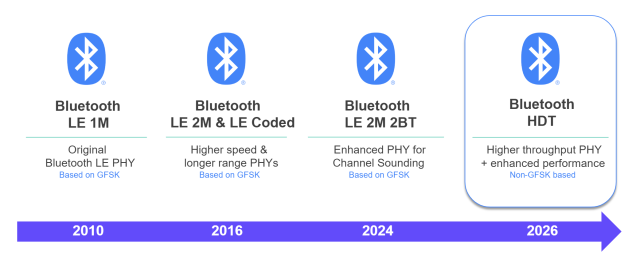
Figure 1. The Bluetooth LE PHY path from LE 1M and 2M to Bluetooth® High Data Throughput.
Is 7.5 Mbps the same thing as lossless audio on my phone?
No — and this is where most coverage of the announcement is loose. A PHY rate is the width of the road; a codec is how much luggage each car carries. Here is where the audio payloads actually sit, against a Bluetooth LE ceiling of 2 Mbps today and 7.5 Mbps with HDT.
| Audio scheme | Typical peak payload | Fits under today's 2 Mbps LE pipe? |
|---|---|---|
| SBC (classic baseline) | about 328–345 kbps | Yes, comfortably |
| LC3 (LE Audio mandatory codec) | 32–345 kbps | Yes |
| aptX HD | about 576 kbps | Yes |
| LDAC | up to 990 kbps | Only in clean radio conditions; it steps down when the room gets busy |
| aptX Lossless | claims about 1,200 kbps peak | Marginal at best, which is exactly the argument for more headroom |
Two things follow from that table. First, efficiency has already been climbing faster than bandwidth: in listening tests commissioned by the Bluetooth SIG, LC3 at 160 kbps scored better than SBC at 345 kbps, meaning better sound on roughly half the airtime. Second, the high-bitrate schemes are the ones that break first in crowded radio conditions, because they are living right up against the pipe.
So the real value of 7.5 Mbps for audio is headroom, not a magic upgrade. Standardised premium wireless audio — lossless and high-resolution, plus multi-channel surround and spatial audio — is the first flagship application for Bluetooth HDT, and the Bluetooth.com press release published on 4 November 2026 puts its release in 2027. Joonsuk Kim of Samsung Electronics framed the same point in the alliance's launch materials: advancing throughput, capacity, energy efficiency and reliability together “gives developers and product makers a stronger foundation for building more capable products and richer wireless experiences.”
What buyers usually miss: reliability is the bigger change
If I had to pick one reason an IT or operations team should care, it is not 7.5 Mbps. It is that HDT supports multiple data rates, so a link can back off as conditions change instead of collapsing, and it introduces a packet format built for larger payloads that can be divided into independently validated blocks. A device then retransmits only the missing or corrupted blocks rather than repeating the whole payload.
That matters because Bluetooth shares the 2.4 GHz band with Wi-Fi access points, microwaves and every other radio in the room, and laboratory studies of that band keep finding the same thing: Wi-Fi, Bluetooth and ZigBee coexistence is where real-world throughput is lost. Fewer full-payload retransmissions is what turns a warehouse scanner that drops its session into one that does not. Fewer seconds of the radio actively transmitting also means more time in lower-power states, which is where the energy-efficiency claim comes from. The headroom from greater capacity also helps the other applications in line: immersive and spatial computing, AI-enabled devices exchanging data at the edge, and more advanced automation and monitoring in commercial and industrial settings.
Who gains first, and who should sit this out
- Consumers with current earbuds or a phone under three years old: no gain, at all. HDT needs new radio hardware on both ends of the link, so a firmware update will not unlock it. Buy the device that fits your budget now; see our experience with the limits of swapping one generation for the next in the Pixel Watch 3 vs Pixel Watch 5 side-by-side.
- Wearables, smart home products and other everyday IoT: billions of products already rely on Bluetooth technology for syncing with phones, moving files and taking firmware updates. Shortening a watch or sensor update from “leave it plugged in overnight” to “do it while you wait” is the least glamorous and most immediate win, and it arrives with the first 2027 hardware.
- Audio brands shipping in 2027–2028: gain most. Standardised high-resolution and lossless audio removes the codec-by-phone patchwork that makes headphone boxes look like a compatibility exam.
- Embedded and industrial teams on long certification paths: treat HDT as a silicon-roadmap question, not a firmware question, for exactly the reason our case review of the 385 dollar Raspberry Pi 5 makes: component availability and price swings, not datasheet numbers, decide when a design change is realistic.
- XR and edge-AI device makers: middle of the queue on benefit, front of the queue on interest, because sensor-rich, low-latency links are where 2 Mbps genuinely hurt.
The cost account: what it takes to actually get HDT
Treat this as a three-line budget, not a headline.
- Radio and SoC, on both ends. HDT is optional inside Core 7.0, so silicon vendors choose whether to implement it. Chip-IP suppliers such as Ceva already report customer interest following the specification's adoption, which is the earliest stage of the chain: IP first, then SoCs, then finished products, then the qualified-product listings on Bluetooth.com that you can actually check.
- End-of-life planning. Existing devices keep working exactly as they do now, because HDT is an additional PHY in the Bluetooth LE PHY line rather than a replacement for it. There is no security-style forcing function here, which means no forced refresh spend in 2027.
- Spec and verification effort. “Works with Bluetooth 7.0” will show up on marketing copy long before lossless profiles are standardised. Ask suppliers for the qualified product ID and for the data rate and payload both ends actually sustain in a noisy 2.4 GHz office, not the peak PHY number.
Risk worth naming: the first flagship application is premium wireless audio, so early HDT silicon is likely to appear in consumer earbuds and flagship phones before it reaches industrial radios, and prices follow that order. Waiting is not a loss here; guessing early is.
Four misconceptions worth retiring
- “My devices will get it through an update.” No. It is radio hardware.
- “7.5 Mbps means lossless immediately.” No. Standardised lossless and high-resolution audio is a 2027 target, not a shipping state.
- “This replaces Wi-Fi for data-heavy jobs.” No. HDT keeps Bluetooth's low-power job description while lifting its ceiling.
- “Bluetooth 7.0 equals HDT.” No. HDT is one optional feature within the specification, and vendors can ship Core 7.0 silicon without it.
FAQ: the questions I get asked first
When can I buy something with Bluetooth HDT?
Expect the first devices in 2027, with announcement news likely surfacing around CES in January. Volume availability in laptops, wearables and industrial gear usually trails flagship audio by a year or more.
Will an HDT device still talk to my older headphones and badges?
Yes. This is our reading rather than a quoted spec line, but HDT arrives as another PHY alongside existing Bluetooth LE PHYs, so a link can only run at rates both ends support — which is how the 1M, Coded and 2M generations have coexisted all along.
Which number should I actually compare when shopping?
Sustained payload rate and retransmission behaviour in interference, not peak PHY rate. Peak numbers sell; airtime and error recovery decide whether your call or your firmware push finishes.
Does this change anything for my company's device policy this year?
Only the paperwork. Add one line to your wireless requirements: state the supported PHY and whether the design is planned for Bluetooth HDT in a future revision. That turns a vague “keep options open” intention into something a supplier must answer.
Next step
Do three things this month. Freeze your 2026 refresh plan and buy on today's 2 Mbps reality. Write HDT and Channel Sounding into the requirements for products that will be designed in 2027, since range and throughput are now separate decisions you can make in advance. Then set a calendar reminder for January to see which radio vendors show first hardware — the honest read is that this is a foundation for the next generation of wireless experiences, and the only cost of waiting is that you get to watch the first devices instead of paying for them.
Sources
- Bluetooth.com: Bluetooth® High Data Throughput opens a new chapter in wireless performance (4 November 2026)
- Bluetooth.com blog: HDT delivers a higher level of wireless performance, including the Samsung Electronics comment
- audioXpress: Bluetooth SIG adopts High Data Throughput, optional in Core 7.0
- Tech Times: Bluetooth Core 7.0 adopted 4 November 2026, 2 Mbps to 7.5 Mbps
- Embedded Computing Design: Ceva on customer traction for HDT silicon IP
- Tech Times: LC3 at 160 kbps outperformed SBC at 345 kbps in SIG-commissioned listening tests
- Idaho National Laboratory: Experimental Evaluation of Interference in 2.4 GHz Wireless Networks
- Mezha (via Engadget): first HDT devices expected early 2027, news possible at CES