
Apple's Best Year Ever, Explained: What a Record $114.477 Billion Quarter Really Tells Everyday Readers | ItInsightsWorld
You do not need a finance background to get something useful out of a big earnings report. Here is the short version first: on November 3, Apple (NASDAQ:AAPL) reported today the numbers for the fourth quarter of fiscal 2026, and they were the biggest September-quarter figures the company has ever posted. Revenue, iPhone sales and earnings per share all set records for the quarter, and services reached an all-time high. Yet the shares moved barely at all after hours. That gap between "record" and "shrug" is the most instructive part of the story, and it is where this guide spends its time: what happened, why it happened, and how to judge the next report on your own.
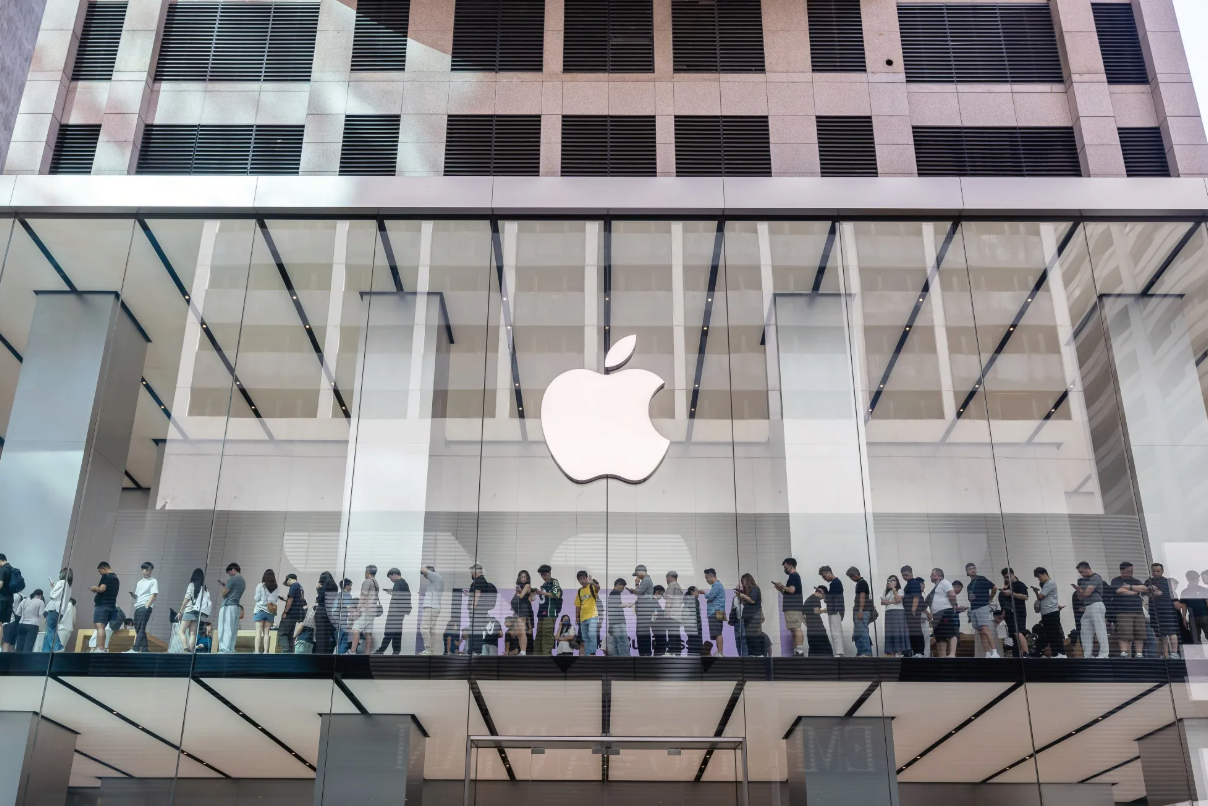
Three records and one soft spot: the two-minute summary
- September-quarter revenue of $114.477 billion, up 12% from $102.466 billion in the same quarter a year earlier; net income of $30.711 billion, up 12% from $27.466 billion.
- iPhone brought in $57.583 billion, up 17% — a September-quarter record — and services hit $31.573 billion, the highest services figure Apple has ever reported.
- For the full fiscal 2026 year, revenue reached $478.834 billion against $416.161 billion in fiscal 2025 (up 15%), with net income of $132.175 billion versus $112.010 billion (up 18%).
- The soft spot: China-region revenue landed below expectations even though Greater China grew 21%, iPad and wearables both shrank, and the stock rose less than 1% after hours — precisely 0.47%.
- The forward signal: Apple told investors it expects the December quarter to grow revenue 7% to 10% and to run gross margin at 45% to 46%, below the 48% it just reported, because memory prices and the Siri AI rollout are getting more expensive.
The quarter at a glance
| Line item | Fourth quarter, fiscal 2026 | Fourth quarter, fiscal 2025 | Change |
|---|---|---|---|
| Total revenue | $114.477 billion | $102.466 billion | +12% |
| Product revenue | $82.904 billion | $73.716 billion | +12% |
| Services revenue | $31.573 billion | $28.750 billion | +10% |
| Gross profit | $54.820 billion | $48.341 billion | +13% |
| Total operating expenses | $19.189 billion | $15.914 billion | +21% |
| Operating income | $35.631 billion | $32.427 billion | +10% |
| Net income | $30.711 billion | $27.466 billion | +12% |
| Diluted earnings per share | $2.10 | $1.85 | +14% |
Two details matter more than they look. First, gross margin held at 48%, so the extra spending did not yet dent profitability. Second, earnings per share climbed 14% while net income rose 12%; that two-point gap is not extra operating strength but arithmetic — buybacks shrink the share count, so the same profit is sliced into more pieces per shareholder.
Products: two lines carrying the load, two standing still
- iPhone: $57.583 billion, up 17% from $49.025 billion. That single line accounts for slightly over half of everything Apple sold in the quarter.
- Mac: $10.792 billion, up 24% from $8.726 billion — the fastest-growing hardware category in the report.
- iPad: $6.229 billion, down 10% from $6.952 billion.
- Wearables, home and accessories: $8.300 billion, down 8% from $9.013 billion.
- Services: $31.573 billion, up 10% from $28.750 billion — a company record rather than a September-quarter one.
Read as a set, the product lines describe a "fewer, bigger, dearer" strategy: the handset and the laptop pull in more money, while the tablet and the watch-and-home cluster give some of it back. For a general reader the practical implication is simple: the company's fortunes still turn on what people spend on a phone, not on what they add to their desk or wrist.
Regions: growth almost everywhere, but the headline market disappointed
- Greater China (mainland China, Hong Kong, Macao and the Taiwan region): $17.539 billion, up 21% from $14.493 billion.
- Americas: $48.680 billion, up 10% from $44.192 billion.
- Europe: $32.008 billion, up 12% from $28.703 billion.
- Japan: $6.540 billion, down 1% from $6.636 billion.
- Rest of Asia Pacific: $9.710 billion, up 15% from $8.442 billion.
The China line is the one investors argued with. Growing 21% is not weakness in any ordinary sense, and Apple's own reporting frames it as iPhone-led. The complaint was about the level, not the direction: consensus wanted more, and the quarter fell short of it. Context helps. Counterpoint Research data for the second quarter of 2026 put Huawei at roughly 23% of mainland China smartphone shipments and Apple at about 18%, which is why a rebound in revenue can still be read as a loss of ground in the most contested premium market Apple sells into.
Why a record quarter produced a near-shrug
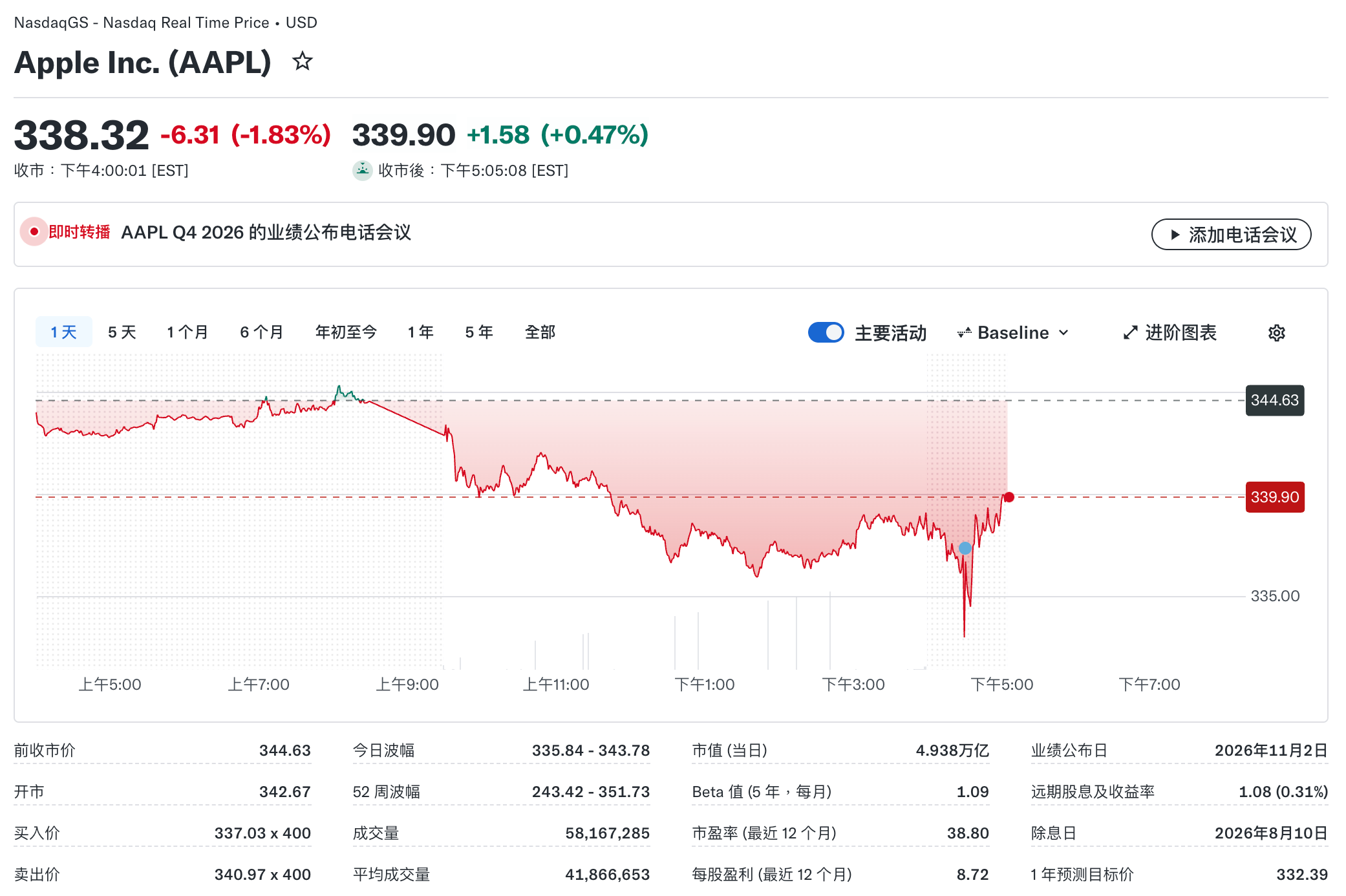
Apple shares rose 0.47% in after-hours trading.
Apple stock opened at $342.67 on the Nasdaq exchange on Monday. By the close it had fallen $6.31 to $338.32, a decline of 1.83%. In after-hours trading it added $1.58 to $339.90, a rise of 0.47%. Over the past 52 weeks the shares have traded between a high of $351.73 and a low of $243.42.
So the revenue beat was real — Wall Street had been modelling roughly $113.39 billion of revenue and $1.99 of earnings per share, according to consensus figures reported by CNBC and Reuters — and the stock still barely moved. Two explanations carry most of the weight.
The first is timing. This quarter closed on September 26, which means it captured only about nine days of iPhone 18 Pro selling, and none at all of the iPhone Duo, Apple's first foldable, which reached shelves on October 23 with a $1,999 starting price. The record you are reading is largely about trade-in demand pulled forward, not about the new lineup.
The second is the cost outlook. Apple steered the December quarter to 7% to 10% revenue growth and, more importantly, to gross margin of 45% to 46% — two to three points below the 48% just reported. Management attributes that to memory prices and the expense of rolling out Siri AI. Counterpoint Research estimated in December 2025 that DRAM price surges had already lifted bill-of-materials costs for low-end, mid-range and high-end smartphones by around 25%, 15% and 10% respectively. A margin guide-down is the kind of number professional investors trade on, even in a record quarter.
What the executives said
Chief executive John Ternus framed the result as the finish line of a record year: "Today, Apple is proud to report that September-quarter revenue reached a record $114.5 billion, up 12% year on year, with iPhone setting a September-quarter record and services reaching an all-time high, capping our best fiscal year ever. We closed the year with the most ambitious product lineup we have ever shipped. That includes the iPhone Duo, the most transformative iPhone since the original, and our strongest iPhones to date, the iPhone 18 Pro and iPhone 18 Pro Max. We also just introduced an all-new generation of hardware for the home, and brought touch to the Mac for the first time. Add the all-new Siri AI, and it is a stunning lineup that will carry us into the holiday season."
Chief financial officer Kevan Parekh put the emphasis on cash and scale: "Apple delivered records for September-quarter net income and earnings per share. Our record September quarter caps a strong fiscal 2026, in which revenue reached a record $479 billion and earnings per share grew by double digits. This quarter we generated $28 billion of operating cash flow, which allowed us to return $28 billion to shareholders. Thanks to very high customer satisfaction and loyalty, our active installed base of devices reached an all-time high across every major product category and geographic region."
Four forces behind the numbers that will shape 2027
1. A product wave the results have not touched yet
The September quarter is a look backwards at the iPhone 17 cycle, not the iPhone 18 one. The foldable iPhone Duo and the full iPhone 18 Pro run rate belong to the holiday quarter, which is why management can call the coming quarter the best revenue quarter in the company's history while the market's attention stays on supply.
2. Services is bigger but slower
Services grew 12% in the June quarter and 10% in the September quarter, and Apple's own guide for the December quarter is 8% to 9%. The line is now large enough — $31.573 billion in three months, an all-time high — that steady deceleration is normal. It is still the most profitable part of the business, and it is the reason the installed base record matters more than any single device launch.
3. Component costs are the new variable
Operating expenses rose 21% year on year, faster than any revenue line. Combine that with memory-cost inflation and a heavy AI rollout, and the shape of the next twelve months is clear: revenue growth driven by premium hardware, margin squeezed by parts.
4. China is a share fight, not a demand fight
Twenty-one percent growth paired with a "miss" is a signal that expectations, not appetite, are the binding constraint. For readers deciding when to upgrade, the practical read is that Apple's pricing power in China is now tested against domestic premium rivals rather than against other foreign brands.
Shareholder returns: two dates worth writing down
Apple's board of directors declared a cash dividend of $0.27 per share of common stock, payable on November 16, 2026, to shareholders registered at the close of trading on November 12, 2026. The dividend is a rounding error next to the $28 billion returned to shareholders during the quarter, most of it through buybacks, but the two dates are a useful lesson in how payouts actually work: buying shares after the record date earns you nothing from this particular distribution.
Common misconceptions about this report
- "Record revenue means every business is healthy." iPad fell 10% and wearables fell 8%. A company record can contain two declining product lines and still be a record.
- "This quarter shows how the new iPhones are selling." It does not. The quarter ended September 26 and captured only days of iPhone 18 Pro sales; the iPhone Duo is not in these numbers at all.
- "Earnings per share grew faster, so the business got more efficient." Most of the gap between 14% EPS growth and 12% net income growth comes from buybacks, not from operations.
- "The stock barely moving means the report was bad." It moved little because the beat was already priced in and the China line missed; after hours the shares were up 0.47%, not down.
- "Fiscal 2026 means calendar 2026." Apple's fiscal year ends on September 26, so "fiscal 2026" covers October 2025 through late September 2026.
A five-point checklist for judging the next report
- Compare the result with the guide, not with the press release. This time the guide said 7% to 10% revenue growth and 45% to 46% gross margin; a "beat" against consensus that misses the guide is a problem.
- Check whether China improved in level as well as direction. Growth of 21% only counts as a win if it clears expectations.
- Watch services growth against the 8% to 9% guide. A second consecutive deceleration changes how much of the story the installed base can carry.
- Look for margin before revenue. Memory costs are a company-wide tax right now; the gross margin line is where you will see it first.
- Count the days of new-product selling included. A record quarter can contain almost no holiday-season sales at all.
Frequently asked questions
Which period does this report actually cover?
The fourth quarter of fiscal 2026, which ended on September 26, plus the full fiscal year. Apple published the figures on November 3.
If the numbers were records, why did the shares fall during the day?
They did not fall on the numbers. The shares closed down 1.83% at $338.32 before the results were released, then rose 0.47% to $339.90 after hours once the report landed.
Who is presenting these results?
This was John Ternus's first earnings report as chief executive, with Kevan Parekh as chief financial officer — a detail worth noting, since the guidance language and the framing of the product roadmap both carry a new signature.
Does this affect what I should pay for a new phone?
Indirectly, yes. Higher memory costs and a $1,999 foldable at the top of the range push the whole market upmarket. If you were waiting for a discount on a flagship, the more likely scenario this cycle is steady prices with longer software and financing sweeteners rather than outright cuts.
The takeaway for a general reader is not "Apple is fine" or "Apple is in trouble". It is that a report can be simultaneously a record, a miss and a warning, depending on which line you look at — and that learning to sort those three signals is the transferable skill, whether the next headline is about phones, cars or groceries.
By James Hartley, IT Insights. Corrections and story tips: contact@itinsights.com.