
The Twelve-Round Offer: A Practical Playbook for Deciding When a Long Hiring Loop Is Worth Your Time
By James Hartley, IT Insights
Lead with the conclusion: the raw number of interviews tells you almost nothing by itself. What separates a thorough evaluation from an open-ended holding pattern is three things — a published loop map, genuinely different evaluators at each stage, and a stated decision date. When those exist, eight or ten conversations can be honest work. When they do not, even three rounds are already a waiting room. Hold that test in mind while we look at the case that set autumn job-seeking threads on fire, then turn it into a checklist you can run yourself.
The case that started the argument
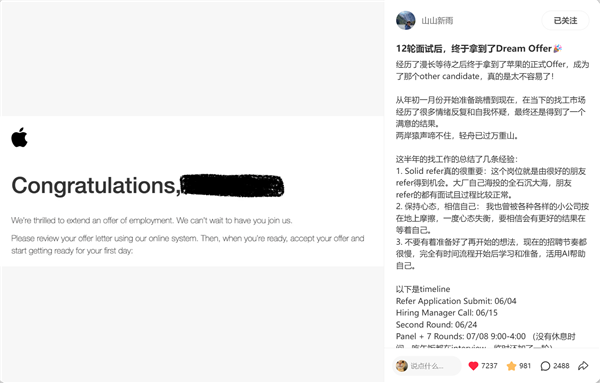
Posts shared on the Xiaohongshu platform describe a job seeker who sent a resume to an Apple opening in early June and did not receive the formal offer until mid-October. The whole search ran more than four months, and the applicant counted 12 rounds of interviews along the way.
The single hardest day was the on-site loop scheduled for July 8. The position was not in the applicant's own city, so the trip was made by air. The day began at 9 a.m. and ended at 4 p.m.; inside those 7 hours the candidate sat through seven back-to-back interviews, each with a different interviewer, each lasting between 30 minutes and 1 hour. Lunch was eaten while still talking to someone from the hiring team.
The second half of the story belongs to a job seeker known as Jojo. Interviewing for Apple as well, Jojo started in July, kept going into October, completed 11 rounds, and received a rejection at the end of it.
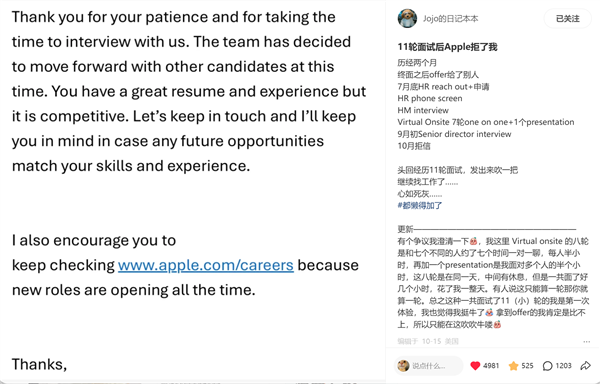
Commenters turned up in the successful applicant's thread with one line: "Congrats on beating Jojo." Nobody has confirmed that the two were after the same seat, but the contrast of 11 rounds and rejected versus 12 rounds and hired is what unsettled people: the distance between the two outcomes was exactly one round of conversation. The running joke was that hell has only 18 levels, while a campus recruiting loop keeps adding floors.
Why the queue keeps growing
China's Ministry of Education puts the 2025 graduating cohort at 12.22 million, and forecasts the 2026 graduating cohort at 12.7 million — 480,000 more people entering the same market in a single year. When applications grow faster than the number of attractive seats, employers stop buying speed and start buying certainty: more evaluators, more cross-checks, longer windows. The cost of that insurance is paid mostly in the applicant's time.
The same drift shows up in Western recruiting data, so this is not a one-country or one-company quirk. Gem's 2025 Recruiting Benchmarks, a dataset built on more than 100 million applications and over a million hires, reports hiring teams running about 20 interviews per hire in 2024 against 14 in 2021 — a 42 percent rise — while average time to hire stretched from 33 days to 41 days. Insiders notice, too: a survey of recruiting professionals summarised in designer Emily Backes' research write-up found that 39 percent of companies admit candidates face too many interview rounds and 52 percent admit their own process is too long.
"Round" is not a single unit — check who is counting
Before you read 12 as a verdict on your ability, note that candidate-side and company-side arithmetic measure different things.
- Team workload is not personal burden. Benchmarks such as Gem's count every interview a team runs for one requisition, including candidates who were never hired. Role breakdowns summarised by Curriculo put engineering near 35 to 36 interviews per hire and design or product roles at 37 to 39, while customer-service work stays under 10 and sales climbed from 14.0 to 21.3. That is staff effort, not the number of times one person must show up.
- One stage can be seven rounds. The July 8 on-site was a single scheduled stage on the company calendar, yet each of its seven conversations had a different interviewer — hence seven rounds from the seat of the applicant.
- The paperwork after the loop. Published guides to Apple-style processes, such as LeonStaff's 2026 breakdown, describe a stage in which 5 to 8 interviewers file written feedback that goes through a review committee, taking one to three weeks after the last conversation. Calendar silence at the end is usually process, not preference.
- Cross-team re-mining. A candidate passed over by one team can be picked up by another inside the same company and assessed from scratch, so the applicant experiences one continuous ordeal while the organisation records two unrelated processes.
- The normal funnel is shorter. Funnel benchmarks summarised by Curriculo — SmartRecruiters at roughly 73 applications, about 3 interviewed candidates and 1 offer per position, and CareerPlug at about 27 percent from interview to hire — show that most hires close after a handful of conversations. Double digits is a signal about process design, not about your competence.
Rigorous loop or holding pattern: a side-by-side read
| Signal | Healthy multi-round evaluation | Low-effort holding pattern |
|---|---|---|
| Schedule | Loop map naming stages, interviewers and an expected decision date | No timeline; every answer is "wait for notice" |
| Interviewers | Level and angle change each round: motivation, craft, team fit, senior sponsor | Same questions again, new face, no new test |
| Headcount | A named opening with a hiring plan; the posting is closed | Requisition stays open for months while interviews continue |
| Feedback | Next step confirmed within 24 to 72 hours after each round | Silence, then a merged or rescheduled round |
| Your cost | Mostly virtual, or travel reimbursed and bounded | Repeated cross-city flights and full days, unbounded |
Convert the loop into hours before you accept round six
Do the arithmetic on paper. A 30 minute to 1 hour conversation typically carries two to three hours of candidate cost once preparation, travel, waiting and recovery are counted. Twelve rounds therefore equal roughly a full working week of unpaid labour, plus airfare and a hotel night for an on-site in another city, plus four months of living with an unresolved outcome.
Then compare that with what the market rewards. Benchmark summaries such as TalentHub's review of SHRM-cited hiring data note that strong candidates are usually off the market within about 10 days, while average time to hire hovers near 42 to 44 days. A long loop is precisely the structure in which you quietly lose your other options.
Action checklist: seven steps to run the process instead of being run by it
- Ask for the loop map in writing. After the first screen, send three questions: how many stages remain, who will I meet in each, and when do you expect a decision? The specificity of the reply is the most useful data you will collect.
- Set a personal decision deadline. Pick the date at which you will stop holding other processes open for this company, and tell the recruiter that date. A stated deadline converts vague waiting into a negotiation.
- Keep a round log. One row per conversation: date, interviewer and team, topics covered, question you asked, promised next step. The log exposes duplicated rounds (a design flaw, not a failing of yours) and gives you a factual basis for a progress enquiry.
- Reuse your material. Build one ten-minute project story, one technical walkthrough and one question bank, then adapt them instead of rebuilding before every session. Loop endurance is a production problem, not a talent problem.
- Run parallel processes on purpose. Never let the first long loop you are offered become your only plan; keep two or three active conversations so you can decline late-stage rounds without fear.
- Price the on-site. For any round that requires travel, ask whether earlier stages can be compressed or taken remotely and whether travel is reimbursed. If both answers are no, treat the trip as an investment you are making and cap it at one visit per process.
- Apply a stop-loss rule. Withdraw when two conditions hold at once: rounds keep repeating the same content, and no decision date exists after three follow-ups. Cutting losses early is a skill, not a surrender.
Common misconceptions
- "More rounds must mean better hiring." Extra stages mostly raise cost and dropout; they raise accuracy only when the evaluator and the question both change. Repeating the same test with a new face measures your stamina.
- "Rejected after 11 rounds, so I am not good enough." Late declines often reflect headcount freezes, internal candidates or committee disagreement. Funnel data showing several interviewed people per single offer means somebody well qualified must be cut at the end.
- "No news means I am still in the running." Silence is common and rarely informative. JobScore's interview statistics roundup reports that 40 percent of job seekers were never contacted again after a second- or third-round interview, and Yomly's candidate-experience data finds 62 percent of applicants lose interest when no reply arrives within two weeks.
- "Enduring the loop proves commitment." Companies read persistence as enthusiasm only until your performance drops. Protecting sleep before a panel does more for your result than accepting an eleventh session you cannot prepare for.
- "Every round is an evaluation of me." Some rounds exist because a stakeholder wanted a say. That tells you about internal politics, and it is fair to ask what decision the next conversation will actually change.
FAQ
Is 12 interview rounds normal?
No. A typical candidate loop runs a handful of stages; team-side counts look larger because they include every interviewed person, not just the one hired. Treat double digits as a prompt to request the loop map and a decision date before investing further.
Should I fly to an on-site during campus season?
Only when the earlier stages are done, the round can no longer be remote, travel is reimbursed, and you have a written expectation for the outcome date. A 9 a.m. to 4 p.m. day is manageable; an unreimbursed flight for a stage with no stated purpose is not.
How do I chase progress without irritating the recruiter?
Send one short, dated note that cites your round log: after my conversation with A on July 8 and B in the following week, is there a target date for the committee's decision? Asking about dates is professional; repeatedly asking whether you are still wanted is not.
Does an AI or recorded screening count as a round?
Count it as cost rather than evaluation. One-way automated screening adds time and gives you no dialogue, so it should not lengthen your patience budget. The question that still matters is when a human will decide.
If I am cut at the end, should I ask why?
Yes — once, in writing, asking for one concrete improvement. The gap is structural, not rude: Yomly's candidate-experience roundup reports 94 percent of applicants want interview feedback while only 41 percent ever receive it.
Bottom line
Two applicants did everything expected of them, flew the same kind of trips and answered the same kind of questions; one closed the offer after the twelfth conversation and one closed a rejection letter after the eleventh. That gap is the honest definition of a lottery run at the applicant's expense. Employers are entitled to be cautious about headcount, and caution is understandable in a market where the graduating class grows by 480,000 people a year. What is not defensible is outsourcing the whole bill for that caution. So treat every loop as a project you manage: ask for the map, budget the hours, log the rounds, set your own deadline, and walk away the moment the process stops producing new information and starts producing only waiting.