
Apple's First Tandem OLED MacBook Pro Raises the Stakes for Laptop Display Suppliers
Apple's newest MacBook Pro uses the PROLED XDR display as the MacBook product line's first tandem OLED touch panel. The shift toward a stacked-emissive design marks a major change in premium laptops, and TrendForce expects shipments of the new model in 2027 to be 1.2 million to 1.5 million units.
Price and parallel sales may slow early adoption
Early demand could still face uncertainty. The 14-inch model begins at $2,899, and the initial plan to offer it alongside existing Mini-LED versions may discourage rapid replacement cycles. The product refresh nonetheless reinforces Apple's premium stance and illustrates a strategy of reaching buyers across multiple price bands.
Apple's entry follows Windows-brand OLED expansion
Before Apple arrived, Lenovo, HP, and ASUS had been the main force behind OLED notebooks. Their Windows-based lineup has moved the panels from rare flagship experiments into more price segments. Apple's adoption is expected to heighten visibility for OLED laptops, make more vendors place OLED earlier in future plans, and improve consumer acceptance.
OLED strengths meet cost and yield limits
Compared with conventional LCDs, OLED offers stronger contrast, darker blacks, quicker pixel response, and more room for slim chassis designs. The technology's spread is still constrained by panel cost, production yield, and divergent expectations for brightness and service life.
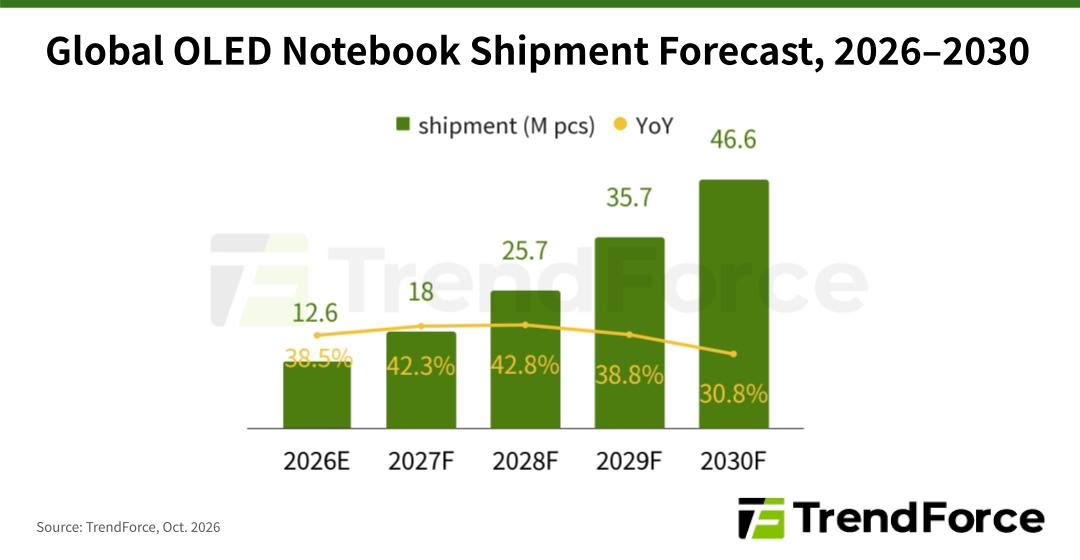
Even when the global laptop market is projected to shrink for two consecutive years, TrendForce sees OLED laptop shipments continuing to grow. Apple's transition would increase OLED panel demand and push supply-chain investment in higher resolution, lower power use, and greater brightness.
Samsung Display gets the first manufacturing advantage
Samsung Display is the exclusive OLED panel supplier for the current MacBook Pro. The first phase of its A6 project, a sixth-generation-and-above large-size OLED line at the Asan campus in South Korea, has been designated for Apple production. The laptop is strategically important because it is the first mass-produced product on Samsung Display's G8.6 fine metal mask OLED line. Apple's decision also highlights Samsung's advanced manufacturing strength and consolidates its competitive position in premium OLED panels.
High PPI and stacked OLED raise production barriers
The MacBook Pro's tandem OLED structure reaches 254 pixels per inch. Stacking emissive layers can improve the balance among brightness, power efficiency, and panel lifetime, but the process is harder to control and increases pressure on material cost, yield, and precision.
Rival panel makers aim at the later MacBook Air
Other suppliers are trying to qualify for related OLED products, yet Apple's exacting specifications and Samsung Display's established supply lead create a steep entry barrier. LG Display, BOE, and TCL China Star (TCL CSOT) are therefore concentrating more effort on winning future OLED MacBook Air orders, with the product expected in 2029.
Supplier competition will hinge on volume economics
As Apple expands OLED across its notebook portfolio, competition among display makers is likely to intensify. The firms that can combine cost control, yield, image performance, and reliable large-scale delivery are better placed to capture orders from leading laptop brands. OLED may not fully replace LCD soon, but capacity growth and technology maturity can lift its share of the laptop market.