
ItInsightsWorld: Apple’s M4 iPad Pro Memory Debate — Why Locked 12GB Silicon Hurts AI Access
During the AI wave, Apple’s read on future platforms has not always felt convincing; but when it comes to spec cuts, tier pricing and budget control, the company has acted as if it has been connected to a world model. Now, the part being trimmed may be memory already soldered inside a machine.
Recently, Apple became a target again for online complaints, especially from owners who bought the M4 iPad Pro two years ago.

One commenter even used the word inhumane. How did a memory tier become this uncomfortable?
Why an Old Milk-Pouring-Into-River Analogy Went Viral Again
The discussion began with a post on X that passed two million views. Just recently, account @mylifcc accused Apple’s precise knife work of reaching an inhumane level.
The target was the 2024 M4 iPad Pro. Although the machine appeared to carry memory packages with a combined rated capacity of 12GB, the operating system gave users only 8GB of usable memory.
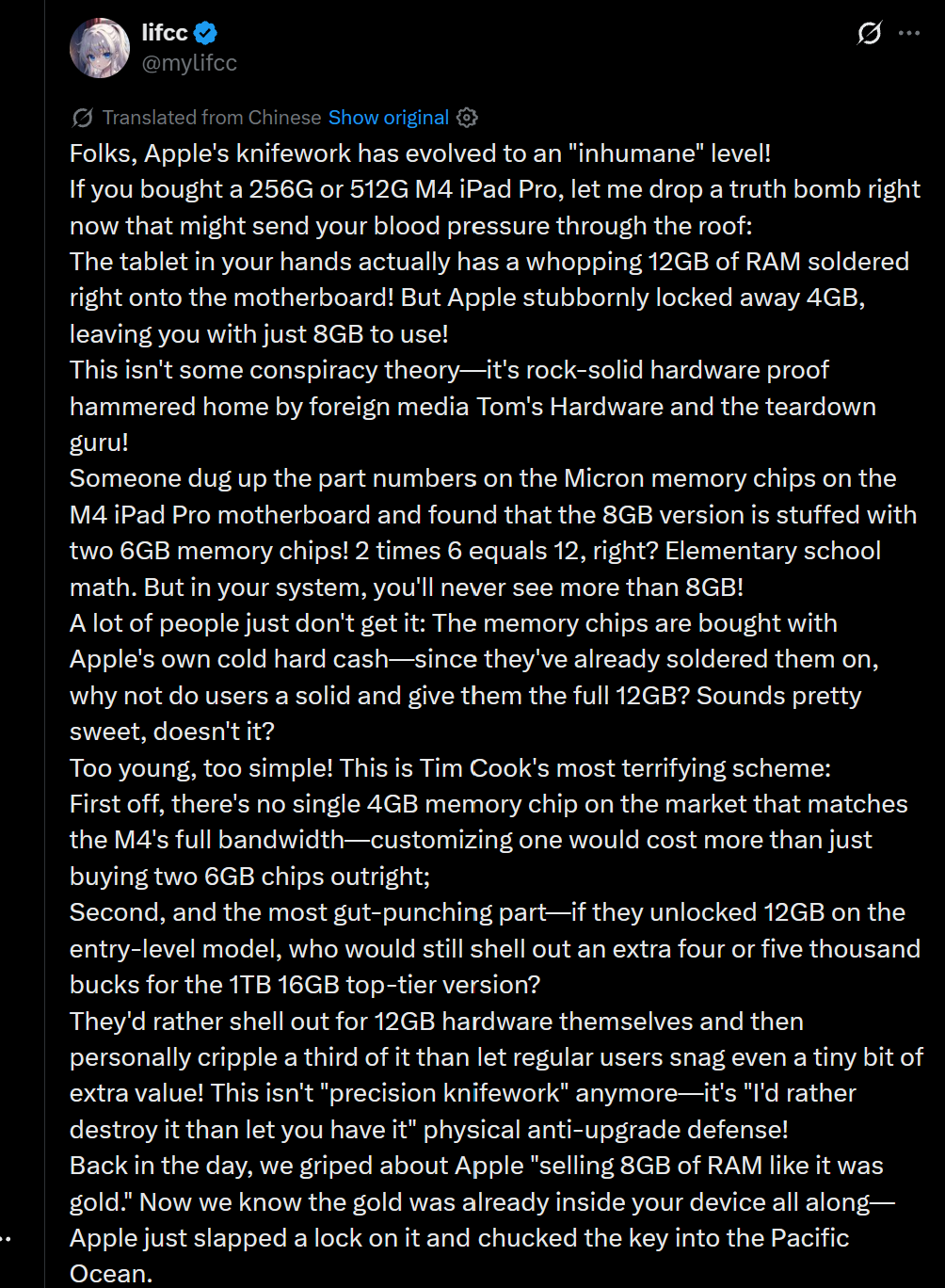
The money had effectively been spent, and the packages were already on the board, yet Apple left 4GB unused. Why?
The account’s answer was that this protected premium headroom: 8GB on the base tier and 16GB on the higher tier, with any upgrade costing more. If the base tier were unlocked to 12GB, fewer users would pay for the 4GB difference. The company would rather use more hardware than give base-model owners a free gain.
A reader asked: “Isn’t this just the tech version of pouring milk into the river?”

The origin goes back two years. In May 2024, Apple launched the M4 iPad Pro. The 256GB and 512GB versions came with 8GB of unified memory, while 16GB required moving to 1TB or 2TB, a classic example of Apple’s precise knife work.
Not long after the new model launched, MacRumors forum user layerstack spotted something in teardown photos: some 8GB M4 iPad Pro boards used two Micron memory packages marked Z8DMS.
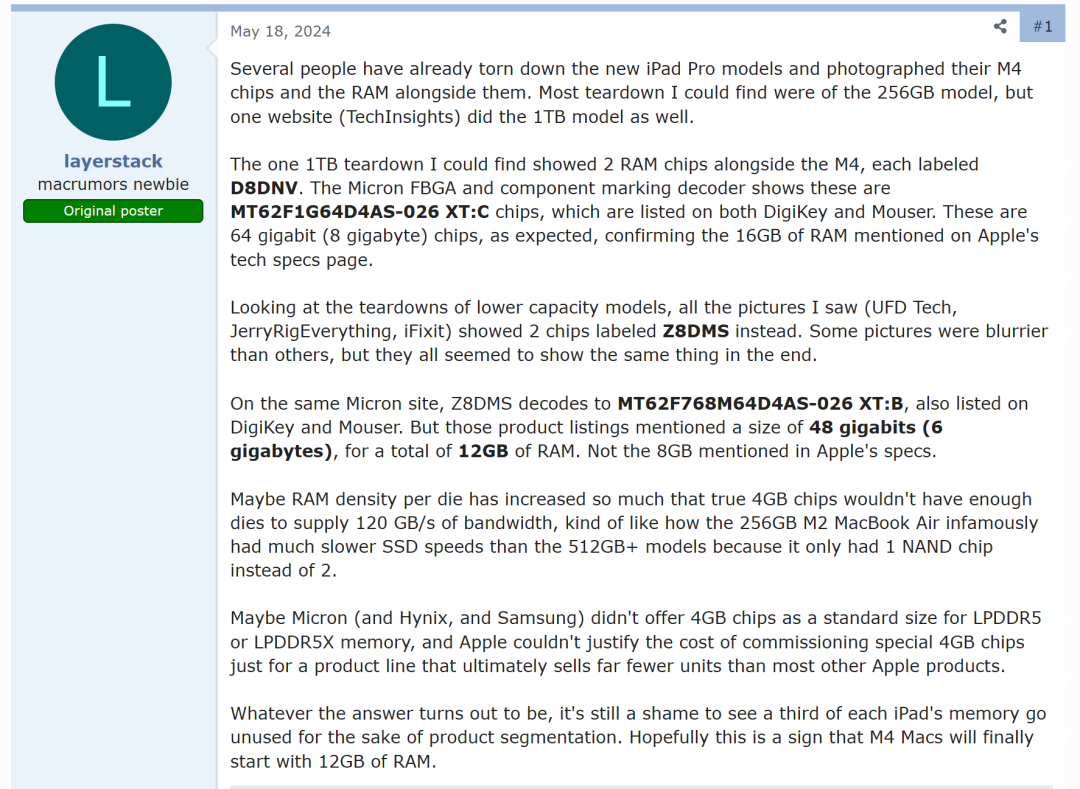
Looking up the part number, those packages were rated at 48Gbit each. Converted, each package provided 6GB, and two together equaled 12GB. The official figure was 8GB, but the physical packages totaled 12GB.
The higher configuration also drew attention. The 1TB version used two other 8GB memory packages, totaling 16GB, matching Apple’s official label. The 16GB tier was openly supplied, while the lower tier had 4GB of package capacity missing from usable memory.
The finding attracted tech media. On May 20, 2024, Tom’s Hardware published an article examining whether the 8GB M4 iPad Pro actually carried 12GB of memory.
What Was Apple Really Trying to Do?
So what was the point of installing 12GB packages and then limiting the result to 8GB?
One possible explanation was supply chain and cost. The M4 chip had certain memory bandwidth requirements, and off-the-shelf 6GB packages may have been cheaper or easier to source than 4GB packages.
Another reading was product tiering. The gap from 8GB to 16GB was a full step, and upgrading memory also forced users into at least 1TB of storage. If the lower tier got 12GB, the gap would shrink to 4GB and reduce the incentive to buy higher-tier models.
That was the @mylifcc complaint: to maintain tiers, Apple would leave working hardware capacity idle rather than let owners use it.
What Has Not Been Verified?
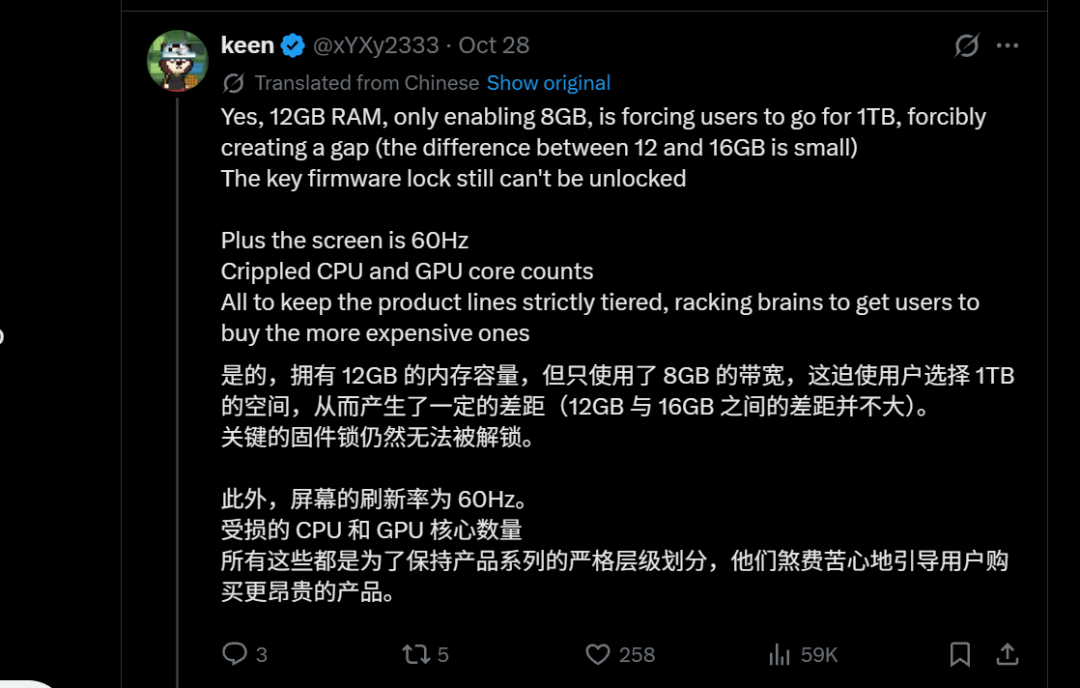
Currently, teardown photos and package numbers support only one claim: some M4 iPad Pro units used memory packages whose rated capacity totaled 12GB. Whether the extra 4GB can be enabled, whether Apple deliberately imposed a software limit, and what commercial motive lay behind it have not been proven with firm evidence.
But one practical fact was clear: those M4 iPad Pro users got 8GB of memory. And that missing 4GB ran into Apple’s newer AI requirements two years later.
A Delayed Cost of the Same Tiering
In June this year, Apple announced iPadOS 27 at WWDC and introduced the next-generation Siri AI. Although the mainland Siri AI version was repeatedly delayed, hardware requirements for some overseas features had already been published. Among them, more natural Siri voice and higher-precision on-device dictation added a new iPad bar: an M4 or newer chip plus at least 12GB unified memory.
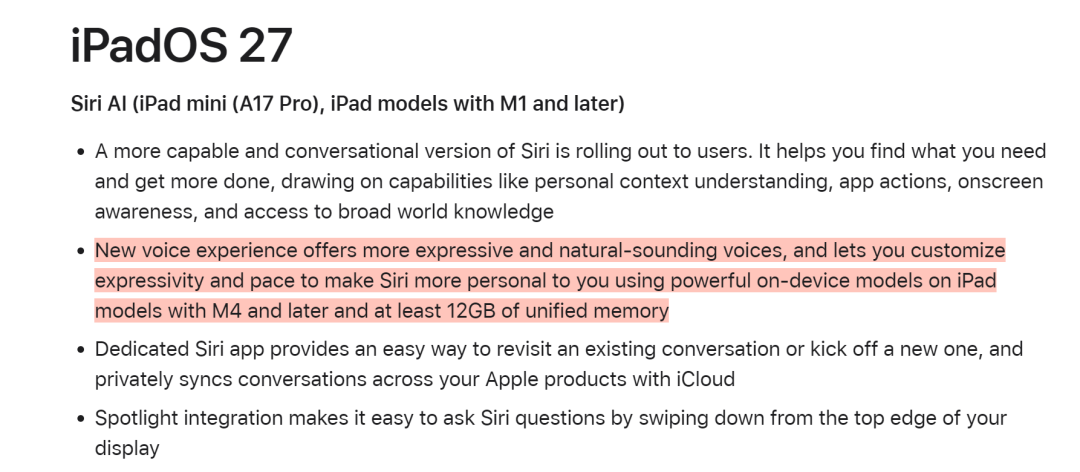
Owners of lower-tier M4 iPad Pro machines found themselves caught: the M4 chip was eligible, but the usable 8GB was not. The processor was still capable, yet 4GB of memory kept them outside the door.
The coincidence was sharper because the earlier teardown estimate had pointed to 12GB of package capacity, exactly 4GB above what the system made usable.
Still, the scope should be precise: the 8GB model still supported many Apple Intelligence features. The restriction mainly affected the more advanced subset. At present, there is also no proof that opening the suspected extra capacity would let those AI features run.
For owners who paid a premium for Pro, that restriction still stung. Who imagined that a few gigabytes visible only in teardown images two years ago would later decide eligibility for new features?
A More Frustrating Comparison Followed
Now, even the lower-positioned iPad Air line has moved to 12GB. In March this year, Apple introduced a new M4 iPad Air, raising unified memory from 8GB to 12GB, a 50% increase. The 11-inch version still started at $599. Apple explicitly noted that 12GB unified memory and 120GB/s memory bandwidth helped devices run AI models faster.
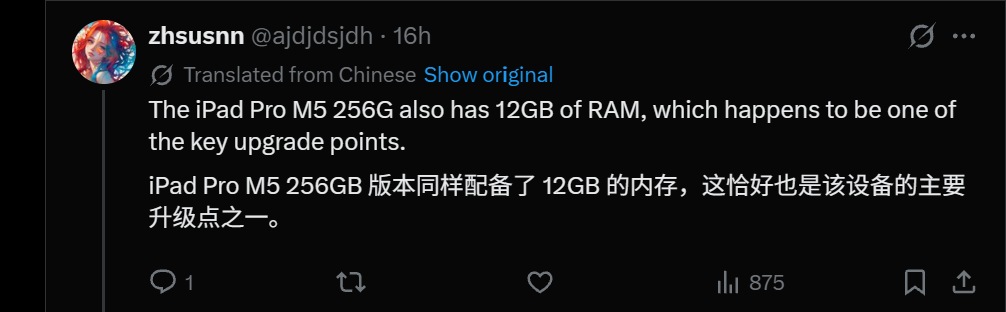
At the same time, the 2025 M5 iPad Pro had also lifted the 256GB and 512GB tiers to 12GB of unified memory.
The comparison made older buyers feel worse. A higher-positioned, more expensive M4 iPad Pro from two years ago now trailed a newer, cheaper M4 iPad Air on some AI feature support. They share the same chip generation. The old Pro still had stronger display, ports and other attributes, but this AI threshold meant the Pro badge did not help.
Memory Is Becoming an AI Passport
In the past, complaints about stingy Apple memory concerned app backgrounding, heavy software or multitasking. In the AI era, memory no longer affects only speed; it can decide whether a device can access the latest on-device AI capabilities. iPad unified memory cannot be upgraded by users. If someone bought 8GB, the machine remains 8GB. Future eligibility depends on where Apple draws the next line.
The result: Apple still knows how to price possibility.
One More Thing
Textbooks once described the Great Depression era, when producers would rather pour milk into the river than lower prices. At the time, it seemed absurd, and absurd even with a known economic logic. Looking at Apple’s memory practice now brings a familiar feeling.
As the X post joked: back in the day, we complained that Apple sold 8GB memory like gold. Now it seems the gold was already inside the device; Apple simply locked it and threw the key into the Pacific Ocean.