
ItInsightsWorld Outlook: Apple iPhone Duo Could Ship 5 Million Units in First Year, Equal to Nearly 25% Foldable Output
Apple's first foldable iPhone is already turning into an early supply and durability question, not just a product launch story: less than a week after iPhone Duo pre-orders opened, parts of the official order queue have slipped to January 2027. The analysis released yesterday by TrendForce says buyers value the open-screen split-view and visual quality, yet black edges in some apps, button placement and fingerprint unlocking still add adjustment costs.
Shipment math: a new entrant in a nearly flat foldable market
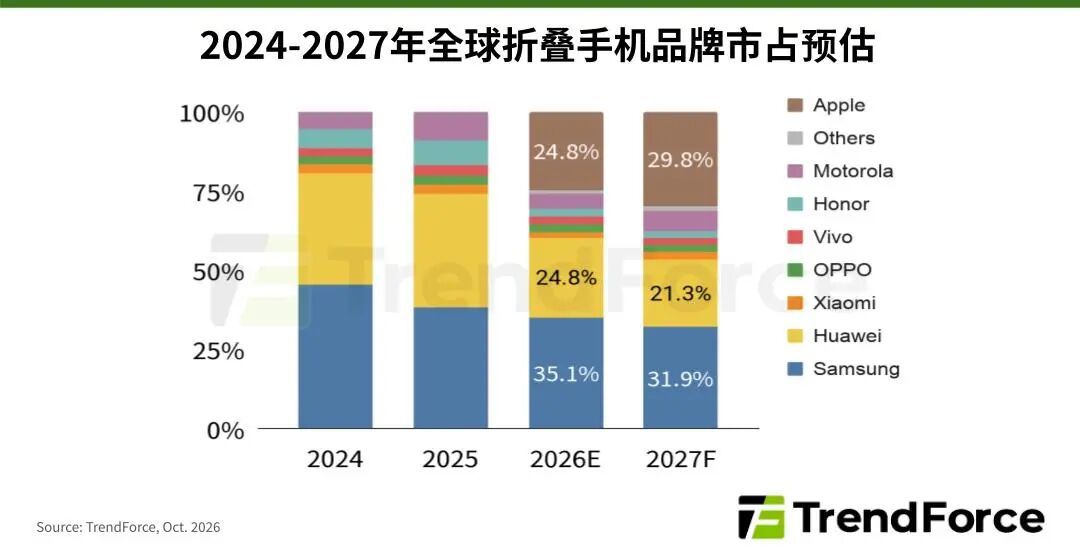
TrendForce expects global foldable smartphone shipments to grow only 0.5% in 2026. In that near-flat context, Apple's first foldable iPhone is forecast to ship 5 million units in its first year. The same estimate puts the volume at about 5 million units, equivalent to nearly 25% of worldwide foldable-phone shipments, and gives Apple roughly a 24.8% market share during the first year on the market. Because the overall pool is not expanding much, the iPhone Duo's arrival is likely to redistribute share among brands rather than enlarge the category.
Hardware concerns: hinge design, screen stress and replacements
Screen damage reports and expensive repair quotes are directing attention toward reliability and total ownership cost. The lower visible crease attributed to multilayer material stress control and nano-textured optical optimization. The waterdrop-style hinge is central to dynamic control; if central support does not recede enough, local extra contact and stress concentration may occur, a conclusion also raised by recent teardown analysis. Apple has reportedly offered replacement devices for a small number of units with abnormal inner-screen issues. Later engineering improvements are expected to focus on coordinated control of hinge travel, support height, lamination precision and assembly tolerance.
Software and power: the foldable battle shifts to efficiency
On software, some apps still display black edges and underuse available screen area, so the hardware advantage is not fully realized. The larger display also raises power-management demands, requiring efficient emissive materials and adaptive driving to balance multitasking, AI computation and battery life. TrendForce believes Apple's biggest advantage is its ability to integrate chips, system software and the developer ecosystem. As app adaptation and hardware reliability improve, foldable competition is expected to move from external-form innovation to core multitasking processing efficiency.