
ItInsights World: Anthropic Files for IPO as $518 Billion in Compute Pledges and Falling Model Prices Set the AI Agenda
What a first-time public filing exposes
Compute is no longer a private line item buried on a startup's balance sheet. On October 26, Anthropic reportedly submitted IPO documents to U.S. securities regulators, and with them came the first detailed public look at what a frontier-model business actually consumes — a figure large enough to make an entire market pause.
The company that rode Claude and a suite of developer-facing coding tools into the enterprise AI segment now stands in front of the capital markets. Data disclosed by Reuters shows revenue of $4.59 billion in 2025, climbing to $16.29 billion in the first half of 2026.
The same documents expose the other face of that growth: a net loss of $80.7 billion in the first half of 2026. About $72.4 billion of it came from fair-value changes on convertible notes and reflected no cash leaving the company; the genuine operating loss was roughly $693 million.
What investors find hardest to relax about sits in the forward-looking section — commitments to purchase at least $518 billion of computing capacity over the next ten years, with approximately 80% of that either non-cancelable or payable regardless of usage. This IPO is intended to raise $100 billion, on top of the $150 billion Anthropic has collected in total since its founding.
U.S. equity markets already carry deep unease about artificial-intelligence infrastructure outlays, and Anthropic's listing touches exactly that nerve. Industry practitioners describe the debut as consequential well beyond one company: if it goes badly, the whole market gets dragged down with it.
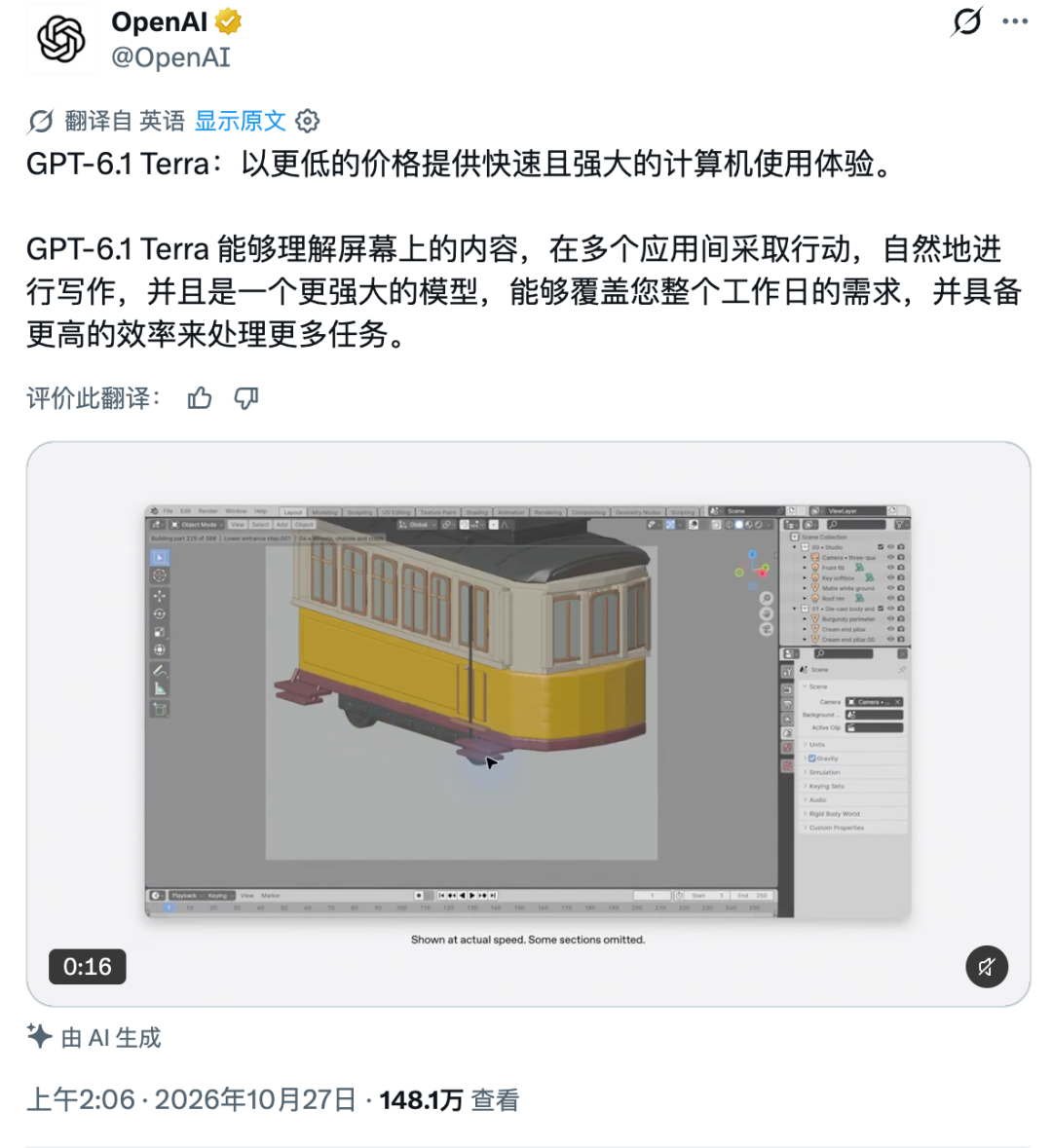
The competitive backdrop shifted in the same week. OpenAI, which once trailed Anthropic's route, has been repositioning toward low-price models, and on October 26 unveiled GPT-6.1 Terra, a new-generation mid-tier model whose headline pitches are a lower calling price and computer-operation capability.
Across the Pacific, DeepSeek, long the standard-bearer of cost-performance, kept raising the size of its current round. The latest report is that new funding exceeded 100 billion yuan, and the company has stepped firmly onto an expansion path. Several people with direct knowledge told iFeng Technology that DeepSeek's team build-out has been intense, adding that "the money you raise eventually has to be spent somewhere reasonable" — and the more capital arrives, the more obligations DeepSeek takes on.
Read as one picture, the three moves describe an AI contest that has never been tighter.
Three roadmaps, one arithmetic problem
| Player | Entry route | The underlying cost bet |
|---|---|---|
| Anthropic | Enterprise services and coding workflows sold through API calls and subscriptions | High-value customers will pay enough to absorb a ten-year compute commitment of at least $518 billion |
| DeepSeek | Cost-performance, now paired with open source | Architecture, training method and inference efficiency can cut unit cost without stacking parameters |
| OpenAI | Capability-first, increasingly price-first | Lower API prices plus free-tier distribution hold volume while losses and rival revenue growth bite |
The Anthropic template: fast revenue, heavier resource bills
Within the global AI industry, Anthropic remains the most useful reference case.
Unlike products that lean on consumer traffic, it cut in through programming and enterprise services and assembled its commercial path step by step. Claude accumulated users among developers, while enterprise customers bought model capability through API calls and paid subscriptions. The model stopped being a chat window and became a production tool inside software development, knowledge processing and business processes.
The appeal of that road is blunt: companies will pay for tools that lift productivity, and high-value scenarios usually carry a clearer payment logic than ordinary consumer applications.
In coding particularly, an AI model's value is no longer measured by whether an answer sounds right, but by whether it can write code, debug, test and execute complex tasks. For an enterprise, if a model shortens development cycles and removes repetitive labor, the case for paying becomes concrete.
One AI-sector CEO, speaking to iFeng Technology, called Anthropic a key sample of the AI business model: "When people first discovered that AI coding has very strong commercial conversion, that too came earliest from Anthropic. Now Anthropic has started on AI drug discovery, and in the future there will certainly be followers."
The quality of revenue, however, is not the quality of profit.
Where the money goes
Reuters' reading of the prospectus puts Anthropic's operating loss at about $8.06 billion for 2025 and about $693 million for the first half of 2026. Over the same stretch, computing and infrastructure spending approached $9 billion, a sharp increase from roughly $2.3 billion a year earlier.
Business expansion is real; so is the resource cost that props it up.

No token a model company sells appears out of thin air. Training needs compute, inference needs compute, and as user counts grow and tasks become more complex, the consumption of computing resources keeps climbing. Once AI moves beyond simple question-and-answer into coding agents and complex task execution, a single job may demand more rounds of reasoning, more tool calls and repeated verification, and the cost structure behind it changes accordingly.
Enterprise willingness to pay does not mean the trade carries a fat margin by default. If revenue growth must be continually bought with additional compute, then scale and profitability may not sit in a simple positive relationship at all.
There is a second layer of pressure: long-dated procurement. Reuters reported that Anthropic has signed cloud-service, computing and infrastructure agreements of enormous scale with multiple partners, with related commitments above $500 billion over the next ten years.
Anthropic's operations are hardly stagnant — revenue growth and a widening enterprise base prove that the market is paying for its model capability. What outsiders cannot settle is the business model itself: as capability keeps advancing, can inference cost fall in step? And as more work is handed to AI, will the prices customers accept cover models, compute and service delivery in full?
With every kind of "chain leader" behind it: DeepSeek's other road
If Anthropic represents entering through high-value scenarios and gradually building commercial revenue, the second lesson DeepSeek delivers to the industry is that cost itself can be part of a model's competitiveness.
One reason DeepSeek first shook the industry was that it forced a reassessment of what it costs to train and to use large models. Outside attention once sat on benchmark performance and on disclosed training cost. For commercialization, though, what matters more than any single training number is whether low cost extends into deployment, inference and actual use.
OpenRouter data shows how far that has travelled on the demand side:
- DeepSeek's models have ranked first on the platform's weekly call-volume chart for three consecutive weeks.
- MiniMax, Zhipu and Tencent models have also long held places inside the platform's top 5 by volume.
That route points to a direction worth studying: model capability is not reachable only by adding parameters and piling on compute. Architecture design, training method, inference efficiency and resource scheduling can all move the final unit cost.
More important, low cost changes the way a model enters its market, and two strikingly different development ideas now stand side by side.
- Restriction: the U.S. Department of Homeland Security recently ordered federal agencies to remove DeepSeek products and third-party services built on its models.
- Expansion: almost simultaneously, DeepSeek announced it would fully open-source its internal inference framework DeepInfer, compatible with the two major compute platforms, Nvidia and Huawei Ascend.
Behind the dramatic contrast is a single fact: DeepSeek has been placed at the front of global AI competition, and the way it responds is not contraction but spreading the technology base wider.
The round, the roster, the spending problem
Multiple outlets recently reported that DeepSeek is close to completing a round of about 100 billion RMB. The target has been "chased upward" repeatedly since September: originally planned at 50 billion, revised mid-way to 80 billion, and finally landing at 100 billion. Add the first tranche of about 51 billion RMB in June, and DeepSeek has absorbed roughly 150 billion RMB within half a year, while its pre-money valuation has held at 500 billion RMB.
According to a tally by the self-media account Tides of Money, more than 20 investment institutions joined the round.
| Role in the round | Institutions named |
|---|---|
| Returning shareholders from the previous round | IDG Capital, Shixiang Technology, Zhengxin Valley Capital, Monolith, CATL, Tencent and Guozhitou |
| Newcomers | China Mobile, China Telecom, China Life Investment, Shixi Capital under GigaDevice, Zhongxin Juyuan, Boyu Capital, CPE Yuanfeng, Gaorong Capital, Legend Capital, CITIC Investment, Meituan Longzhu, Hengdian Capital and Geely Capital |
| Indirect participation by listed companies and industrial capital | Muyuan Foods, Zhihu, Century Huatong, Perfect World, Giant Network, Dahua Technology and others too numerous to list one by one |
The pattern is easy to read: in choosing investors, Liang Wenfeng weighs industrial value above all — the CATL camp with its solid energy reserves, and the GigaDevice camp, tightly bound to domestic memory chips.
Facing that much capital, DeepSeek has run into the trouble of "spending" it. A person close to the company told iFeng Technology that DeepSeek is drawing up a fresh growth roadmap for investors, and that it includes a large expansion of the team.
- June 25 — barely settled after the first round of about 51 billion RMB closed in June, DeepSeek posted a recruitment notice explicitly stating it would "expand the size of all departments by at least one-fold", opening 33 positions at once across seven job families: technical research and development, compute infrastructure, product deployment, frontier algorithm research and general functions. Data-center construction roles in Ulanqab were on the list too.
- September — Cui Tianyi, head of the DeepSeek Harness team, released about 150 hiring slots in a single social-media post; in his words, the demand is "unprecedented".
- Benefits — word is that DeepSeek offered an intern from Tsinghua University's Yao Class pre-tax pay of 5,500 yuan a day, with monthly income above 120,000 yuan, while the campus-hire core systems engineer role sits in a monthly range of 60,000 to 90,000 yuan.
Liang Wenfeng himself, by contrast, stays plain and low-profile. A person close to DeepSeek told iFeng Technology that the company's offices are mainly in Beijing and Hangzhou, while Liang has long rented an apartment in Beijing and the room's furnishings have always been very simple.
Cost-performance starts to steer everything
Among the AI giants, OpenAI has consistently been the one that wavers.
- It began by chasing the ceiling of model intelligence, then wanted the consumer market, and even imagined building "the WeChat of the AI era" that connects everything.
- Confronted by enormous losses and revenue growth being overtaken elsewhere, it took lessons from Anthropic and stormed the AI coding field, hunting better commercial conversion.
- Today its conduct looks more and more like DeepSeek's.
On September 23 this year, GPT-6 Sol and Luna shipped at the same time, and Luna's API input price was knocked down to $0.1 per million token — a floor price.
Half a month later, on October 7, OpenAI pushed Luna straight to free users, covering the entire ChatGPT population: paying users receive Sol, free users receive Luna.
GPT-6.1 Terra, released on October 26, sits in OpenAI's mid-tier model line and leans on computer operation and everyday office tasks. Its standard API price is 50% below the previous generation, GPT-5.6 Terra, and OpenAI further claims that in some task tests Terra can finish work at a cost far below the flagship model.
Not everyone is convinced the swinging has stopped. One industry practitioner argued that "OpenAI is still in its vacillation phase — you can tell from the fact that it is also building embodied-intelligence models. Compared with Anthropic, OpenAI wavers far more often, but it will be educated by the market quickly and go do a business that makes money."
Large-model competition is visibly brutal: a vendor that cannot keep building an edge on its core business will be a flash in the pan.
What ItInsights World takes from the week
Set the filings, the funding rounds and the price cuts side by side and a single theme emerges: capability, cost and balance-sheet endurance are now judged together rather than one after another. Anthropic's prospectus puts the industry's resource bill under a spotlight, DeepSeek's capital and hiring push shows how efficiency can be converted into reach, and OpenAI's successive price reductions show how quickly a premium posture can give way to a value one. For anyone choosing vendors this quarter, the practical question is the same one the market is asking — whether what a customer pays can ultimately cover the model, the compute and the delivery behind it.