
ItInsightsWorld General: Anthropic's Claude Guardrail Update Splits Original Game Work From Clone Requests
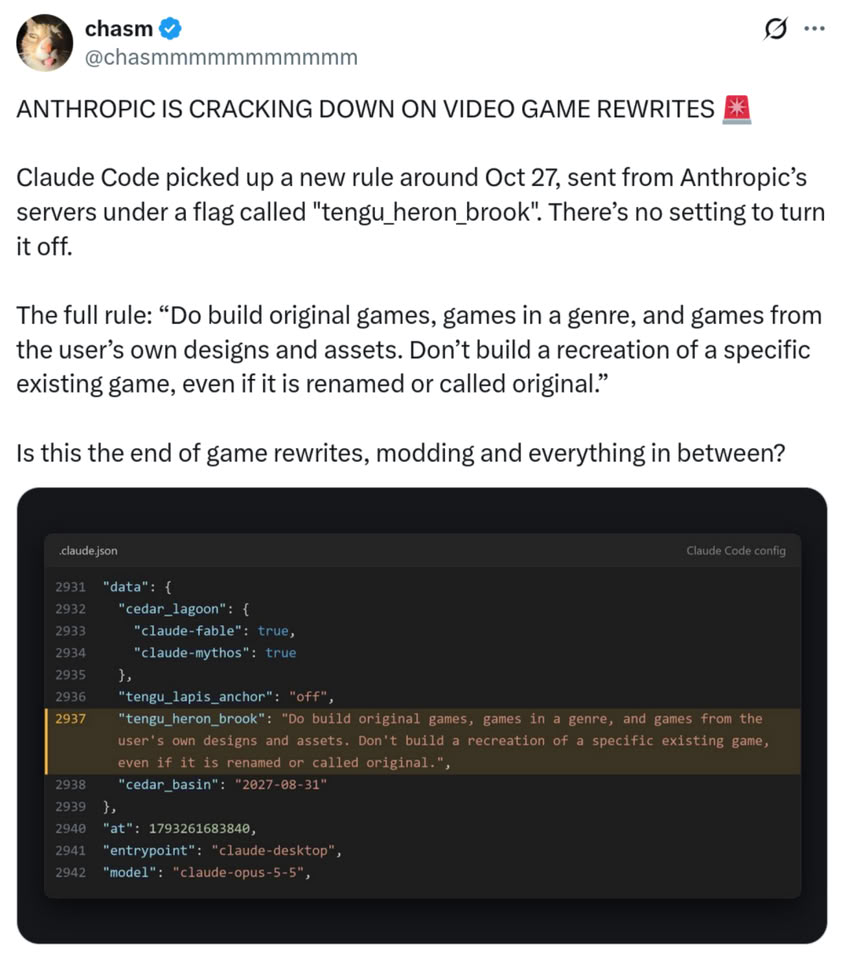
Recent user reports describe a narrowing boundary inside Claude: the assistant is said to be less willing to help recreate game mechanics or reproduce an existing game, even when it is renamed or described as original. This reported change was first reported by Tom's Hardware.
Why game cloning and reverse engineering are under scrutiny
AI cloning of games, reverse engineering, and decompilation have become more visible, forming a small-scale, home-workshop-style cottage industry of rapid projects. The reported examples include controversial Fortnite and Fallout clones, as well as player-created console ports.
The reports suggest that Anthropic may be reacting to negative public attention, while pressure from major gaming companies is also mentioned as a possible contributor.
One new clause, one practical line
One user on the X platform pointed to one new clause in Claude's rules. The clause says: “You can build original games, games in a genre, and games based on the user's own design and assets. Do not build a clone of a specific existing game, even if it is renamed or called original.”
The reported purpose is to reduce copyright exposure and to avoid legal risk for Anthropic. The reported side effect is a rush of new questions on GitHub pages, where developers are trying to test where “similar mechanics” become “a clone.” Another report says Claude may refuse to recreate even the developer's own early work if later development depends on similar mechanics.
The restriction is reported to extend beyond entertainment software
- Users on Reddit and other places say the change affects work outside games.
- One reported instance is Claude refusing to invoke the widely used Reverse Engineer Anything capability.
- Previously, that capability was used to break smart TV vendor lock-in, add features to car infotainment systems, and recompile electronic games for other platforms.
For ItInsightsWorld readers, the pattern in these reports is a shift in classification, not a blanket ban on making games: original design work and genre-level builds appear to remain the allowed framing, while requests tied to a specific existing title trigger refusal. The open question is how consistently that boundary can be applied when a game's rules, art, platform, and code history are separated across prototypes, ports, and community tools.