
ItInsightsWorld General Review: Comparing the AMD, IBM and ORNL Error-Correction Platform
This platform should be read as a comparison lab for hybrid quantum computing, not as a finished product. IBM contributes the 120-qubit IBM Quantum Nighthawk, ORNL contributes the Umbra HPC system, and AMD contributes the classical stack—AMD EPYC CPUs, AMD Instinct GPUs, AMD Versal adaptive SoCs and AMD ROCm—that error correction needs to control, decode, and orchestrate a real scientific workflow.
The launch, announced on 2026-11-05, is useful less because of individual chips than because it creates a measurable environment. Researchers can see which combination of quantum processor, classical accelerator, low-latency controller, and open software layer actually reduces the cost of error correction. That makes the partnership easy to compare with simpler cloud-access models: it is not merely remote quantum time, but a shared test bench for the plumbing that keeps quantum systems scientific.
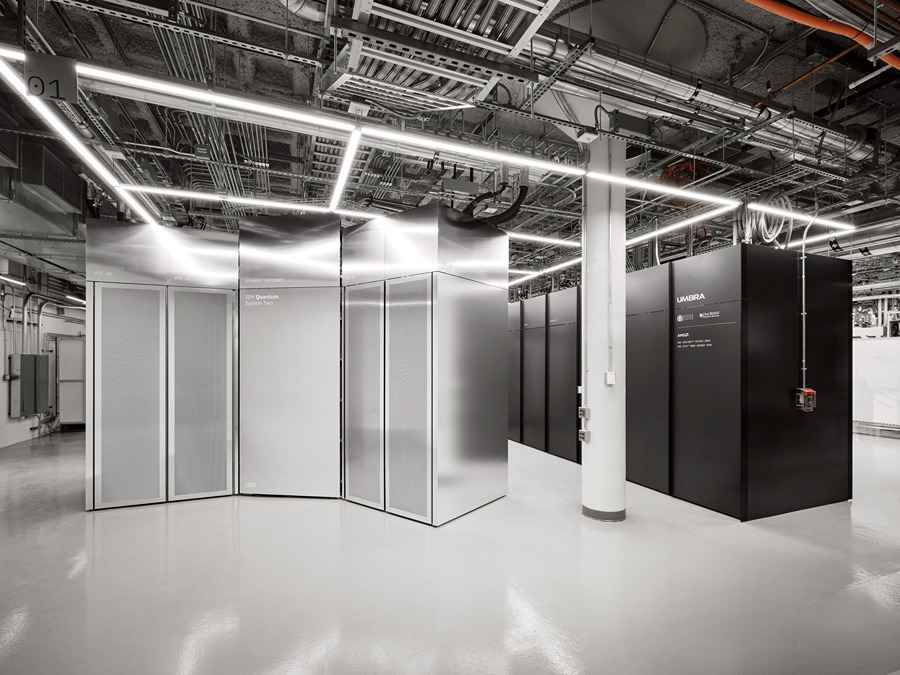 A new codesign platform for quantum error correction from IBM, Oak Ridge National Laboratory (ORNL) and AMD colocates IBM quantum computers with ORNL’s Umbra High-Performance Computing system, shown to the right, nearest black rack. Umbra is composed of AMD Instinct MI355X GPUs and 5th Gen AMD EPYC CPUs. (Credit: IBM)
What kind of comparison is the AMD, IBM and ORNL platform?
It is a co-design comparison: the three parties are testing whether quantum processing and classical high-performance computing can be planned together from the beginning. The platform involves the Quantum Science Center at Oak Ridge National Laboratory (ORNL), IBM quantum computers, and AMD’s classical computing technologies. That structure matters because error correction is not a single device feature; it is a chain of readout, decoding, feedback, scheduling, and simulation.
IBM Fellow and Director of IBM Research Jay Gambetta frames the shift bluntly in IBM’s announcement: “The question is no longer if error correction will work on quantum hardware.” The practical question, he says, becomes how to accelerate and optimize it. That quote is a good reader shortcut: the partnership is not a promise of immediate quantum supremacy, but an engineering race to make quantum computation reliable enough for real problems.
How do IBM, ORNL and AMD divide the evaluation work?
| Evaluation dimension | IBM | ORNL | AMD |
|---|---|---|---|
| What each party supplies | Quantum processors, including the 120-qubit IBM Quantum Nighthawk | Scientific research environment and the Umbra HPC system | Classical CPUs, GPUs, adaptive SoCs, and open software |
| What the platform tests | How quantum code and measurement patterns behave on current hardware | Whether hybrid workflows fit national-lab scientific computing | Whether AMD’s portfolio can keep up with control, decoding and simulation demands |
| Why it matters | Higher connectivity can support error-correction experiments with more flexible coupling | ORNL provides mission-critical scientific use cases | Classical compute decides how much overhead error correction consumes |
| Best-fit reader | Quantum researchers and software teams | HPC scientists and public-sector technology offices | Infrastructure architects choosing CPUs, GPUs, FPGAs, and software stacks |
Where does the classical stack become the bottleneck?
The most underrated insight in the launch is that quantum systems need a very different kind of classical support: not one task, but several timing-critical tasks. Real-time control needs predictable response. Scientific calculation needs parallel throughput. Orchestration needs general-purpose coordination. The platform therefore compares hardware choices by workload.
- AMD EPYC CPUs provide orchestration and general-purpose performance, useful for routing jobs and keeping hybrid systems coherent.
- AMD Instinct GPUs accelerate simulation, optimization, and other parallel scientific computations that sit around the quantum processor.
- AMD Versal adaptive SoCs address low-latency control, readout and decoding near the quantum processor.
- AMD ROCm gives developers a common software route to connect HPC and AI applications with the hardware.
This is also where the public caption detail becomes more than specification noise: the image note says Umbra is composed of AMD Instinct MI355X GPUs and 5th Gen AMD EPYC CPUs. In a comparison article, the meaningful takeaway is not the name of the silicon alone, but that the test bed uses a broad classical architecture, with accelerator, CPU, and adaptive-control layers evaluated together.
What does colocation add beyond a standard testbed?
The first configuration colocates IBM quantum computers with ORNL’s Umbra High-Performance Computing system, as shown in the official image. Colocation is a comparative advantage because error correction depends on timing: if quantum measurement results must travel too far or wait behind scheduling delays, the logical machine may lose its ability to correct in a useful window.
IBM’s own description of the Nighthawk deployment gives another dimension: square-lattice connectivity. For readers comparing processors, this is less a marketing number than a workflow feature. More direct connections can make it easier to define, route, and repeat error-correction experiments, especially when the goal is to test decoding and feedback rather than simply execute one circuit.
How should general readers judge this against other quantum-HPC efforts?
Use four comparison questions rather than one headline metric. First, ask what is physically close: a quantum processor and a decoding layer that merely exist on the same product page are not the same as colocated research hardware. Second, ask what software can be opened and reused; AMD ROCm and partner tooling matter because error-correction research is cross-stack. Third, ask what public mission the work supports; here it is tied to the Department of Energy’s Quantum Genesis Mission and the target of a scientifically relevant quantum computer by 2028. Fourth, ask what classical infrastructure expansion is planned, such as connecting the platform with the Oak Ridge Leadership Computing Facility (OLCF), where ORNL’s Lux SI (Super Intelligence) + HPC supercomputer is also powered by AMD EPYC CPUs and AMD Instinct GPUs.
That fourth question is the one most casual readers miss. The value of the partnership is less a single announcement and more a chain: near-term research on a defined environment, then scale-up into larger OLCF systems. Further details are available through amd.com.
Who should care now, and who should wait?
Researchers and advanced developers
Watch this first if your work needs timing-sensitive decoding, code comparison, or hybrid simulation. The platform’s value is that it puts the questions where the hardware actually sits.
HPC and infrastructure teams
Use it as a benchmark for architecture tradeoffs: CPU orchestration, GPU acceleration, and FPGA-class adaptive control. The best lesson is not to buy a quantum chip and hope for the best; it is to model the classical overhead required to make it usable.
Enterprises and general technology readers
Do not expect a commercial app store yet. This is an evaluation layer for a future stack. The near-term benefit for non-specialists is better literacy: when a quantum result is announced, ask whether it was supported by control, readout, decoding, and simulation infrastructure—not just qubit count.
What are the most common misconceptions?
- It is not a fault-tolerant quantum computer today. It is a test environment designed to move the sector closer to that goal.
- It is not only an IBM quantum story. ORNL and AMD are central because scientific workloads and classical control define the usable scale.
- It is not solved by software alone. Low-latency hardware and orchestration matter as much as error-correction algorithms.
- It is not simply faster computing. The comparison is between reliable, corrected quantum computation and useful overhead.
FAQ: Quick answers for readers evaluating the platform
Is this a product buyers can purchase?
No. The announced collaboration is a shared research and co-design environment, not a turnkey commercial product listed for general customers.
Why does error correction matter more than qubit number?
Because today’s quantum processors are fragile. Error correction is what makes longer calculations credible, and it requires classical computation to measure, decode, and correct errors while the experiment runs.
What is the most useful comparison metric?
Overhead: how much control latency, CPU, GPU, memory movement, and software integration is needed to produce a corrected logical result. Qubit count alone does not answer that.
Does the platform include larger Oak Ridge systems?
Yes. Plans call for connecting it with the Oak Ridge Leadership Computing Facility (OLCF), which also houses the Lux SI (Super Intelligence) + HPC supercomputer.