
Data-Center-First, Gaming Down 40%: How to Read AMD's Record Quarter as a Structural Signal
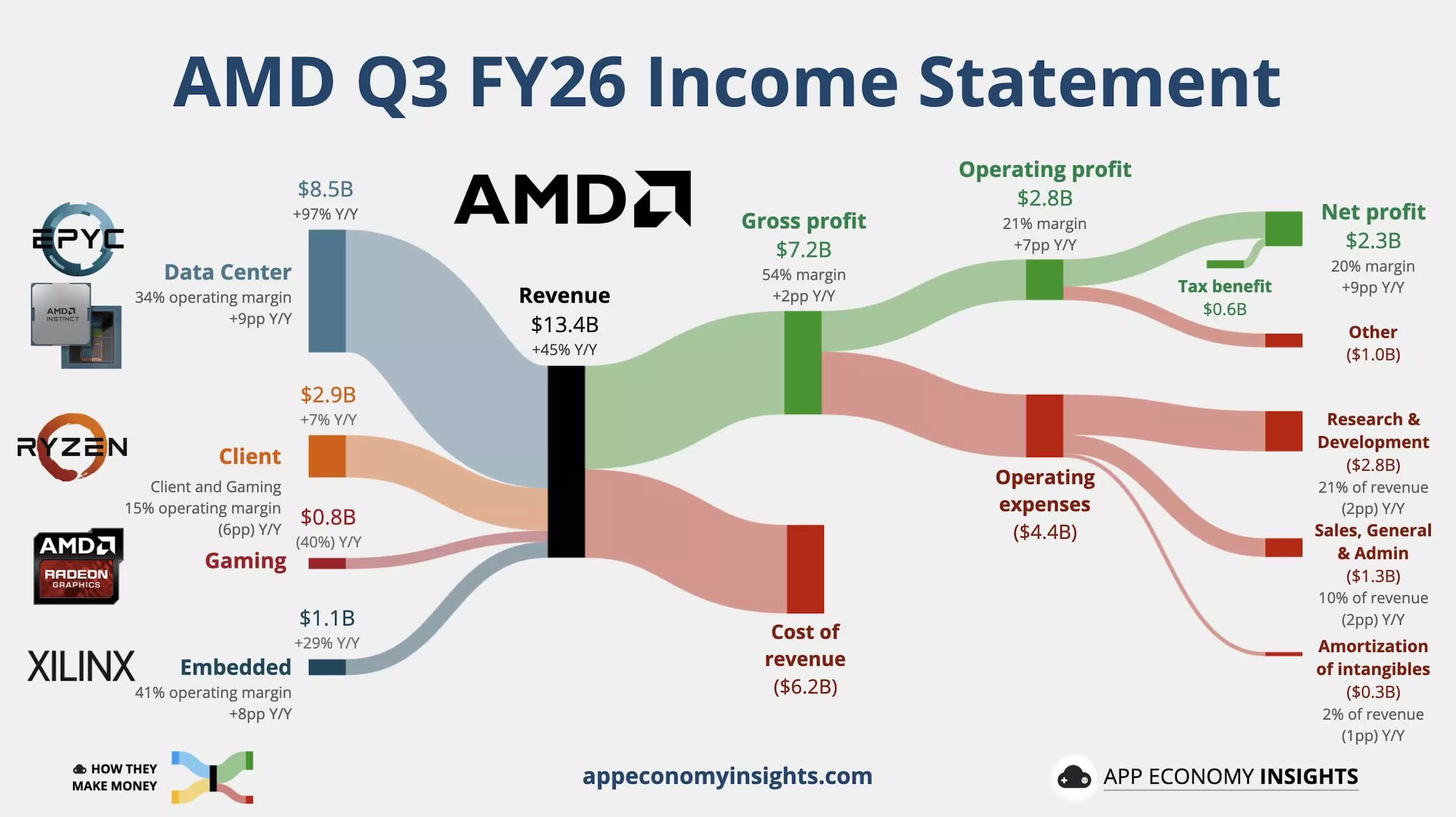
Short answer: AMD's third quarter of 2026 is not a "good sales quarter" story, it is a mix story. Revenue hit a record $13.4 billion, up 97% year on year, while gaming revenue slipped to $773 million, down 40% year on year. Read together, those two numbers say the company's research budget, fab capacity and supply-chain negotiating power now follow the data centre, not the living-room console or the gaming desk.
What does "data-center-first" actually mean?
It means priority order, not product retirement. Chief executive Lisa Su put it plainly in an interview with Yahoo Finance: "We are a data-center-first company, that is our position. People need more computing power to support all kinds of applications."
Historically AMD fought Intel on the desktop with Ryzen and fought Nvidia in the GPU aisle with Radeon. Today the growth engine is elsewhere: Instinct AI accelerators for model training and inference, and EPYC server processors for general-purpose compute in large data centres. Cloud providers and big technology firms keep building AI infrastructure, and those two product lines absorb most of the incremental demand.
The official earnings release gives the financial texture behind the slogan: for the third quarter AMD reported GAAP gross margin of 54%, operating income of $2.8 billion and net income of $2.4 billion. When the data centre is already contributing roughly 63% of total revenue — about $8.5 billion on most tallies — a company does not allocate scarce advanced packaging or memory supply to the segment with the lowest certainty of return.
Why did AMD's gaming revenue fall 40%?
Because demand weakened and costs rose at the same time, and the costs came from AI.
TechSpot noted that the sharp drop in gaming revenue is partly explained by AI data-centre buyers hoovering up memory and other critical components, squeezing consumer hardware supply and pushing graphics card production costs higher. Rising GPU prices then feed back into softer PC gaming demand.
That mechanism is now measurable. In a 30 September 2026 outlook, TrendForce projected conventional DRAM contract prices to rise 10-15% quarter on quarter in the fourth quarter of 2026, with NAND flash contract prices up 15-20%. High-bandwidth memory for AI accelerators competes for the same wafer capacity as the GDDR used on consumer cards, so the pressure does not stop when a quarter closes. Independent industry trackers estimated cumulative contract DRAM inflation of roughly 170% during 2025, with graphics memory following later in 2026 as vendor kit prices moved up.
This is not an AMD-specific failure. It is an allocation problem that hits every maker of low-margin consumer silicon, because consumer graphics cards have little margin headroom in which to absorb an input-cost shock.
How does AMD plan to grow the data-centre business from here?
With an explicit ramp schedule. Su disclosed in the same Yahoo Finance interview that AMD's data-centre business is expected to grow 50% quarter on quarter in the fourth quarter, and that beyond 2027 the company hopes to take that business to more than double its current scale.
The supply side of that plan already exists on paper. At its Advancing AI event on 23 July 2026, AMD launched sixth-generation EPYC CPUs, the Instinct MI400 series of data-centre GPUs and the Helios rack-scale AI system — a full-stack pitch aimed at agentic workloads rather than single chips. Su has described the third quarter as the largest and most profitable in the company's history, with next-generation data-centre products moving toward volume production.
Su also argued that AMD holds enough technical resources and supply-chain expansion capability to meet demand, and that the company wants to be the most important partner for the world's largest buyers of compute. Translated into management practice, that means research, capacity and commercial effort keep concentrating on hyperscale cloud firms and AI infrastructure customers.
On the "is AI spending overdone" question, her answer was about time horizon. Su suggested some investors judge AI infrastructure outlays too much on short-term payback and overlook compute demand growth over the coming years; AMD invests with a three to five year planning window. That view has a macro benchmark: in September 2026 The Wall Street Journal described projected U.S. investment in data centres and AI infrastructure reaching $10.3 trillion between 2025 and 2032, while Goldman Sachs research has argued the debate should be framed around the assumptions behind that build-out rather than demand alone.
How far along is AMD compared with Nvidia?
Both have crossed the same line, but at different points on the road. Nvidia's latest disclosed fiscal second quarter of 2027 data showed data-centre revenue of $89.02 billion, 92.5% of total revenue, and it no longer reports gaming separately, folding that activity into a broader edge-computing category. AMD, by the third quarter's numbers, sits at about 63% data-centre share of revenue and still reports gaming and client products as distinct lines.
| Comparison point | Nvidia (fiscal Q2 2027 disclosures) | AMD (calendar Q3 2026) |
|---|---|---|
| Data-centre weight | $89.02 billion, 92.5% of revenue | About 63% of a record $13.4 billion quarter |
| Consumer gaming treatment | No separate gaming line; grouped under edge computing | Still disclosed separately: $773 million, down 40% year on year |
| Flagship data-centre platform | Rack-scale AI systems for training and inference at cloud scale | Instinct MI400 plus Helios racks and sixth-gen EPYC, launched 23 July 2026 |
| Practical effect for PC buyers | Competitive pressure on consumer value largely gone | Radeon still exists, but allocation follows data-centre priority |
For players, the risk is structural rather than symbolic. Competition between AMD and Nvidia is what historically pushed price-per-frame down in the consumer GPU market, and Radeon has long played the role of offering strong gaming performance at lower prices. If AI accelerators and server CPUs deliver the bigger growth and the better margins, research spend, supply-chain slots and refresh cadence drift away from consumer cards. AMD has not announced any exit from Radeon or any halt to consumer GPU releases; Su's statement was about strategic position, not about ending the consumer business.
Still, the financial data and the management language point the same way: both AMD and Nvidia are turning from PC and gaming hardware suppliers into semiconductor companies built around AI compute infrastructure. For the whole PC industry that marks a change of era. Consumer processors and graphics cards once drove silicon progress; today the capital, the manufacturing capacity and the research effort flow toward AI data centres. Whether Radeon keeps winning enough research and supply-chain resources will depend, increasingly, on its commercial value inside AMD's overall strategy.
Five common misconceptions
- "Data-center-first" means AMD is abandoning gamers. It means resource priority; gaming revenue is still reported, and Radeon still ships.
- A 40% gaming decline proves nobody wants to game. It mostly reflects memory and component cost inflation passed into card prices, plus supply squeezed by AI demand.
- A record quarter means every segment is healthy. Revenue records can coexist with a shrinking consumer business; mix matters more than totals.
- AI growth eventually trickles down to cheaper PCs. In the short run it competes for the same wafers, packaging and memory that consumer hardware needs.
- Higher card prices are simply vendor greed. Input costs for graphics memory moved up across the industry, and consumer margins are the thinnest place to absorb them.
A watch list for the next two quarters
- Whether the disclosed 50% sequential data-centre growth in the fourth quarter materialises, or slips into 2027.
- Whether gaming revenue stabilises above the $773 million level or resets lower.
- Memory contract prices: TrendForce's 10-15% DRAM and 15-20% NAND quarterly ranges are the clearest forward cost signal for consumer cards.
- Gross margin direction — a data-centre mix usually lifts it, and a fall would hint at pricing concessions to secure share.
- Roadmap language: how many quarters ahead AMD commits supply to named AI customers versus retail channels.
Action advice: what different readers should do now
- PC builders and gamers: treat this as a cost-cycle, not a demand-cycle. If your current card is serviceable, waiting does not obviously help while memory contracts keep rising; if you must buy, mid-range and entry models have historically absorbed cost increases less violently than flagships, and more video memory ages better than a small performance bump.
- Small businesses weighing a server or workstation purchase: competitive pressure keeps accelerator and server pricing favourable, but plan capacity on a three to five year horizon rather than today's lowest quote — memory and packaging supply, not sticker price, is the binding constraint.
- General readers following AI economics: separate three questions that get muddled in headlines — is compute demand growing (clear evidence yes), is the financing structure resilient (open debate), and are consumer hardware markets collateral damage (currently, mostly yes).
FAQ: the questions readers actually search
Is AMD stopping making Radeon gaming graphics cards?
No. AMD has made no such announcement. What changed is stated priority: the company describes itself as data-center-first, so consumer GPUs compete for investment against a segment worth about 63% of revenue.
Why is Lisa Su's "three to five years" answer relevant to AI bubble talk?
Because it reframes the debate. If infrastructure is planned on a multi-year horizon, short-term payback metrics will always look unfavourable. The counter-risk is that depreciation and financing, not demand, decide whether the plan holds.
Will graphics card prices come down in 2027?
Nothing in current supply forecasts supports a quick fall. TrendForce still expected double-digit quarterly DRAM and NAND contract increases for late 2026, and AI server demand keeps memory capacity allocated away from consumer parts.
Is Nvidia a better AI company than AMD now?
By disclosure, Nvidia is further along: 92.5% of its revenue is data-centre and gaming is no longer a separate reported line. AMD's position is more mixed, which cuts both ways — less concentration, but also more residual interest in keeping consumer platforms alive.
Does this mean my console or gaming laptop will get pricier?
The same memory and packaging squeeze applies to consoles and laptops, since they draw from the same component pool. Price increases show up first where margins are thinnest, which is why entry-level options tend to disappear before flagships do.
Reference sources
- AMD, "AMD Reports Third Quarter 2026 Financial Results" — https://ir.amd.com/news-events/press-releases/detail/1303/amd-reports-third-quarter-2026-financial-results
- AMD, "AAI 2026: AMD Delivers Full-Stack Compute for the Agentic AI Era" (23 July 2026) — https://ir.amd.com/news-events/press-releases/detail/1294/aai-2026-amd-delivers-full-stack-compute-for-the-agentic-ai-era
- TrendForce, "AI Server Demand Sustains Memory Contract Price Momentum" (30 September 2026) — https://www.trendforce.com/presscenter/news/20260930-13258.html
- The Wall Street Journal, "The AI Build-Out Is Becoming the Biggest Economic Bet in U.S. History" (September 2026) — https://www.wsj.com/economy/the-ai-build-out-is-becoming-the-biggest-economic-bet-in-u-s-history-c60716dd
- Goldman Sachs Insights, "Tracking Trillions: The Assumptions Shaping the Scale of the AI Build-Out" — https://www.goldmansachs.com/insights/articles/tracking-trillions-the-assumptions-shaping-scale-of-the-ai-build-out
- Newegg Insider, "Why Gaming Laptop Prices Are Rising in 2026" — https://www.newegg.com/insider/why-gaming-laptop-prices-are-rising-in-2026-and-why-waiting-will-cost-you/
Written for ItInsightsWorld by James Hartley, IT Insights. For questions about this analysis, reach the editorial team at contact@itinsights.com.