
Alibaba Spins Off Its Chip Unit: What a Confidential September 11, 2026 HKEX Filing Really Signals
On November 10 Alibaba disclosed that its wholly owned chip arm, T-Head (Shanghai) Technology Co., Ltd., had already filed confidentially with The Stock Exchange of Hong Kong Limited on September 11, 2026 for a separate H-share listing, and is expected to remain an Alibaba subsidiary afterwards. The listing itself changes little. The two-month gap between filing and disclosure is the part worth reading carefully.
Most technology leaders I talk to are not short of chip options; they are short of a supplier they can plan against two years out. An internal semiconductor team is a promise. A listed semiconductor company is a contract with public reporting attached. This announcement is the first time Alibaba's silicon team has to become the second kind, and that shift is more interesting than the share sale.
What exactly did Alibaba announce, and what is still open?
Short answer: a confirmed spin-off process, not a completed initial public offering. The Stock Exchange of Hong Kong Limited has told Alibaba it may proceed with the proposed separation, and the application itself is already in.
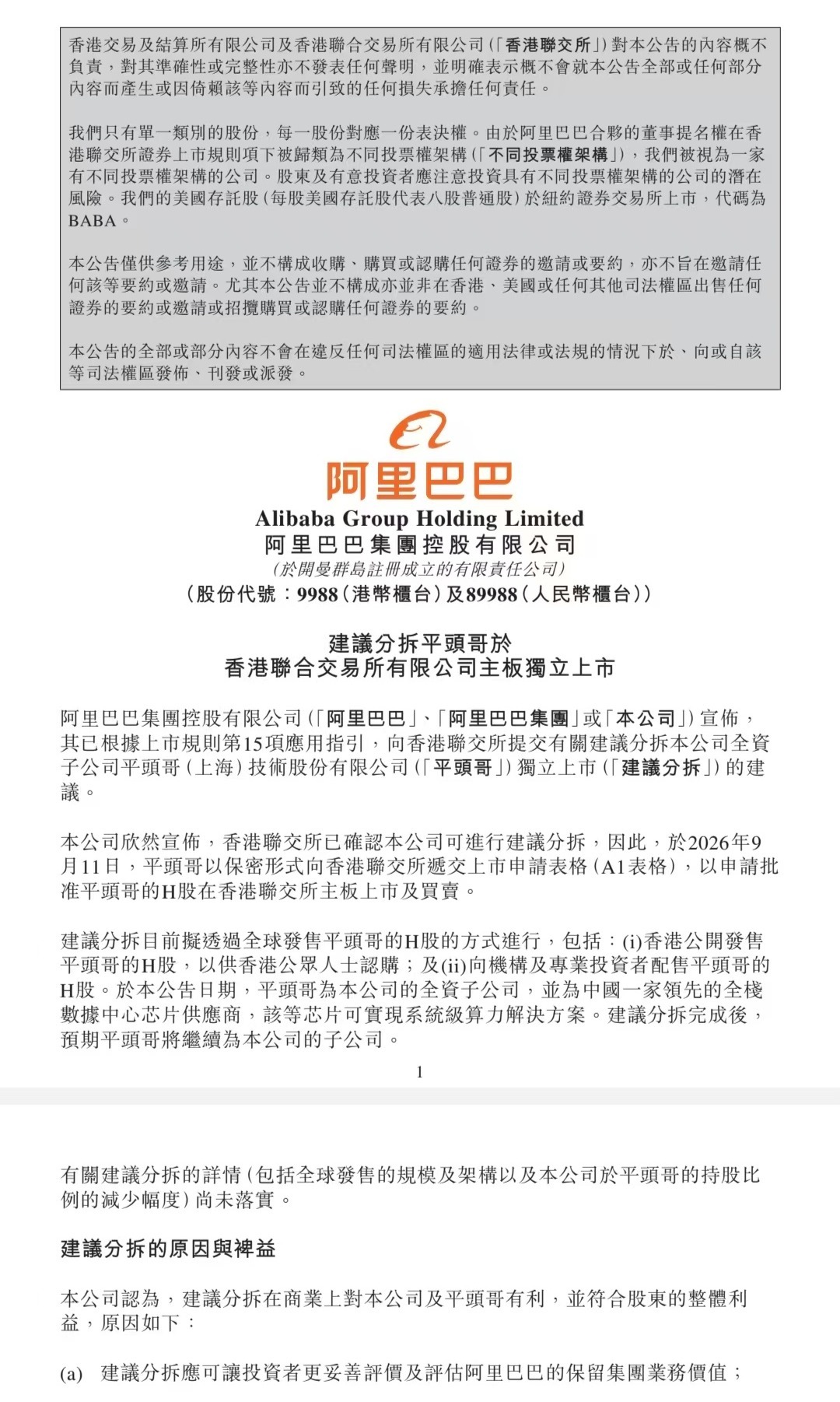
- Filed: T-Head submitted its A1 listing application to the HKEX in confidential form on September 11, 2026, seeking approval for H shares to be listed and traded on the main board in Hong Kong.
- Method: a global offering of H shares, comprising a Hong Kong public offering plus placement to institutional and professional investors.
- Ownership: after the separation, T-Head is expected to remain a subsidiary of Alibaba.
- Not fixed: the size and structure of the offering, and how much Alibaba's shareholding will be adjusted.
- Still required: approval from the HKEX Listing Committee and completion of the record filing with the China Securities Regulatory Commission.
Read that last bullet first. Nothing in the November 10 disclosure guarantees a listing date, a price or a float.
Why did a September 11, 2026 filing surface only on November 10?
Because Hong Kong now lets issuers file without publishing. A confidential A1 submission means the exchange and the regulators review the application while the market sees nothing but the parent company's obligation to tell you that a filing exists.
The mechanics are recent. In May 2025 the Hong Kong regulators opened a dedicated channel that allowed qualifying specialist technology and biotech companies to submit listing applications in confidential form (Xinhua report). On July 24, 2026 the HKEX published consultation conclusions that widened the non-public route beyond those narrow categories (Sina Finance summary of the revised Listing Rules). T-Head's September filing sits inside that expanded window.
Three practical consequences for anyone watching from the buyer's side:
- No prospectus yet means no audited split between internal Alibaba demand and outside customers.
- Roadmap detail and architecture choices stay unpublished until the hearing pack becomes public.
- A stalled process leaves no official trace, so silence is not evidence of progress.
Why now? Alibaba's stated rationale in the announcement is valuation clarity and financing flexibility: letting investors value the retained group properly, making the chip unit's own numbers visible, and attracting investors who underwrite semiconductors rather than internet platforms. The timing is also opportunistic. Analyst work circulated by Jinrongjie puts the unit somewhere in a US$25 billion to US$62 billion band — a spread of more than 2.5 times, which tells you that comparable companies barely exist. Alibaba's US-listed shares rose in pre-market trading on the news, as 21st Century Business Herald reported.
What does T-Head actually sell?
Not one chip — a stack. The company was founded in 2018 by merging C-SKY MicroSystems, which Alibaba had acquired, with the chip team inside DAMO Academy. Early work served Alibaba's own businesses, aiming to cut dependence on external suppliers across cloud computing, artificial intelligence and connected devices. In its own description, T-Head is now China's leading full-stack data center chip supplier, selling system-level compute rather than individual parts.
| Product line | What it is | Where it stands |
|---|---|---|
| Zhenwu V900 | Next-generation AI chip unveiled in September 2026 | The company says 3 times the performance of the previous M890, with support for clusters of up to 500,000 chips for frontier model training; mass production and launch expected in Q1 2027 |
| M890 | Prior-generation AI accelerator | Already the reference point the new part is measured against |
| Yitian 710 | 5nm Arm server CPU with 128 cores, unveiled in October 2021 | Built for cloud instances (Alibaba Cloud press room) |
| Hanguang 800 | AI inference accelerator announced in 2019 | Inference workloads rather than training |
| Xuantie | RISC-V processor IP for devices | Terminal-side and edge designs |
Scale context, from third-party measurement: IDC's ranking of China's cloud AI accelerator market by shipments in 2025 put Huawei first at roughly 812,000 units and T-Head second at roughly 265,000 units, ahead of Baidu's Kunlun chip and Cambricon, according to reporting that cites the IDC data. Reaching number two on shipment volume is a real milestone; it also shows the top slot is still contested.
Does the spin-off change how you should buy AI compute?
It changes the risk picture more than the price sheet. Here is the comparison that matters when you build a two-year capacity plan.
| Decision factor | Chip unit inside one group | Listed subsidiary |
|---|---|---|
| Roadmap visibility | Internal promises, no external review | Quarterly disclosure and analyst questions |
| Supply priority | Anchor parent demand comes first | Outside customers compete for wafer and packaging capacity |
| Pricing | Transfer pricing, invisible to buyers | Market pricing under margin expectations |
| Survivability | A bad year is absorbed by the group | A bad year shows up in guidance and fundraising terms |
| Auditability | Hard to diligence a private division | Published accounts, named directors, real filings |
One caution from the procurement side: signed paper is not delivered silicon. Our review of South Korea's Nvidia GPU delivery episode showed how a public dispute can make a contracted order feel uncertain overnight. A newly listed supplier with independent directors is easier to hold accountable, but it is also freer to walk away from a loss-making deal.
What still has to happen before shares trade?
- Review and approval by the HKEX Listing Committee.
- Completion of the record filing with the China Securities Regulatory Commission.
- Publication of the audited prospectus, including the revenue split between Alibaba-internal and third-party sales.
- Confirmation of offering size, structure and the final adjustment to Alibaba's stake.
- Pricing, allocation and the lock-up terms that apply to the retained parent holding.
Treat any date in a headline as an assumption. There is no mandatory progress announcement during a confidential review, so the useful signals are the Listing Committee outcome and the first public hearing pack.
The cost account: who actually pays?
Follow the money rather than the narrative. IPO proceeds land on T-Head's balance sheet to fund wafers, tooling access and headcount, not in Alibaba's operating budget; the parent monetizes through a smaller stake and through a separately traded share that can be used in future fundraising. After listing, consolidated earnings carry a minority interest. For buyers, a supplier that answers to outside shareholders about gross margin tends to push prices up, not down — that is my analysis, not a company statement. For investors, the widest number in the whole story is the valuation band itself: a US$25 billion to US$62 billion range gets settled by the prospectus, not by a one-page announcement.
Four misreadings I keep seeing
- A filed application means an approved listing. Two approvals and one record filing are still outstanding.
- A spin-off means Alibaba exits chips. The company states that T-Head is expected to remain a subsidiary.
- Listing means cheaper accelerators. Public ownership means margin discipline, which usually works the other way.
- Confidential filing means something is hidden. It is a legal route, increasingly common, and T-Head used it on September 11, 2026.
Questions readers are asking
Is T-Head already listed?
No. The A1 application was filed in confidential form on September 11, 2026; the HKEX Listing Committee still has to approve it and the record filing with the China Securities Regulatory Commission still has to be completed.
Will Alibaba keep control?
Per the November 10 disclosure, T-Head is expected to remain an Alibaba subsidiary after the separation. The exact shareholding adjustment is not yet determined.
What should a general reader take from a two-month filing gap?
That disclosure timing is now a strategy rather than an accident. Under the Hong Kong rules widened in July 2026, applicants can complete most of the regulatory conversation before publishing anything.
Does this prove China's AI chip supply is self-sufficient?
It proves scale: number two in cloud accelerator shipments for 2025, behind Huawei. Software ecosystem, memory supply and the Q1 2027 mass production date for Zhenwu V900 remain the open questions.
What to do next
- If you are budgeting AI capacity for 2027, do not price in Zhenwu V900 until a public document confirms the Q1 2027 production date.
- Add one clause to every accelerator purchase agreement: written delivery windows and a named remedy when a window slips.
- Watch two dates only — the HKEX Listing Committee decision and the published prospectus. Everything before that is noise.
- If you hold the parent stock, assume the chip story moves from a footnote in the cloud segment to a separate line you have to value twice.
Sources referenced
- Alibaba announcement coverage and stated rationale: Cailian Press; EET China
- Hong Kong confidential filing rules: Xinhua on the May 2025 dedicated technology listing channel; Sina Finance on the July 24, 2026 consultation conclusions
- Shipment and valuation figures: reporting that cites IDC's 2025 cloud AI accelerator shipment ranking; Jinrongjie on analyst valuation estimates
- Product background: Alibaba Cloud press room on Yitian 710