
ItInsightsWorld General: What Alibaba's Qwen4-Max Cost Cut Actually Means for Enterprise Buyers
Alibaba's Qwen4-Max cuts the average cost of a completed task by 58%, lifts its Terminal-Bench 4.0 score from 38.9 points to 48.5 points, and trims per-Token compute by about 25%. That is a genuine engineering gain. It is not the same as a working enterprise rollout: the hard part is still deciding which old workflow to switch off. Here is what the numbers support, and what they do not.
A familiar dilemma: one team wants to move a customer-facing agent onto a cheaper model, while another points to a vendor contract that still has years to run and asks who will own the migration. Nobody wants to be the person who approves a switch and then explains a bad quarter. Read this announcement through that lens — as a cost-and-commitment question, not a leaderboard story.
What did Alibaba actually ship?
Qwen4-Max is a sparse mixture-of-experts (MoE) foundation model: 2.4T total parameters, only 71B active per Token, native vision, and a one-million-token context window. It is live now on the Qwen AI platform via API, through Alibaba Token Plan, and inside Qwen Office, Qoder and Qwen App. Smaller Qwen4 variants are expected to be open-sourced later.
Plain-language version: picture a call centre with 2.4T people on the roster but just 71B on shift for any one request. You pay for the shift, not the roster. That is sparse activation — in MoE designs only a subset of parameters run during inference, which is why throughput stays high (NVIDIA Developer Blog, September 2026). It is why a trillion-scale model can be offered at a price per million Tokens that looks almost ordinary.
| Attribute | Qwen4-Max | Why it matters |
|---|---|---|
| Total parameters | 2.4T | Size of the underlying knowledge base |
| Active per Token | 71B | Compute actually paid for on each step |
| Context window | One million tokens | Room for long documents and long tasks |
| Architecture | MoE with Qwen Sparse Attention (QSA) | Cheaper attention over long context |
| Access | Qwen AI platform, Alibaba Token Plan, Qwen Office, Qoder, Qwen App | API and apps, no waitlist |
Where do the 58% savings actually come from?
The short answer: fewer active parameters per Token, shorter reasoning traces and cheaper cache hits, stacked together. No single trick accounts for it.
Under the same Xhigh thinking setting on Terminal-Bench 4.0, Qwen4-Max used about 151K Tokens per attempt versus 289K for the previous generation, Qwen3.8-Max — a drop close to 50%. Its score rose from 38.9 points to 48.5 points, a gain of about 25%. On top of that, cached input is priced as low as 0.5 yuan per million Tokens, and Alibaba reports the average Cost per Task falling 58%, roughly 60% below the prior generation.
Note the compounding: shorter traces mean fewer Tokens, sparse activation means each Token costs less compute, and cache hits cut the unit price again. A single price-per-million-Tokens comparison misses this. Measure a finished task end to end; that is the number that belongs in a budget.
How does it rank — and should that change your mind?
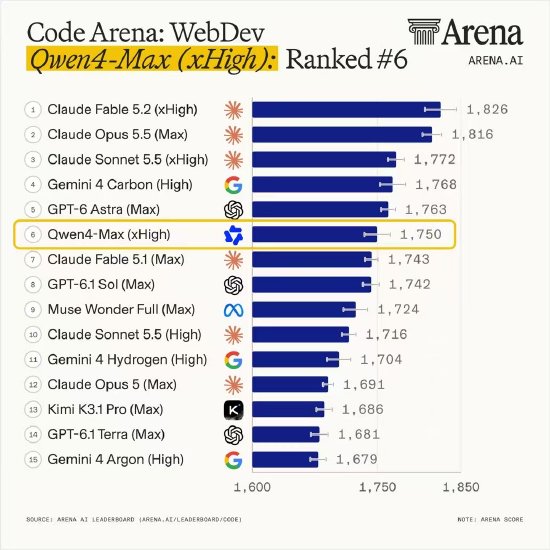
Qwen4 placed sixth in the global front-end coding blind test CodeArena and sits in the leading tier of third-party evaluations including Agents' Last Exam (ALE) and Vals Index, which probe agent behaviour and specialist task ability. Alibaba tuned the family on real-world tasks so it can call professional tools for long-cycle work in areas such as automotive manufacturing, game development, financial research and scientific work.
But a rank is a triage filter, not a verdict. A 2026 model-selection review notes that models dominating leaderboards often underperform in production, and treats Arena-style scores as a shortlist rather than a decision. The practical sequence: pick the sub-benchmark matching your workload, then validate on your own tasks. A sixth-place finish in a coding blind test says the model is worth piloting; it does not say it will pass your evals.
What is the enterprise reality check?
Cheaper Tokens do not repair a broken rollout. The MIT NANDA report found that 95% of enterprise generative-AI pilots produced no measurable return, calling that rate the clearest manifestation of the GenAI Divide (Fortune, August 2025). Meanwhile enterprise AI deployment spend rose from $33 billion to about $177 billion by September 2026, and agents — not humans — are becoming the largest consumers of model output, according to Menlo Ventures. A falling Cost per Task matters precisely because agent workloads multiply tasks; our field read on why 89% of US enterprise open-model spend went to Chinese models shows how fast procurement is shifting.
Two implications for an IT team. First, model price is now a workload variable, not a line item you fix once a year. Second, savings appear only if the agent actually completes the task — which brings the conversation back to workflow design, not model choice.
What is the rollout path?
Start with one workflow whose task has a clear finish line, measure it, and only then widen. Most enterprises are not short of tools; they are short of someone willing to decide that the old system gets retired.
- Pick a single task with a measurable outcome, such as a first-pass code review or a research-packet summary.
- Baseline the current Cost per Task, including retries and human clean-up, before switching models.
- Run Qwen4-Max on your own eval set, not just CodeArena or ALE.
- Set a kill criterion in advance: the score or cost threshold that ends the pilot.
- Name an owner for switching off the legacy path. Without one, you pay for two systems.
What are the common mistakes?
- Equating a 0.5 yuan cache-hit price with your real bill — misses and output Tokens still cost.
- Treating one-million-token context as free memory; long context changes cost and retrieval behaviour.
- Assuming the 58% Cost-per-Task drop transfers unchanged to your workload; it was measured on Terminal-Bench 4.0.
- Buying on the sixth-place CodeArena headline without checking the sub-benchmark that matches your traffic.
What does the cost ledger look like?
Inference accounts for roughly 85% of AI budgets in scaled agent deployments, with reports of $500–$2,000 in monthly API cost per engineer (Cockroach Labs, June 2026). The ledger therefore has two columns, not one.
| Line item | What Qwen4-Max changes | What it does not |
|---|---|---|
| Token price | As low as 0.5 yuan per million Tokens on cache hits | Cache-miss rates, output pricing, egress |
| Tokens per task | 151K vs 289K on Terminal-Bench 4.0 | Your task may be longer or shorter |
| Cost per Task | Reported 58% lower than Qwen3.8-Max | Your own baseline still needs measuring |
| People and process | Not addressed by a model swap | Often the dominant cost; see the 95% pilot finding |
For a sense of how aggressive the pricing is, compare it with the launch terms we unpacked for Google's Gemini 4 Carbon launch price. Both signal a race to turn frontier-class capability into a routine line item. Good news for buyers — provided the capability lands in a workflow someone actually owns.
Frequently asked questions
Is Qwen4-Max really cheaper than Qwen3.8-Max?
On Alibaba's Terminal-Bench 4.0 measurement, yes: 151K versus 289K Tokens per attempt and a 58% lower Cost per Task. Treat that as a benchmark result and then verify on your own tasks.
Does a sixth-place CodeArena result mean it writes production-ready code?
No. It means the model earned a place in the blind test's top tier. Code quality in your repository depends on your eval set, review process and integration, not an Elo-style rank.
Can I run Qwen4-Max on my own servers?
Not on the evidence available so far: Alibaba says smaller Qwen4 models will be open-sourced later. Today the routes in are the Qwen AI platform API, Alibaba Token Plan and the Qwen Office, Qoder and Qwen App clients.
What is the one-million-token context good for?
Long documents and long-cycle tasks where an agent must hold a lot of state — a codebase, a research packet, a multi-step plan. It works best alongside Qwen Sparse Attention (QSA), and it is not a substitute for good retrieval.
Will switching to a cheaper model fix our AI ROI?
Unlikely on its own. The MIT finding was that most pilots fail on integration and workflow, not model price. Cheaper Tokens widen the room to experiment; they do not choose a workflow or retire an old one.
Next step
If you take one action this quarter, make it this: choose one task with a clear finish line, record its current Cost per Task, and pilot Qwen4-Max against that number on the Qwen AI platform. Decide in advance who switches off the legacy path if the pilot passes. The model is ready; the decision is still yours.
References
- Fortune — MIT report: 95% of generative AI pilots at companies are failing (August 2025) — https://fortune.com/2025/08/18/mit-report-95-percent-generative-ai-pilots-at-companies-failing-cfo/
- Menlo Ventures — 2026: The State of Enterprise AI — https://menlovc.com/perspective/2026-the-state-of-enterprise-ai/
- Cockroach Labs — The Bill Arrives: Managing Agentic AI Costs at Scale — https://www.cockroachlabs.com/blog/agentic-ai-costs-at-scale/
- NVIDIA Developer Blog — Dense vs. MoE Models: Active Parameters — https://developer.nvidia.com/blog/dense-vs-moe-models-active-parameters-throughput-and-when-to-choose-each/