
Google Ads vs. Meta vs. ChatGPT: Where Ad Budget Really Belongs Now | ItInsightsWorld General
Short answer: Google's ad machine did not break in the third quarter. Its search growth slowed because Google's own AI surfaces earn less per query than the old keyword page, while users moved part of their research into chatbots. The practical conclusion for advertisers is not "leave Google" — it is move test money, not revenue money; treat Meta as the scale channel; and buy ChatGPT as an exposure bet that can only be judged across quarters.
Here is the situation I keep running into. A brand's paid search still books sales, still looks healthy on the dashboard, and still costs more every month. Nobody on the team can say how much of that spend is now carried by traffic Google itself no longer fully controls. Most companies are not short of tools. They are short of someone willing to put a number on the shift and change the plan anyway. So let's put the number on it.
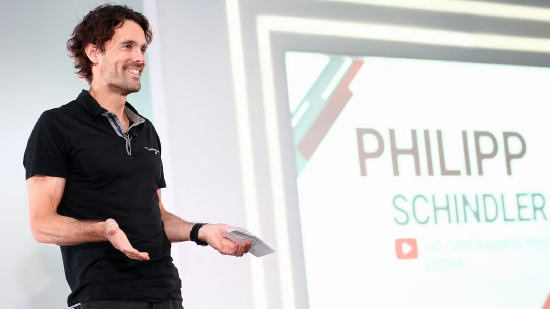
Google chief business officer Philipp Schindler.
What actually happened to Google's numbers?
Philipp Schindler puts the cause on how people research things online: more of them use AI chatbots instead of a search results page. "I wanted to put more money into Google, but I think this search traffic has been diverted into situations where people do their own research with large models," he said.
For more than two decades, Google's dominance in search plus its built-in automated ad system produced one of the most profitable advertising businesses ever recorded. Now Google's own AI build-out is eroding it. In the same window, Meta's advertising revenue growth ran at more than twice Google's search ad growth, and OpenAI has entered the advertising market.
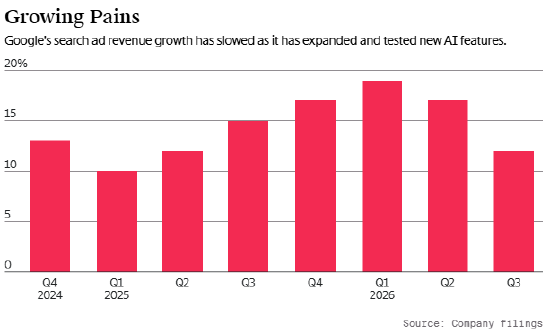
The market read it harshly. On October 29 — the day after Google's earnings report — Alphabet shares fell nearly 13%. The report showed that in the third quarter the full-year growth rate for search advertising eased to 12%, from 17% in the second quarter. Schindler blamed part of that on AI Mode (AI Mode) monetising weakly — the very product Google built to compete with ChatGPT on search. Google does not disclose how much ad revenue comes from AI features versus classic search, but a slowing growth line tells you the honest answer: when users switch to AI Mode, Google earns less than it used to.
One comparison puts the gap in perspective. Meta's own third-quarter release, published on October 21, reported advertising revenue of US$63.06 billion, up 26% year over year, with ad impressions up 10% and the average price per ad up 14%. Growth at Meta is partly a price story — which matters when you plan to move budget into it.
Why does an AI answer earn Google less than a results page?
Because the ad slot changed, and the buyer's state of mind changed with it.
In May 2024, Google launched AI Overviews, the AI-generated block sitting above results. Nearly a year later, AI Mode arrived. Ads only started appearing in the two products months after launch. Classic web search sells against keywords; in AI Overviews and AI Mode the ads are untied from keywords and show up alongside long prompts and multi-turn conversations. Advertisers cannot buy Google's AI search inventory on its own, and cannot choose to stay out of it.
Scale of what is at stake: since 2016, when search moved from desktop to mobile, AI summaries and chatbots are the biggest change in the industry — and they carry one risk, that AI nibbles at the US$224.5 billion search ad business Google earns every year.
For several consecutive quarters, Google's search revenue showed no fatigue. As adoption of Google's AI features rose, the growth rate started to slip. Two causes: Google is deliberately holding down ad density so it does not scare off AI search users, and it is still in the painful phase of working out how to serve and bill for ads inside a conversation instead of a keyword list.
Google's spokesperson put it this way: "We are taking a measured approach, prioritising the best user experience, which builds a durable foundation for our customers and our business. Our ad experiments in AI Overviews and AI Mode have made good progress, and we are now scaling monetisation using formats that deliver verified return on investment for advertisers."
The deeper problem is behaviour. Google says prompts typed into AI Mode run roughly three times longer than a classic search, with richer context and deeper questions. A user does not type "tent"; they type "which tent should I buy for a week of hiking in the Sierra Nevada in September". That is a person comparing options, not a person with a wallet open.
Can anyone actually measure what AI search is doing?
Not cleanly — and that is the single most underrated risk in this story.
Frederick "Fred" Vallaeys, chief executive of ad management software vendor Optmyzr, spent nearly a decade inside Google's ads business. His read: these browsing habits mean users are usually not purchase-ready yet, so the odds of a click, and of a sale after that click, are lower. Working from the 21,000 ad accounts Optmyzr manages (many of them small and mid-sized businesses), Vallaeys calculated that in the third quarter the conversion rate of Google's all-platform ad clicks (search included) fell 1.4% against the second quarter, while return on ad spend — revenue earned per one dollar of ad budget — dropped 2.9%, a second consecutive quarter of decline after a 3.8% fall in the second quarter.
Price is moving the other way. Advertisers report that AI Mode shows fewer ads than classic search. Over the past year, that has pushed cost per click upward: fewer slots, the same number of bidders, and Google's automated auction lifting prices.
Attribution broke too. Agencies describe a buyer who researches a product inside ChatGPT and then completes the purchase through Google. Before chatbots, the same person searched Google, clicked the ad, and bought — and the advertiser could book that sale against the ad. Today nobody can say which step did the work.
Then there is the reporting gap: Google merges AI Overviews and AI Mode data with classic search, so advertisers cannot see AI-scene performance on its own, nor where, when, or why the AI served a particular ad. Google's explanation is that these features are still scaling, so no standalone report exists yet. In response it has added reporting inside ad accounts showing, for example, the query that triggered an ad, and shipped creative tools such as Asset Studio, which uses Gemini Omni and Nano Banana models to generate ad images and video.
Nick Stoltz, chief strategy officer at measurement firm Measured, which mainly serves large retailers: "These features are essentially an adaptation to the search paradigm change AI has brought."
Victor Batista, global search lead at London agency Jellyfish, says advertisers now feed Google richer product information — detailed product descriptions, for instance — so its AI can decide which conversations should show their ads. Many advertisers, he adds, now care more about impressions than click-through rate. "The centre of value has moved from clicks to impressions; plenty of searches end without a click. Brands are now competing to be recommended inside the answer AI gives."
External data points the same way, and adds a timing warning. A study of close to 1,900 websites published by Search Engine Land on November 2 found that a paid ChatGPT visit in US traffic produced US$0.89 in revenue per session against US$2.45 for a paid Google Search visit — a 64% shortfall, with ChatGPT ad conversion measured at 0.37%. Adobe's quarterly AI traffic reports show the picture flipping fast: AI-referred visitors once converted at nearly half the rate of other traffic, then converted 42% better by March 2026. Any single quarter of AI traffic data should be treated as a sample, not a benchmark.
What Google is doing behind the scenes
Google management keeps pitching the AI opportunity to investors and advertisers to steady the room: AI decides which queries are worth triggering an ad, picks the landing page after a click, and auto-generates versions of ad creative.
Below the surface, Google is negotiating partnerships and evaluating potential acquisitions to make ads in AI contexts worth more. Sources say its corporate development team is looking at AI ad-creative tooling — a space where Google's own tools now face pressure from Higgsfield, Runway and Typeface, tools that more companies use directly instead of a traditional ad agency.
Google has also paid Hightouch to steer advertisers toward that startup's customer-data sharing tools, because AI has amplified an old hole: when Google serves an ad, it often does not know what the advertiser's customer already bought, and many small advertisers never sync that data. Google has struck deals with Adswerve, CustomerLabs, Datahash, Fifty-five, Jellyfish, Lytics, Tealium, Treasure Data and Zapier to pipe advertiser-owned data into its ad systems.
Google, Meta and ChatGPT: the side-by-side trade-offs
Read this as a set of trade-offs, not a ranking. Each row is a question you can actually ask your agency on Monday.
| Dimension | Google Search (with AI Overviews / AI Mode) | Meta | ChatGPT ads |
|---|---|---|---|
| What the user is doing | Searching, then increasingly conversing; prompts about three times longer than a classic query | Scrolling short video and social feeds; ads sit beside the feed | Asking a question and reading an answer; decision-stage research |
| Can you buy it separately? | No — no standalone AI search buy, and no way to opt out | Yes, standard auction | Yes, self-serve since May 2026 |
| Can you see its performance? | No — AI data merged into search reporting | Yes | Partial; early reporting was thin on post-click conversion |
| Does the new inventory cannibalise your core ads? | Ad load is capped on purpose | No — new AI products such as the Muse agent run separately from main feed ads | Not applicable yet |
| Verified performance signal | Click conversions -1.4% quarter on quarter; return on ad spend -2.9% | Ad revenue +26% year on year; price per ad +14% | US$0.89 revenue per paid visit versus US$2.45 on Google |
| Entry cost trend | Cost per click rising as AI shows fewer ads | Cost per thousand impressions roughly a third of ChatGPT's launch price | From US$60 CPM and a US$200,000 floor (February 2026) to no minimum (May 2026) |
Six advertisers and agencies say many of them have grown frustrated and started shifting budget elsewhere — Meta among the destinations. Farhad Divecha, who buys advertising for multiple brands as group chief executive of marketing agency AccuraCast, frames it plainly: "This year, genuinely workable options outside Google have appeared in the market — ChatGPT ads, Meta. We reallocate budget based on where the delivery actually lands."
History is a useful corrective here. Meta lived through the same transition: when it launched Reels in February 2022 to chase TikTok, ad growth stalled — and the following year it won growth back with discount policies and AI tools for advertisers. Before this quarterly earnings report was published, Google had already pushed AI Overviews and AI conversation features out at scale as alternatives to classic search, and keeps testing ad formats inside them. As usage of AI Mode and AI summaries climbs, Google's ad growth may rebound the same way. Google's October 28 announcement that ads in AI Mode are expanding to ten more markets, with ads appearing in follow-up queries in the US, says the inventory is growing faster than the measurement built around it.
Which channel fits which job
- Keep on Google: bottom-of-funnel demand you can already prove — branded queries, high-margin repeat purchases, and any campaign where the sale still closes inside your normal attribution window.
- Scale on Meta: reach and creative-led demand capture. Note the price per ad rose 14% in the same quarter that revenue grew 26% — you are buying into an inflating auction.
- Test on ChatGPT: category-level exposure and answer visibility, where OpenAI says the ad business has crossed a US$1 billion annualised revenue run rate. Advertiser counts differ wildly by source: Google's AI ad products were reported to serve hundreds of thousands of advertisers while ChatGPT counted only about 600 — which is itself the signal that this channel is moving faster than any benchmark can track.
The cost math: how much can you safely move?
People who actually place the money describe today's ChatGPT line as experiment money, not committed money: typically 1% to 5% of an annual budget, according to reporting on advertiser behaviour in October 2026. That is a sane ceiling for an unmeasurable surface.
Watch a second-order effect before you celebrate cheap inventory. The AI vendors themselves are now heavy buyers: generative AI makers sharply increased their own advertising spend, with OpenAI up about 800% year on year and Anthropic up about 1,184%, according to an industry media-spend review published by the Beijing Academy of Artificial Intelligence. When the tools you are buying from are also bidding for users, prices in every auction stay unstable.
Practical sequence: hold your Google keyword budget flat for one quarter, fund the AI test from the existing innovation slice rather than from proven campaigns, and only reallocate after two quarters of incrementality data — not after a dashboard screenshot.
Four mistakes that wreck the switch
- Reading a merged report as two separate channels. Google's AI and classic search numbers are combined, so "search is fine" can hide an AI drag.
- Judging AI by last click. If prompts rarely produce clicks, click-based metrics will always tell you AI does not work.
- Chasing exposure with no floor. Impressions are the new currency, but impressions without a holdout test are just cost.
- Assuming alternatives are cheaper. ChatGPT opened at roughly three times a typical Meta CPM; Meta's own price per ad is climbing.
What to do in the next 30 days
- Pull your search campaigns apart by query type and flag the long, conversational queries — the ones that look like prompts, not keywords.
- Ship structured product data upstream: detailed descriptions, availability and review counts, to Google and to the answer engines your customers actually ask.
- Agree on one measurement owner and one method — incrementality or geographic holdout — before you spend a dollar on a new surface.
- Set the test budget as a percentage of annual spend, write the stop condition down in advance, and review it on a calendar date instead of on a mood.
Frequently asked questions
Is Google advertising failing?
No. Search advertising still grew 12% in the third quarter, off a US$224.5 billion annual base. What changed is the slope: growth decelerated from 17%, because AI surfaces convert attention less efficiently than a keyword page.
Can I exclude my ads from AI Mode and AI Overviews?
Not currently. Google sells AI-scene inventory inside the same systems as classic search, so there is no separate buy and no opt-out. Google says standalone AI reporting will arrive as these features scale.
Should a small business buy ChatGPT ads now?
Treat it as a low-cost probe, not a channel. Self-serve access removed the large minimum commitment that defined the February 2026 pilot, so entry is easy; the evidence on revenue per visit is still thin.
Does this mean AI search converts worse?
Not necessarily. Adobe's own reporting shows AI referral conversion swinging from roughly half the rate of other traffic to 42% better within months, while the study of nearly 1,900 websites found ChatGPT ad visits earning 64% less per visit than paid Google search visits. The defensible conclusion: nobody has enough data yet, so buy small and measure independently.
Sources referenced
- Google, ads in AI Mode global expansion — https://blog.google/products/ads-commerce/ads-in-ai-mode-global/
- Meta Investor Relations, third quarter 2026 results — https://investor.atmeta.com/investor-news/press-release-details/2026/Meta-Reports-Third-Quarter-2026-Results/default.aspx
- OpenAI, expanding access to AI with ChatGPT ads — https://openai.com/index/expanding-access-to-ai-with-chatgpt-ads/
- Search Engine Land, ChatGPT ads and revenue per visit study — https://searchengineland.com/chatgpt-ads-generate-less-revenue-per-visit-than-google-search-study-500160
- Adobe Business, AI-driven traffic across industries — https://business.adobe.com/blog/ai-driven-traffic-surges-across-industries
- Zhiyuan Community media-spend review of generative AI vendors — https://hub.baai.ac.cn/view/55683
- Jin10 Data, advertiser budgets on ChatGPT — https://xnews.jin10.com/details/232686
- 36Kr, advertiser counts on Google AI ads versus ChatGPT — https://m.36kr.com/p/3797619013868808
By Jack Ross, IT Insights. Questions about this coverage: contact@itinsights.com.