
Case Notes on the Chip Super-Cycle: How AI Compute and Memory Demand Reshaped Global Sales in Q3 2026 | ItInsightsWorld
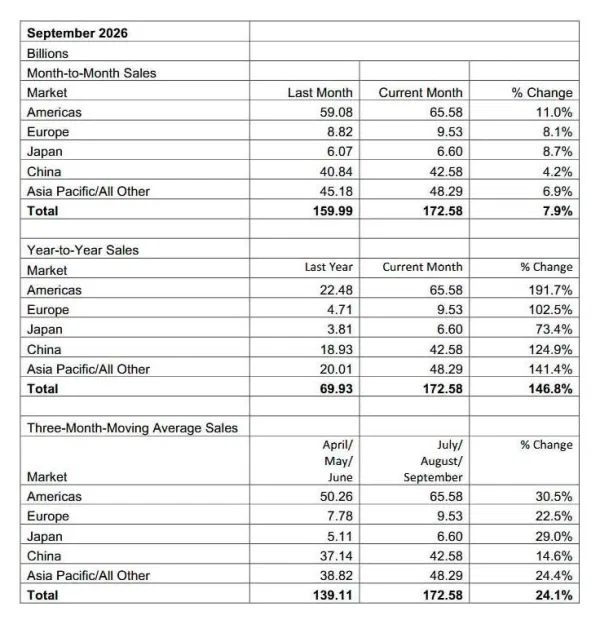
Short answer: this is no longer a one-region, one-product boom. In September alone, every major market posted enormous year-to-year gains — the Americas 191.7%, Asia Pacific and other regions 141.4%, China 124.9%, Europe 102.5%, Japan 73.4% — and worldwide sales in the third quarter logged a third consecutive quarter of more than 20% sequential growth. Two forces are colliding: AI compute build-outs and a memory market that has flipped to seller terms. This ItInsightsWorld General-column read revisits the cycle through three documented cases — the HBM sell-out, the wafer trade-off inside DRAM fabs, and the price pass-through into devices — and converts them into a practical checklist.
What the third-quarter numbers actually say
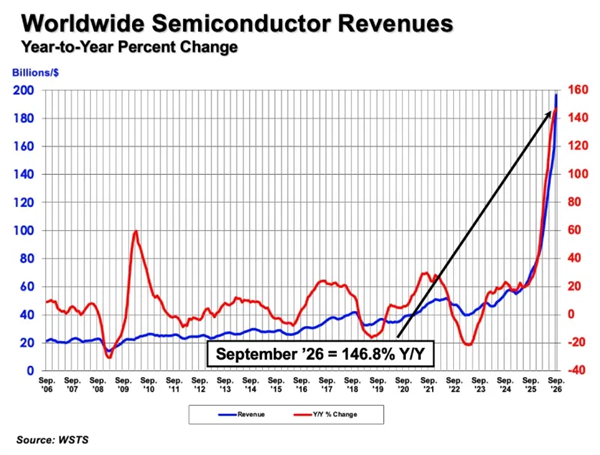
Conclusion first: growth was simultaneous, broad-based and record-scale, not a statistical fluke in one geography. The Semiconductor Industry Association (SIA) announced on 3 November 2026 that global semiconductor sales reached $517.7 billion in the third quarter, up 24.1% from the second quarter, and that September alone came in at $172.6 billion, up 146.8% year-to-year and 7.9% month-to-month.
| Region | September year-to-year growth | September sales (three-month moving average) | September month-to-month change |
|---|---|---|---|
| The Americas | 191.7% | $65.58 billion | +11.0% |
| Asia Pacific and other regions | 141.4% | $48.29 billion | +6.9% |
| China | 124.9% | $42.58 billion | +4.2% |
| Europe | 102.5% | $9.53 billion | +8.1% |
| Japan | 73.4% | $6.60 billion | +8.7% |
Read the table as a demand map, not a scoreboard. Regional monthly values are compiled by the World Semiconductor Trade Statistics organisation on a three-month moving average, so the spread between 191.7% in the Americas and 73.4% in Japan reflects where orders were placed, not where chips were made. Independent analyst Omdia had pointed the same way weeks earlier: it forecast that global semiconductor revenue would break through $500 billion in the third quarter of 2026, after a record $425 billion second quarter, and that revenue for the first three quarters of 2026 would clear $1.25 trillion — more than 50% above the full-year 2025 total. Omdia published that view on 14 September 2026, six weeks before the official count landed.
Case 1 — the HBM sell-out: what pre-booked capacity does to prices
The process: high-bandwidth memory is the scarcest component in an AI server. SK hynix and Micron both publicly confirmed that their entire 2026 HBM allocation was sold out, and some customers began locking in supply for 2027 to 2028 rather than gambling on spot purchases.
The result was a shift in who holds leverage. In late October 2026 SK hynix went further, telling investors that signed long-term agreements already covered more than half of its 2027–2028 capacity and that its DRAM and HBM output was effectively sold out through 2029, while acknowledging it would be difficult to fully meet customer demand (Barron's via Yahoo Finance, 28 October 2026). A seller's market of that shape turns AI infrastructure spending into booked revenue years before a single chip ships — which is precisely how a demand story becomes a sales-number story.
- Lesson on visibility: pre-sold capacity removes price risk for the supplier and moves it to the buyer, who now competes for allocation instead of negotiating a discount.
- Lesson on timing: when a vendor says a calendar year is "sold out", the practical lead time for new demand shifts to the year after next — plan purchase orders accordingly.
- Lesson on contracts: multi-year agreements are becoming the norm in memory, so enterprise buyers lose the option to wait for a price trough.
Case 2 — the wafer trade-off: why AI memory starves everything else
Conclusion: the shortage is structural, because HBM is an inefficient consumer of the same wafers that make ordinary memory. Goldman Sachs research put the 2026 supply gaps at 4.9% for DRAM, 4.2% for NAND and 5.1% for HBM — the widest shortfalls since 2011 in each category. Those gaps are what give price its floor.
Micron supplied the mechanics at Hot Chips 2026 in August: producing the same number of bits in HBM consumes roughly three times the wafer supply of DDR5, and the gap widens with each generation, because a single HBM3E die has to feed about 256 GB/s against roughly 8 GB/s from a DDR5 die (Tom's Hardware, 25 August 2026). By Micron's own estimate, HBM would absorb 22% of the leading suppliers' DRAM wafer input in 2026 while contributing only about 9% of total DRAM bits, rising to 30% of wafers for 13% of bits in 2027. That arithmetic is the reason AI servers crowd out PC, TV and set-top memory rather than living in a separate product lane.
NAND behaves the same way with a longer fuse. TrendForce's April 2026 review of the NAND market concluded that newly added capacity would not reach volume before the end of 2027 or during 2028, which is why well-funded data-centre customers keep being prioritised over consumer orders. For a general reader, the takeaway is simple: wafer time is zero-sum, and every gigabyte of HBM is paid for by gigabytes that will not appear elsewhere.
Case 3 — the pass-through: what the shortage cost device buyers
The cycle shows up in your invoice before it shows up in your news feed. TrendForce's contract-price tracking put the second quarter of 2026 increases at 58–63% quarter-to-quarter for conventional DRAM and 70–75% for NAND flash, then flagged a slower but still-rising third quarter — a pattern in which component makers recover margin first and consumers absorb it last.
Device makers responded by repricing and resizing. IDC projected PC average selling prices to rise 18.3% in 2026 and warned that no meaningful relief to the memory shortage was expected before the end of 2027; IDC research manager Jitesh Ubrani argued that the era of cheap PCs and tablets is effectively over, that price pressure may start easing from 2028 but that the market is unlikely to return to 2025 price levels. The smartphone chain got the same shock: IDC expected RAM prices to stabilise only by mid-2027, and senior research director Nabila Popal noted that vendors were re-cutting total addressable market, competitive landscape and product mix around scarce memory, in a year that could bring the biggest smartphone shipment decline in more than a decade (TechCrunch, 27 February 2026).
Why the Americas pulled ahead of every other region
Conclusion: the Americas figure is a capex number wearing a chip-sales costume. September sales in the Americas reached $65.58 billion — about 38% of the worldwide monthly total — and the region posted the highest sequential gain at 11.0%. That maps onto hyperscaler spending rather than consumer demand: CNBC reported in early February 2026 that Microsoft, Alphabet, Amazon and Meta together were heading toward roughly $700 billion of capital expenditure in 2026, an increase of more than 60% over their already record 2025 outlay, and J.P. Morgan's October 2026 research still sized global AI capital spending at about $900 billion for 2026 on the road to $5.5 trillion by 2030.
For readers outside the hardware industry, the practical translation is that server-attached memory, networking silicon and power components in North America are being bought forward, years in advance — which is why consumer-facing markets see price, not availability, as the first symptom.
How long can this run, and what could break it
Michael Robbins, president and CEO of SIA, said the global chip market expanded sharply in the third quarter, that worldwide sales recorded a third consecutive quarter of sequential growth above 20%, and that year-to-year sales remained strong across all major regional markets — underlining semiconductors' irreplaceable role in driving innovation, lifting productivity and strengthening economic competitiveness. He added that AI infrastructure investment shows no sign of slowing, so this compute-and-memory-led upcycle is likely to run into 2027.
Risks, flagged as our own analysis rather than a sourced forecast: pre-sold capacity can turn into double-ordered capacity when buyers fear shortage; consumer segments already showing volume declines (PCs and smartphones) can erode the demand base the cycle depends on; and wafer capacity re-allocated away from commodity memory in 2026 returns to that pool only when AI demand growth decelerates. None of that contradicts the reported extension into 2027 — it defines what would end it.
Five misconceptions that mislead budget owners
| Common belief | What the evidence shows |
|---|---|
| "Chip sales are up because consumers are buying more devices." | Consumer demand is softening: IDC projected a higher-priced, lower-volume PC market and a possible decade-worst smartphone year, while Americas server purchases set the pace. |
| "The shortage will ease as soon as new fabs open." | NAND capacity additions were not expected at volume before the end of 2027 or during 2028, and HBM's 3x wafer penalty keeps eating the reclaimed supply first. |
| "Prices will snap back to 2025 levels once AI spending normalises." | IDC's view is that average selling prices stay structurally higher; memory makers hold multi-year agreements through 2029, which removes the incentive to discount. |
| "Regional growth rates are comparable in size." | They are not comparable in scale: the Americas booked $65.58 billion in September against Japan's $6.60 billion, so a 73.4% Japanese gain adds far less absolute volume than 191.7% in the Americas. |
| "This is only a chip-industry story." | Memory is a line item in laptops, handsets, cars and public-cloud bills; the pass-through into device pricing makes it a household-finance story too. |
A seven-step action checklist for the next two quarters
- Write memory and accelerator availability into your hardware plan as a constraint with dates, not as a price question.
- Lock the quantity you genuinely need for the next 12–24 months now, and refuse to pay for speculative buffer you cannot redeploy.
- Split procurement into server-grade and consumer-grade lanes; the two respond to different supply curves.
- Re-check right-sizing opportunities first — retired instances and overprovisioned virtual machines release memory faster than any vendor can supply it.
- Track quarterly contract-price series rather than spot prices, which overreact and distort budgeting.
- Build a device-refresh buffer: expect higher average selling prices through 2027 and budget for fewer, longer-lived machines.
- Read regional sales data as an early indicator of where allocation queues will tighten before your region does.
Frequently asked questions
Is the 2026 chip boom real demand or an investment story?
The evidence points to real, contracted demand. SK hynix and Micron reported 2026 HBM capacity already sold out, with long-term agreements covering more than half of 2027–2028 output — orders signed and scheduled are a different thing from planned capital spending.
Why do AI data centres make my laptop more expensive?
Because wafer capacity is zero-sum. Micron's own figure is that HBM needs roughly three times the wafer supply of DDR5 for the same bits, so as HBM moves from 22% of leading suppliers' DRAM wafer input in 2026 toward 30% in 2027, the pool left for ordinary devices shrinks.
When do prices come down?
Consensus says not before 2028, and not to 2025 levels. IDC expects no meaningful relief before the end of 2027 with smartphone-grade memory stabilising around mid-2027, while Goldman Sachs sizes the 2026 gaps at 4.9% for DRAM, 4.2% for NAND and 5.1% for HBM — the widest since 2011.
Should a normal household rush out to buy RAM or a new PC?
Generally no. Panic buying at spot prices is the most expensive response available to an individual; the practical moves are delaying low-priority upgrades, buying the memory configuration you will actually use rather than the cheapest sticker, and choosing repairable or upgradeable machines.
What is the single number to watch next?
Hyperscaler capital-expenditure guidance. The Americas' 191.7% September gain rests on it; if that spending plateaus, allocation pressure eases within roughly two quarters and the rest of the table follows.
Sources referenced
- SIA — "Global Semiconductor Sales Increase 24.1% from Q2 2026 to Q3 2026" (3 November 2026)
- Omdia via BusinessWire — record $425bn in Q2 2026, revenue above $500bn forecast for Q3 2026 (14 September 2026)
- Tom's Hardware — Micron on the widening silicon gap between HBM and DDR5, Hot Chips 2026 (25 August 2026)
- IDC — PC market enters volatile territory as memory shortage persists through 2027
- TechCrunch — memory shortage could cause the biggest smartphone shipment dip in over a decade (27 February 2026)
- Barron's via Yahoo Finance — SK hynix says memory is effectively sold out through 2029 (28 October 2026)
- CNBC — big-tech AI spending approaches $700 billion in 2026 (6 February 2026)
- TrendForce contract-price outlook for Q2 2026 and NAND capacity timing, via IT之家 (1 April 2026)
- Igor's Lab — TrendForce sees slowing but still rising DRAM and NAND contract prices in Q3 2026
- J.P. Morgan Global Research — AI capital expenditure outlook, about $900 billion in 2026 (19 October 2026)
Written and edited by James Hartley, IT Insights · ItInsightsWorld. For editorial questions or to report a factual correction, contact contact@itinsights.com.