
From Months to Days: What TI's Agentic CCStudio Bet Means for Embedded Teams | ItInsightsWorld AIapplications
Texas Instruments has pushed agentic AI into the CCStudio ecosystem so that the toolchain, not only the model, carries device knowledge: software development kits, pin configurations and peripheral data are handed to the agent through Model Context Protocol (MCP) servers. The claim on the table is deliberately narrow — embedded software migration compressed from months to days. In most hardware organisations the port never failed for lack of a model; it failed because nobody owned it and it never had a budget line.
Look at the situation that surfaces in nearly every product roadmap review. An MCU line that has shipped for eight years is approaching end-of-life, the replacement silicon is cheaper and faster, and sitting between those two facts are years of peripheral drivers, board files and API calls plus two engineers who will be pulled off feature work for a quarter. Amichai Ron, senior VP for embedded processing and DLP products at TI, describes exactly this kind of work as an incredibly manual and time-consuming process, and credits agentic AI with changing it substantially over the last few years: device migration, system configuration and debugging now sit inside an agentic layer built around embedded expertise.
What actually changed inside CCStudio
Short answer: the context moved into the workflow. Device-specific knowledge — SDKs, pin configurations, peripheral data — is injected into the AI tooling through MCP servers instead of being left to the model's memory. TI says this raises accuracy, reduces hallucinations and produces implementation-ready output rather than plausible-looking pseudocode.
CCStudio IDE exposes its core capabilities to industry-standard AI agents, so those agents can autonomously generate code, configure peripherals, build the application, flash it to the device and debug it. Engineers can work the full flow in CCStudio IDE or in CCStudio for VS Code using plain language, without switching tools or rebuilding context each time they touch the board.
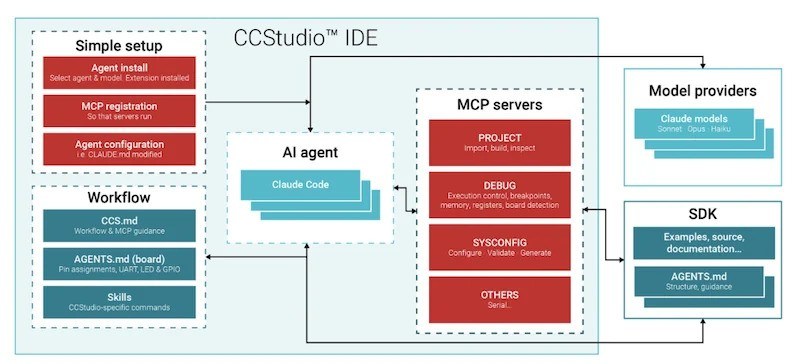
CCStudio strengthens agentic AI capabilities to streamline embedded software development across MCUs. Source: Texas Instruments
Agentic AI in the CCStudio IDE allows developers to autonomously generate code, configure peripherals, build the application, flash it to the device, and debug it. Source: Texas Instruments
When an engineer asks a preferred AI tool to migrate code, the agentic model navigates the whole migration itself while preserving the developer's existing software investment. Specialised subagents split the job: one analyses the source project, another configures peripherals, another updates code and API calls, and another iterates through build errors until they are resolved.
Traffic-light detail for buyers: the capability is available today across TI's general-purpose and real-time MCUs, wireless connectivity devices and radar system-on-chips (SoCs). Because the architecture is modular — task-specific skills, MCP server integrations and context injection kept separate — TI says support is designed to keep expanding to new devices, updated SDKs and emerging edge AI development workflows.
Why this is more than a faster copilot
Because the missing context is the reason embedded AI has underdelivered so far. Design engineers have used generative AI tools for the past two years to write code faster, yet complex embedded tasks stalled: the tool did not know which pin went where on your board. An agentic framework attacks that specific layer, which is why TI positions the move as a shift from generative assistance toward autonomous development.
Independent survey data tells the same story from the opposite side. Stack Overflow's 2025 Developer Survey found that 70% of developers using AI agents spent less time on specific tasks and 69% reported higher productivity, but only 38% said code quality improved, and 66% named "almost right but not quite" answers as their biggest frustration. METR's early-2025 study of experienced open-source maintainers was blunt in the other direction: AI-assisted work took roughly 19% longer than the same tasks done without assistance. The transferable lesson is that typing speed was never the bottleneck in embedded work — verifiable correctness against real silicon is. Context injection is an honest attempt at that problem; it is not a productivity slogan.
How to read the cost account behind "months to days"
The comparison below is how we frame the choices for a migration programme. Only the third column reflects TI's stated capability; the first two are our editorial reading of the market.
| Dimension | Generative AI copilot in the editor | Generic agent plus plug-in tools | Agentic AI inside CCStudio |
|---|---|---|---|
| Hardware context | Whatever the model memorised or the engineer pastes in | Ad-hoc integrations that drift as tools update | SDKs, pin configurations and peripheral data injected via MCP servers |
| Task scope | Function-level code generation | Multi-step work across disconnected tools | Generate, configure, build, flash and debug in one environment |
| Autonomy | Suggests; human applies | Executes steps, rebuilds context often | Specialised subagents hand migration phases to one another |
| Human work left | Review, port, compile, bench debug | Review plus integration glue code | Review of system-level design and sign-off on verification |
| Realistic schedule effect | Faster typing, unchanged project duration | Highly setup-dependent | TI's claim: migration from months to days |
| Where it breaks | Wrong register assumptions become silent bugs | Context lost between tools | Legacy code outside SDK coverage; regulated verification still runs at human speed |
Treat the headline number as a project-duration claim, not a headcount claim. If a port previously consumed two engineers for a quarter and now consumes one engineer plus a validation pass, the recovered capacity is real money. If your schedule is dominated by an external notified-body review or a hardware-in-the-loop test queue, no agent inside CCStudio will move that date.
The three numbers worth putting in the business case: elapsed port days, build-error iterations per module, and defect escape rate found during hardware validation. Anything else is decoration.
Four mistakes that sink agentic embedded rollouts
- Accepting agent output as reviewed code. Agent-generated firmware still needs the same static analysis, unit tests and bench validation as human-written code, and the review log is where a programme survives an audit.
- Skipping the context plumbing. Point an agent at an SDK and pin map it cannot actually read, and it will hallucinate confidently — with the failure surfacing on hardware rather than in a pull request.
- Aiming at the whole legacy monolith on day one. Migration scope creep is the standard reason pilots stall; a single module with a known-good reference build tells you far more than a big-bang port.
- Leaving permissions and rollback undefined. An agent that can flash boards and push to the build farm is not covered by paperwork written for hosted software; our breakdown of why AI agents cannot be sold as ordinary SaaS applies directly to embedded benches.
A rollout path we would actually sign off on
- Pick one device migration already on the roadmap, ideally an end-of-life part with a documented replacement, and freeze the reference build.
- Wire the context before asking for speed: confirm MCP access to SDKs, pin configuration and peripheral data for the exact device family in use.
- Write the exit criterion first — build passes, peripherals configured, functional test parity with the old binary — and keep a human gate on flashing and release.
- Run the agent on the driver and API-call layer, not the safety logic, until its iteration behaviour is predictable on your codebase.
- Measure the three numbers above on the first port, then decide whether the second product family is a repeatable win or a demo.
- Sequence the rest like any other agent programme: a practitioner's agentic AI rollout playbook maps the same gates onto a different process, which makes it a useful checklist when your operations team asks why embedded gets to be special.
What to watch through 2026
Texas Instruments is demonstrating agentic AI workflows in CCStudio IDE and CCStudio for VS Code at electronica 2026, the Munich trade fair that runs November 10–13, 2026 at Messe München and attracts around 80,000 visitors. The live demonstrations at its booth in Hall C4 cover end-to-end application development from system configuration to debugging. Go to the bench and ask how many iterations the agent needed and what a human had to fix.
Three reads on where this lands. First, the toolchain vendor is becoming the context provider: whoever ships the most complete machine-readable device knowledge owns the agent's accuracy, and model choice becomes a commodity underneath it. Second, the standard is consolidating — MCP marked its first anniversary with a November 2025 spec release and moved under foundation governance in December 2025, which makes device context servers portable across agents rather than locked to one IDE. Third, expect the same architecture from other semiconductor suppliers within a product cycle; at that point the buyer question stops being "which agent" and becomes "whose context is most complete for the parts I actually use".
FAQ
Does an agent inside CCStudio replace embedded engineers?
No. TI's own framing is that repetitive, time-consuming migration tasks are offloaded so developers can focus on system-level design and innovation. In practice the scarce skill shifts from writing register code to judging whether generated code is correct — which is why verification ownership is the first thing to settle in a rollout.
Is "months to days" a promise or a demonstration?
It is a vendor claim from Texas Instruments, based on its stated design intent for the agentic framework, not an audited benchmark. Teams should validate it on one of their own codebases and on their own hardware before it enters a plan.
Can agentic AI be used on safety-critical firmware?
The rule changes nothing about classification. Under IEC 62304, software safety class is determined by the hazard the software can contribute to, not by who or what wrote the code, so agent-generated code still needs full traceability and verification evidence. Most compliance teams start agents on non-classified modules.
Which environment should a team adopt: CCStudio IDE or CCStudio for VS Code?
Both expose the same agentic workflow, so pick by habit: CCStudio IDE if your team lives in the vendor toolchain and needs the full debugging chain out of the box; CCStudio for VS Code if your engineers already work in VS Code and want the agent inside their existing setup.
Reference sources
- Texas Instruments press release on agentic AI in the CCStudio ecosystem, distributed via PR Newswire, November 2026 — prnewswire.com
- EE World Online, "Agentic AI takes on embedded code migration", 10 November 2026 — eeworldonline.com
- Stack Overflow 2025 Developer Survey, AI section — survey.stackoverflow.co
- METR, update to its developer-productivity study, February 2026 — metr.org
- Model Context Protocol, one-year anniversary and spec release, November 2025 — modelcontextprotocol.io
- electronica official site, dates and venue — electronica.de