
ItInsightsWorld AIapplications: The Grid, Massachusetts, and the AI-Scheduled Route for On-Demand Circuit Boards
Today, ItInsightsWorld AIapplications examines how an application-layer factory can make electronics scheduling responsive without changing the laws of manufacturing. The example is The Grid, a Massachusetts production system that CircuitHub describes as having operated for five years while moving individual boards through machines with learned models, AI agents, and classic optimizers.
Why high-mix electronics became a hidden operations problem
For 30 years, many electronics jobs left the West because assembly was labor-intensive and wages differed across markets. Design stayed in the US, while production moved to China where labor was cheaper. That arrangement worked when a product was repeated enough to justify dedicated equipment.
Automation is now changing parts of that model, but mostly where volume is enormous. SpaceX produces Starlink dishes by the million in Bastrop, Texas, because repeating the same task many times makes a fixed line efficient.
A different problem appears when hardware teams need ten of one design, a hundred of another, and a revised board next week. Each new design historically required setup time, manual changeover, and a slow handoff. The usual destinations were offshore production or quick-turn shops that sold flexibility at a premium.
How The Grid embeds scheduling into production
Instead of a line that must be rebuilt for each product, The Grid is described as one large robot. Levitating movers carry each board and its parts among machines that perform solder paste printing, component placement, reflow, soldering, and inspection. Scheduling is handled by learned models, AI agents, and classic optimizers.
That makes the factory behave less like a fixed assembly line and more like a dynamic routing system. Each board can follow its own path. One batch can contain 100 different designs and be treated as easily as 100 copies of one design. Prototype work and production batches can share the same equipment rather than being split into separate queues.
The need is not limited to small startups. Large organizations also carry many low-volume items: test stations, tooling, R&D systems, and small production lots. The release cites a leading EV maker, a top AI lab, and household-name technology firms as customers.
Step-by-step way to read the business case
- Map demand shape. List boards where the quantity is ten, a hundred, or next week, because these are the situations where setup dominates cost.
- Separate labor cost from flexibility cost. Offshore pricing may be lower per unit, but design changes, schedule uncertainty, and shipping can add hidden delay.
- Benchmark one real board. Use a concrete product, not a theoretical category, and record time, price, included parts, and import friction.
- Check the changeover burden. Ask whether the system still needs per-design setup, manual reconfiguration, or separate prototype and production flows.
- Convert days into engineering value. If a faster route shortens the calendar by five days, the team may gain more planning room than the price gap suggests.
Case comparison: a 4-layer motor controller
The published benchmark uses one 4-layer motor controller with 118 parts per board, of which 38 are unique. It prices five assembled boards with parts included and delivery to a US address.
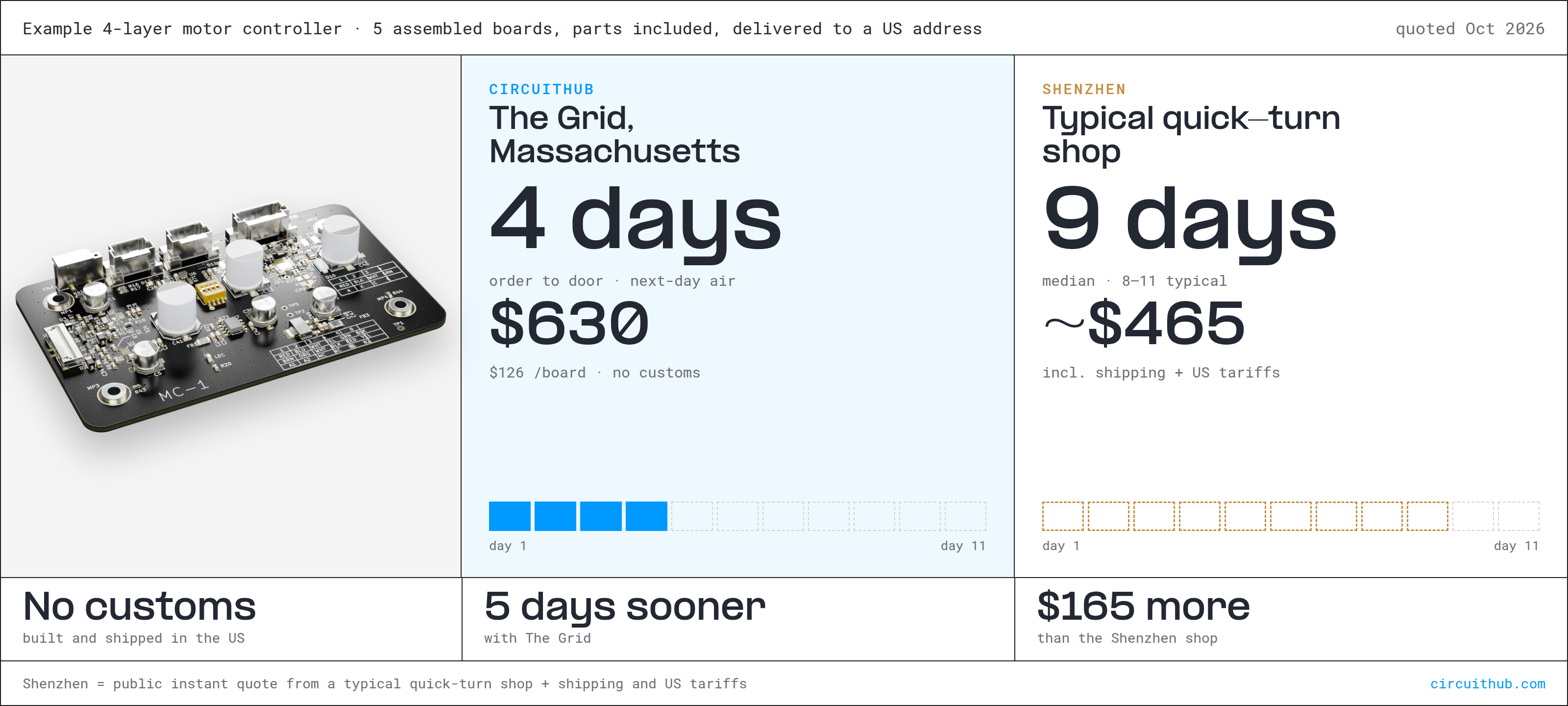
| Route | Calendar time | Stated cost basis |
|---|---|---|
| The Grid | 4 days to the customer address | $630 with parts included and no customs |
| A Shenzhen quick-turn option | 9 days median estimate | $465 once shipping and US tariffs are counted |
The comparison gives about $165 more for the faster path and a gap of five days. The value is not only the price difference. It is the removal of customs exposure and the ability to plan around a shorter supply line. In hardware work, five days can change debugging, integration, or market timing.
What has already been demonstrated
The system is not presented as a prototype. It has been running for customers for five years, building tens of millions of dollars of electronics a year. The CircuitHub record cited with it includes 2.2 million boards shipped, 150 million parts placed, and service to 26,000 engineers.
Capacity appears to be the next bottleneck. The release says demand exceeds what can currently be built. This year it plans to 5x capacity, with another large increase expected in 2027. The release also mentions hiring and instant quotes.
Common mistakes when judging an AI application in hardware operations
- Looking only at wage arbitrage. The old model depended on cheap assembly labor; the new model depends on removing setup time between designs.
- Assuming automation only works at enormous volume. That is true for dedicated lines, but not for high-mix work if scheduling and routing change.
- Equating low unit price with low project cost. A quote may be cheaper while adding shipping, tariffs, and lead-time risk.
- Treating AI as a digital-only layer. Here AI scheduling touches physical machines, parts movement, and factory sequencing.
- Separating prototype and production too early. If the same equipment can handle both, teams may reduce handoff friction.
FAQ: What does this mean for AI application leaders?
Is this an AI product or a factory product?
It is an AI application inside a physical workflow. The visible product is circuit-board manufacturing; the intelligence is in how learned models, AI agents, and classic optimizers decide routing and sequencing.
Does the example prove that Western factories will replace China?
No. It shows one route can make high-mix work faster and more predictable, while the earlier cost model still matters for very large, repeatable volumes.
Which teams should pay attention?
Teams that regularly need ten or a hundred units, change designs often, or carry low-volume test, tooling, R&D, and production lots. The cited customer mix includes large organizations, not only startups.
How should a company evaluate the cost?
Compare the 4 days path and $630 quote against the 9 days path and $465 for the same benchmark, then convert the five days and the $165 gap into planning value.
Checklist: when to consider an on-demand factory route
- You have frequent revisions and cannot batch everything for months.
- Your order pattern is closer to ten, a hundred, and next week than to a million copies.
- Your board contains mixed part counts, such as 118 total parts with 38 unique parts.
- You need five assembled boards, prototypes, and small production runs to use the same flow.
- You care about US delivery, customs complexity, and a median 9 days versus 4 days.
- You can justify about $165 as the price of schedule certainty.
Action recommendations for application owners
For AIapplications, the practical lesson is to look for bottlenecks that are not purely algorithmic. In this case, the bottleneck was not soldering or placement alone, but the coordination of many different designs through many machines. The fix was an application-layer routing problem: move each board on its own path, remove per-design setup, and make scheduling data-driven.
A team should start by inventorying its smallest, fastest-changing workflows. Then compare those workflows against a real case, using numbers such as 2.2 million boards, 150 million parts, 26,000 engineers, and tens of millions of dollars a year. The longer-term ambition described is to make hardware building as fast as hardware design. The stated plan covers demand ahead of capacity, a 5x expansion target, and another increase in 2027. The next question is whether flexibility, not labor cost, is the metric that unlocks better outcomes.