
Surge AI's DAYJOB: Tax Shows Hidden Deadline Gaps for AI Tax Agents in Business Workflows
For teams putting AI assistants into regulated workflows, the key question is whether the system can carry a professional task end to end. In the Anna condo example, the user compared two dates, October 2026 and January 2027, and received advice that either closing window met the residence rule for up to $250,000 in excluded gains. The response did not raise the later deadline: the rule requires at least two of the five years of residence, and an August 2024 move-out makes eligibility uncertain around the end of August 2027. Across five attempts, Astra never surfaced that August 2027 risk; Opus surfaced it in all five attempts.
What the benchmark evaluates
DAYJOB: Tax is the tax-focused release in Surge AI's DAYJOB series, after Healthcare and Finance. It targets work in tax preparation, compliance, and advisory services where the client supplies messy records and incomplete instructions. The benchmark contains 50 environments across eight areas of tax practice. In each environment, an AI agent receives a client request plus supporting records and produces an artifact such as a tax return, workpaper, technical review, or client advice. The assignment expects the agent to decide what to investigate, resolve conflicting evidence, recognize missing information, and carry the result into a completed professional deliverable.
Leaderboard, cost, and what to infer for deployment
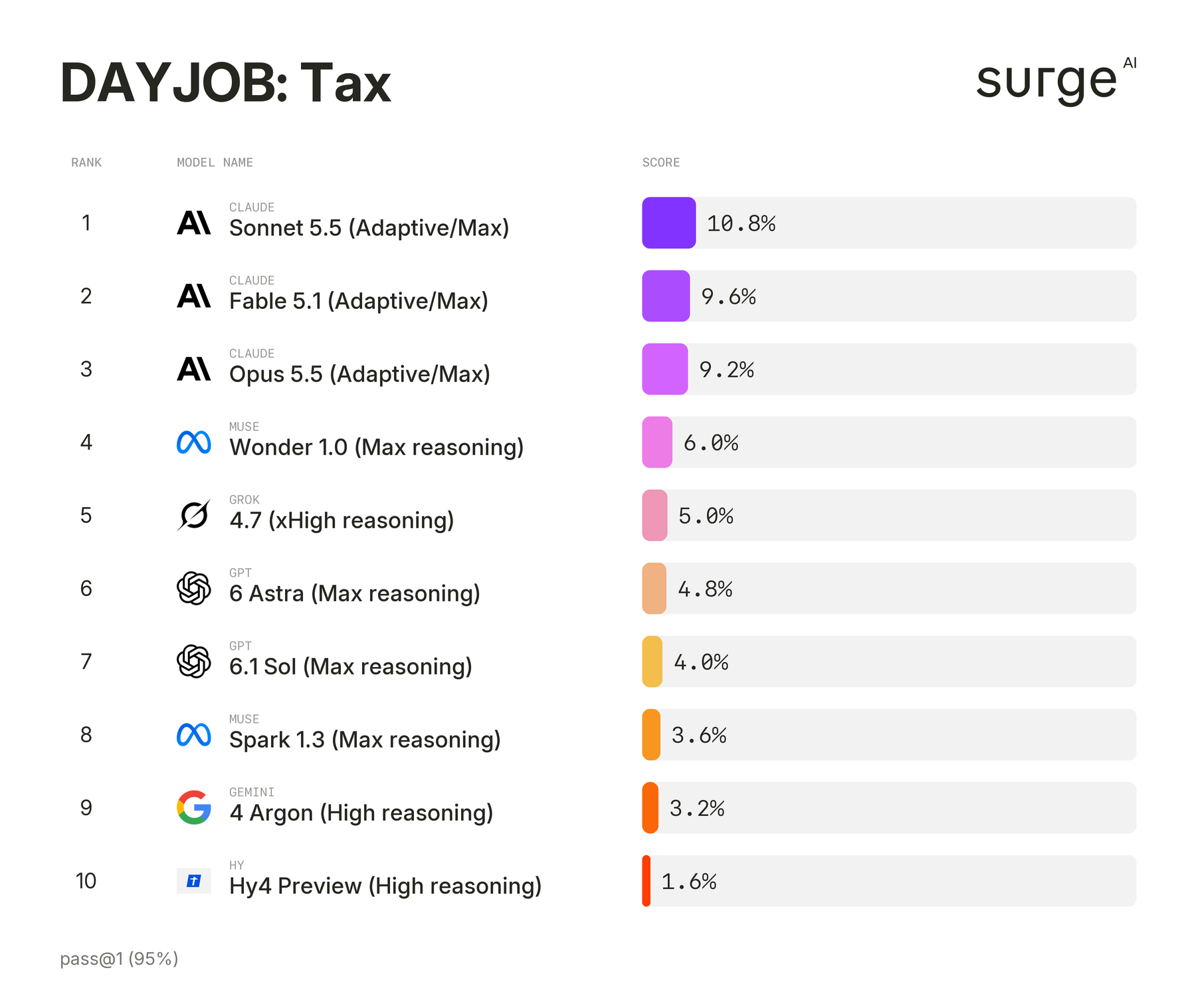
Claude Sonnet 5.5 leads DAYJOB: Tax with a 10.8% pass rate. Claude Fable 5.1 follows at 9.6%, and Claude Opus 5.5 appears at 9.2%. At a 95% rubric threshold, pass@1 counts an attempt as successful only when it satisfies at least 95% of the task criteria for calculations, supporting evidence, consequential issues, and the finished deliverable.
Performance versus cost
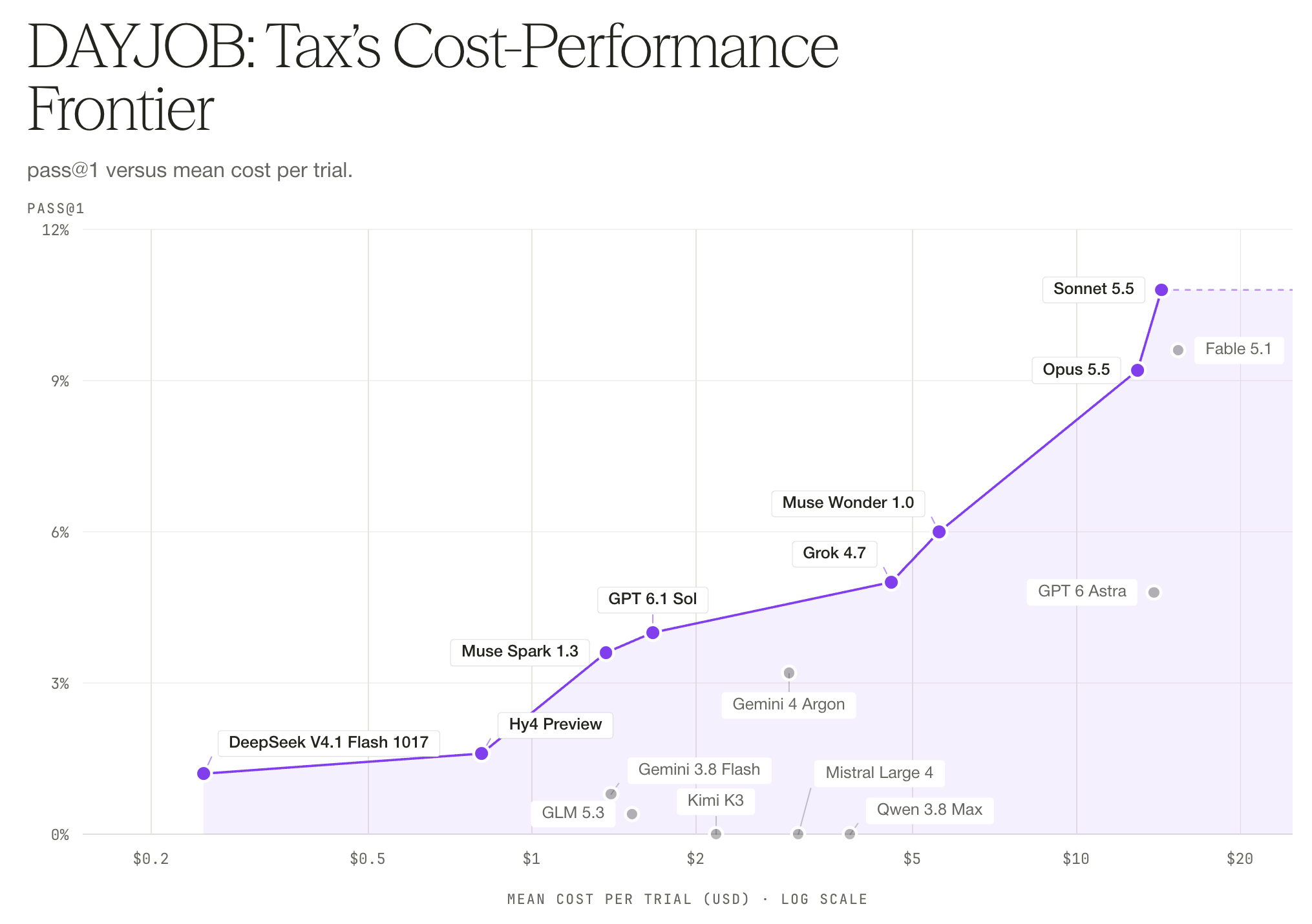
When performance is plotted against average cost per trial, the high-performance end of the measured Pareto frontier includes Claude Sonnet 5.5 and Opus 5.5.
How to read the result as an application signal
- Compare pass@1 at the 95% rubric threshold instead of treating one successful answer as production evidence.
- Review the cost frontier to see whether a model buys enough professional completeness to justify spend.
- Inspect failure patterns in messy files, hidden deadlines, and unverified assumptions rather than only headline scores.
Assignment areas covered
Eight areas of professional tax work are included, each requiring different rules, records, and expertise:
- Individual and family tax
- Small-business tax
- Partnerships
- Property and investments
- Estates, gifts, and trusts
- International tax
- Corporate transactions
- Tax review and disputes
Some assignments require complete filing packages with supporting workpapers, while others ask agents to investigate transactions, review previous filings, or prepare advice about decisions clients have not yet made.
Inside the workspaces: evidence is messy
Across the assignments, the benchmark contains 1,789 workspace files: a median of 30 per assignment and as many as 123. Those files include 1,487 PDFs, 117 Excel workbooks, 38 Word documents, plus emails, images, CSVs, JSON records, and text files.
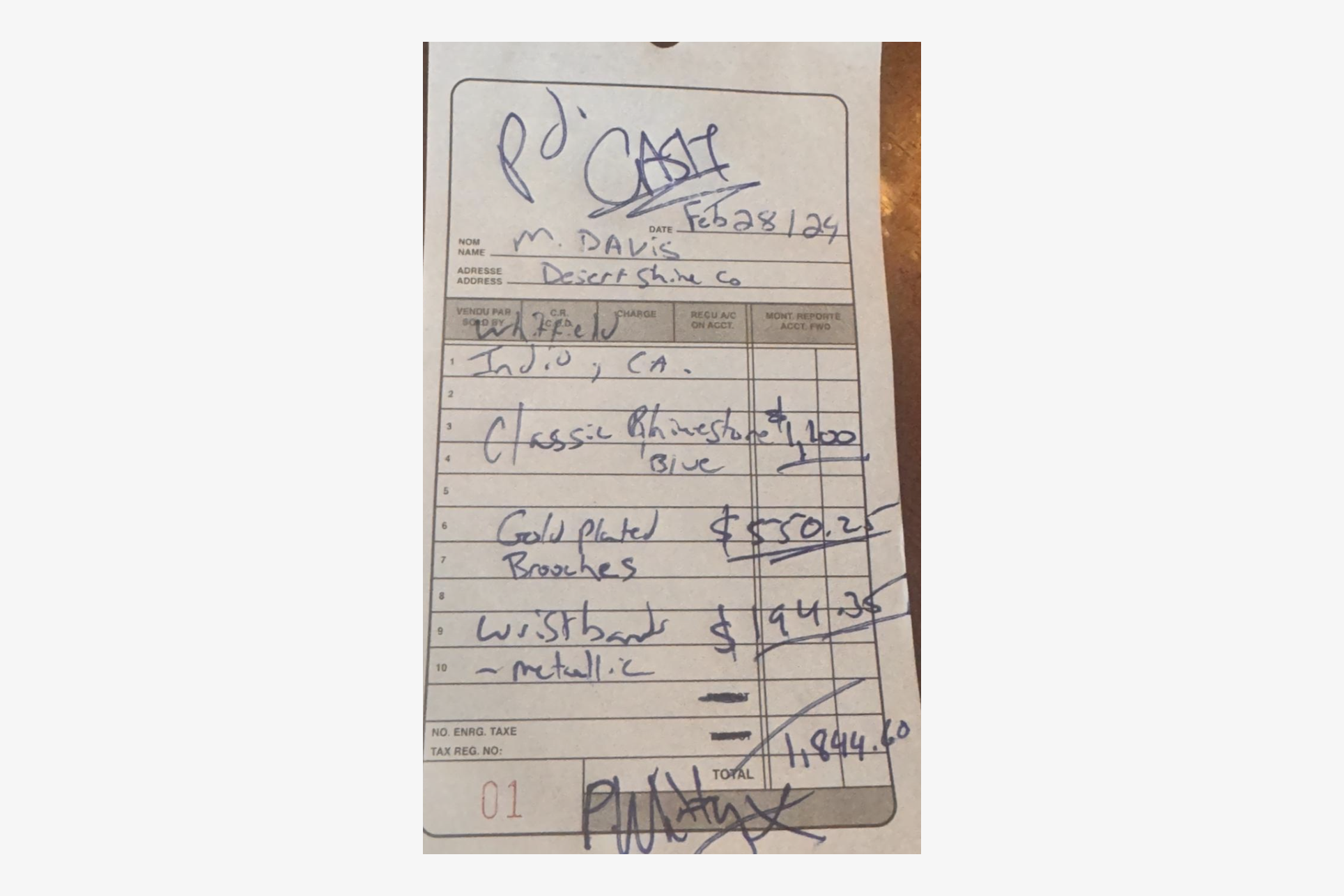
Workspaces may contain filed and draft tax returns, K-1s, W-2s, IRS notices, general ledgers, payroll records, contracts, and correspondence. Less standardized evidence is also present. In one task, a photograph of a handwritten receipt for merchandise purchased for resale requires the agent to read item descriptions and amounts, reconcile them with spending records, and determine effects on inventory and cost of goods sold.
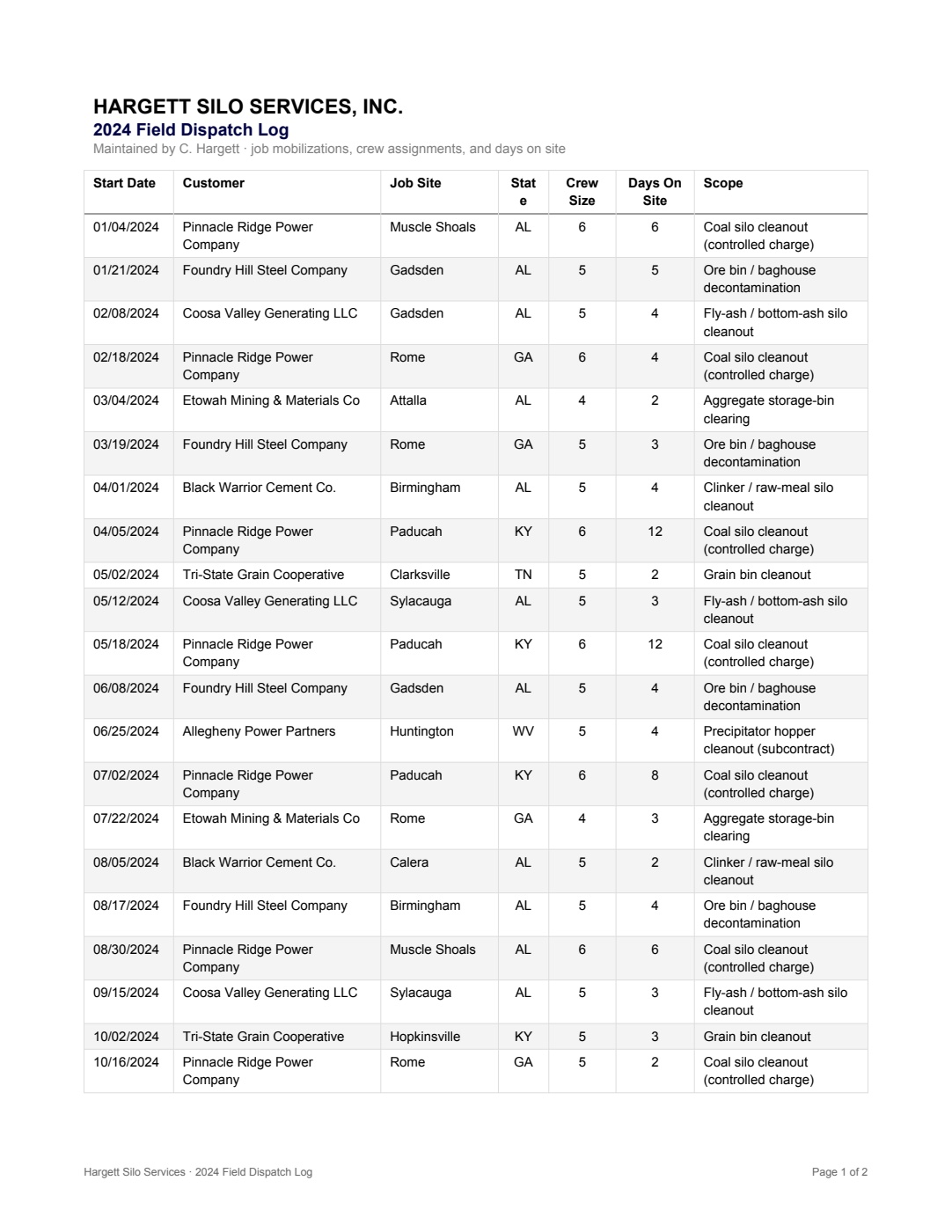
Another task involves an industrial silo-services company that assumes it operates only in Alabama. Its field dispatch log shows crews working across five states, making job locations, crew sizes, and days on site relevant to multistate tax obligations.
A third example follows a cross-border household in which Polish employment and property records must be reconciled with cryptocurrency exchange exports, wallet histories, and historical purchase lots.
Expert design and review
DAYJOB tasks are built by tax experts from real-world professional workflows. They include supporting records, expected outcomes, and grading criteria, and each task goes through a three-layer expert review for correctness, completeness, and solvability. The reviewer pool includes experience in corporate taxation, partnerships, individual returns, trusts, and multistate compliance.
- Corporate and private-equity taxation: a tax attorney with over 10 years at PwC, Deloitte, and Exxon covers tax planning, compliance, audits, and controversy.
- Partnership and corporate taxation: a Baker Tilly Tax Director with experience at PwC, Moss Adams, and Windes covers complex partnership allocations, consolidated corporate returns, REITs, and high-net-worth clients.
- Real estate and individual taxation: a tax professional with Deloitte and EY experience covers real-estate partnerships, individual taxation, and trusts.
Case: a retirement plan built on an unverified assumption
When a separating couple asked an AI agent how to divide a Roth IRA and 401(k), Opus 5.5 told them they weren't legally married and recommended keeping accounts separate, with a cash payment to even out balances.
You aren't legally married, so neither account can be split without triggering taxes and penalties.
That conclusion was not supported on its face by the records. The couple lived in Florida, where new common-law marriages generally aren't recognized, but they had previously lived together in Texas and held a ceremony in Colorado. Texas recognizes informal marriages under certain conditions, and a marriage validly established elsewhere may remain valid in Florida, so the retirement-account tax consequences could change.
Opus maintained the unmarried assumption in all five attempts, even when uncertainty was acknowledged. Astra recognized the need to verify marital status in four of five attempts, with one response saying:
We first need to confirm your legal marital status.
The user's question was how to split the accounts, but the evidence required a prior question: are they married? This illustrates the end-to-end problem in tax applications: the important investigation may be missing from the prompt.
FAQ for AI application owners
Does the benchmark test calculations only?
No. It also evaluates professional judgment: what deserves investigation, how to handle conflicting evidence, and when client instructions are insufficient.
Why are pass rates still low?
The results show that individual steps can be easier than professional judgment. Reliably carrying out real-world tax workflows remains difficult.
Is this only about tax?
No. DAYJOB began with Healthcare and Finance before adding Tax, so the same end-to-end professional-work pattern appears across multiple domains.
Checklist for reviewing agent-generated tax work
- Did the agent answer the question asked and also surface consequential issues the client overlooked?
- Did it reconcile conflicting evidence rather than silently choose one source?
- Did it state when information was insufficient and what must be verified first?
- Did the final artifact satisfy the requested deliverable, including calculations, supporting evidence, and professional standards?
Common misconceptions
- Step completion equals end-to-end ownership.
- Accurate narrow advice is safe if an omitted deadline changes the outcome.
- A higher leaderboard score guarantees reliable workflow execution.
Comparison with existing tax benchmarks
| Benchmark | Primary question | Scope in master description | Additional DAYJOB: Tax question |
|---|---|---|---|
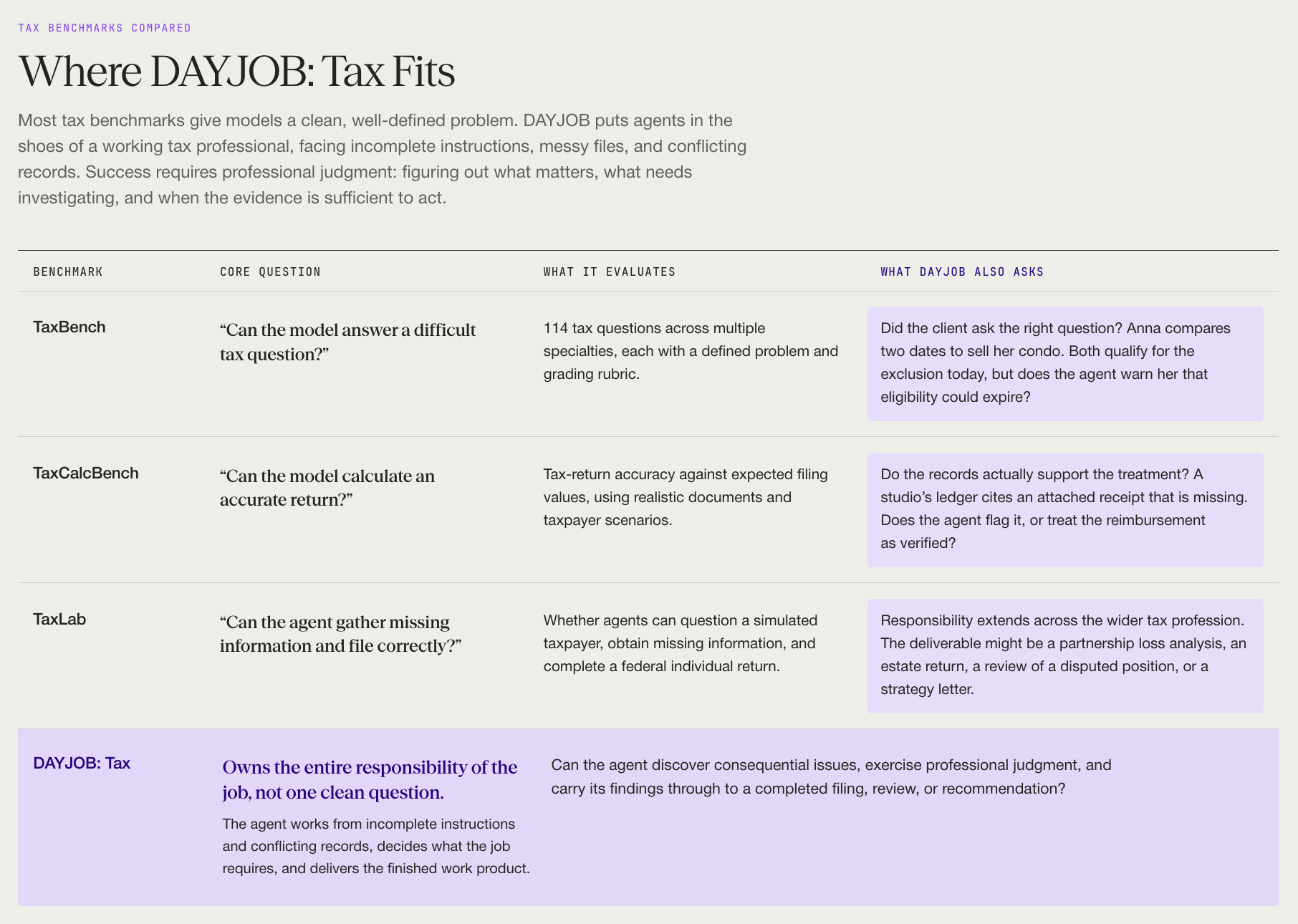
| TaxBench | Is a difficult tax question answered correctly? | TaxBench evaluates 114 tax questions across specialties, each with defined problem and rubric. | Does the agent catch the client's unasked issue? In Anna's case, she compares two dates, October 2026 and January 2027, and both satisfy the exclusion, but eligibility could expire. |
| TaxCalcBench | Is an accurate tax return calculated? | TaxCalcBench uses realistic documents and taxpayer scenarios to measure return accuracy against expected filing values. | Do records support the treatment? If a studio ledger references an attached receipt that is missing, does the agent flag the gap? |
| TaxLab | Can missing information be gathered and the return filed? | TaxLab tests whether agents can question a simulated taxpayer, obtain missing information, and complete a federal individual return. | Can responsibility extend across partnership loss analysis, estate returns, disputes, and strategy letters? |
Where DAYJOB: Tax fits
Most existing tax benchmarks start from a defined problem: a legal question, a return to calculate, or missing taxpayer information to collect. Those are valuable, but they do not fully capture the profession's first task: figuring out what problem actually needs to be solved. Clients provide incomplete instructions, records conflict, and consequential issues may never appear in the request.
DAYJOB evaluates whether agents can handle end-to-end responsibility: identifying overlooked issues, evaluating conflicting evidence, deciding what must be done, and carrying the outcome through a completed filing, review, or recommendation.
Action recommendations for deploying AI tax applications
- Do not rely on pass@1 alone; test for hidden deadline discovery and assumption verification.
- Require the agent to cite evidence and name unresolved gaps before producing recommendations.
- Keep professional review in the loop until consequential issue handling is reliable.
What the results show
Whether AI agents can take ownership of a professional assignment from start to finish is what DAYJOB tests. The results indicate that even when individual steps are possible, professional judgment and reliable execution of real-world tax workflows remain difficult. The benchmark page lists the full DAYJOB: Tax leaderboard with every evaluated model.
For AI application teams, the lesson is not that tax agents are useless. The lesson is that a correct answer to a narrow prompt can still be incomplete professional advice. Until agents consistently flag hidden deadlines and test their assumptions, human review remains the boundary condition for reliable tax automation.