
ItInsightsWorld AIapplications Field Notes: Embedding PLM.AI into Mercedes-Benz Development Workflows for 30% Faster Cycles and half Less Physical Testing
AIapplication readers usually need a decision aid, not a model essay: where does an AI system actually sit in the business workflow, and what operational result does it change? The Mercedes-Benz PLM.AI example answers that at the application layer. The platform links development, procurement, production, sales and after-sales through one intelligent, end-to-end knowledge base, with the stated aim of helping new products and technologies reach series maturity faster, more efficiently and more sustainably. The performance framing is explicit: development time can fall by up to 30 percent, some individual engineering processes may gain up to 50 percent efficiency, the platform targets a 30% reduction in development time, and physical testing may be cut by half, without lowering quality or safety standards.
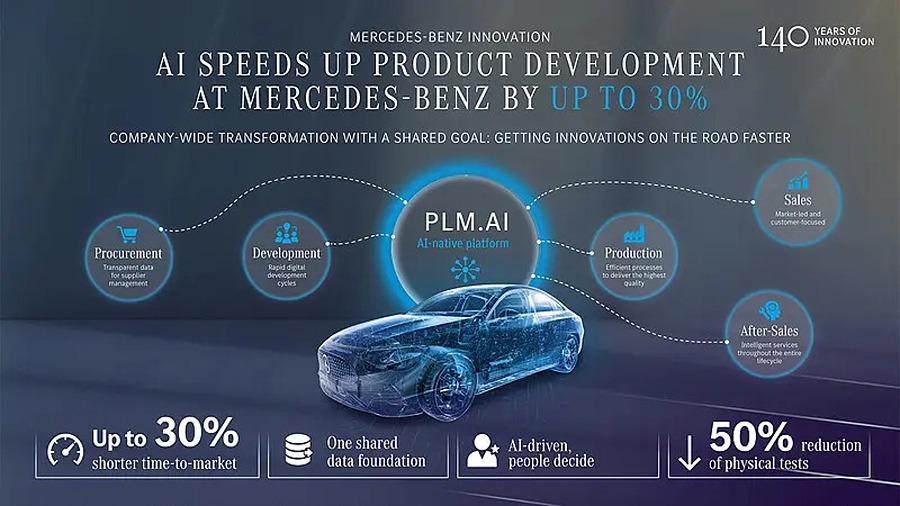
© Mercedes-Benz AG
The operating logic is not to relax safety or quality requirements. It is to reduce complexity earlier by putting relevant lifecycle information in front of the people who need it. When teams can make better decisions sooner, new technologies can reach customers with the same Mercedes-Benz benchmarks intact and with the same expectation of quality, safety, craftsmanship and engineering excellence.
Why the application layer is the main story
Mercedes-Benz product development already uses AI inside defined tasks. The relevant AIapplications question is placement.
- Existing role: AI agents support material-cost optimization, certification and homologation, fault detection and resolution, and software work.
- Current constraint: those agents are now mostly confined to separate process steps.
- Next step: PLM.AI pushes the capability further by linking applications across development workflows.
- Result for teams: product data, process knowledge and validation signals move through one environment instead of living in task-specific silos.
What changes when lifecycle data becomes application-ready
Standardized data models and end-to-end integration of development data create one continuous digital thread, supported by consistent data and clear standards. This is the core condition for making PLM data 100 percent AI-ready for applications.
- Information becomes available in real time.
- Coordination across functions is simplified.
- Innovations can be implemented faster.
- Employees can analyze complex cross-functional relationships, connect relevant information intelligently and spot trade-offs early.
- AI-powered simulations and development workflows make physical testing more targeted, which could reduce physical testing by half over time.
An investment of around half a billion euros backs the transition. The stated objective is a development environment in which interdependencies are assessed holistically, new technologies are translated into customer benefits faster, and product decisions remain with the teams while AI supplies connected context.
One example: weight optimization
One example is weight optimization. When a single component changes, consequences can spread across costs, crash behavior, hardware and software functions, and production processes. Specialized AI agents are positioned to analyze those interdependencies simultaneously. As a result, teams can form an overall picture faster and compare solutions that balance safety, quality and commercial considerations. Linking product, service and operating data may also open after-sales potential.
Two partners and one ownership rule
Two strategic technology partners are engaged for PLM.AI: CONTACT Software and Siemens. Their contributions are complementary, while Mercedes-Benz retains the end-to-end transformation mandate.
- CONTACT Software supplies the open PLM core layer through CONTACT Elements. The modular and scalable foundation allows Mercedes-Benz to integrate product data, processes and applications along the product development process and to incorporate future AI technologies flexibly.
- Siemens contributes solutions and know-how in AI-enabled automotive design, simulation and digital validation for the digital twin. Through the shared data and process foundation of PLM.AI, key engineering domains can be interconnected and accelerated.
Mercedes-Benz defines the target vision, target architecture, data models and governance. Global implementation is managed within an agile transformation program, and the digital backbone continues to evolve. PLM.AI is positioned as the cornerstone of the engineering ecosystem, supporting integrated, data-driven and AI-supported development across all vehicle programs. Mercedes-Benz retains full ownership and control of its data, as well as of the AI models developed and used on that basis.
Implementation path for AIapplication teams
- Map the lifecycle workflow: identify the handoffs among development, procurement, production, sales and after-sales that delay decisions.
- Build a common data thread: standardize models and integrate development data so PLM data can be treated as 100 percent AI-ready for applications.
- Move agents into connected workflows: use AI not only for isolated tasks, but for links between material-cost, certification, homologation, fault detection, resolution and software work.
- Add targeted validation: apply AI-powered simulations and digital validation to make physical testing more focused, with the goal of reducing physical testing by half.
- Keep humans accountable: preserve product-decision responsibility with the teams while surfacing cross-functional trade-offs earlier.
- Govern ownership: retain full ownership and control of data and AI models as the platform scales.
Comparison: fragmented AI tasks vs connected PLM.AI workflows
| Dimension | Fragmented AI tasks | Connected PLM.AI workflows |
|---|---|---|
| Placement | AI agents are mostly confined to separate process steps. | Applications are linked across development workflows. |
| Data model | Task data may not follow one digital thread. | Standardized data models and end-to-end integration create one continuous digital thread. |
| AI readiness | Readiness is uneven across tools and teams. | The stated direction is 100 percent AI-ready PLM data for applications. |
| Testing approach | Physical testing remains broad and later-stage. | AI-powered simulations make physical testing more targeted, with a potential cut by half. |
| Responsibility | Decisions can drift across isolated systems. | People remain central, and product-decision responsibility stays with the teams. |
Checklist: is an AI-native lifecycle platform usable for your application layer?
- Does it connect development, procurement, production, sales and after-sales through one end-to-end knowledge base?
- Does it support a continuous digital thread instead of scattered data pockets?
- Does it make PLM data 100 percent AI-ready for the tasks you want to automate or assist?
- Can it incorporate specialized agents for material-cost optimization, certification, homologation, fault detection, resolution and software work?
- Is the foundation modular and scalable enough to add future AI technologies flexibly?
- Does it provide simulation and digital validation that reduce physical testing without weakening safety or quality?
- Does the enterprise retain ownership of data and AI models?
Common misconceptions
- Myth: faster development means lower standards. Reality: the target is faster cycles with unchanged quality and safety expectations.
- Myth: AI replaces engineering accountability. Reality: people remain central, and product decisions stay with the teams.
- Myth: one isolated assistant delivers the value. Reality: the stated value depends on linking applications across workflows.
- Myth: partners own the transformation. Reality: Mercedes-Benz defines architecture, data models and governance, while partners supply components and know-how.
FAQ
What is the application-layer lesson of PLM.AI?
The lesson is to embed AI inside the lifecycle workflow rather than treating it as a standalone tool. The platform connects development, procurement, production, sales and after-sales through one intelligent, end-to-end knowledge base.
What performance effects are claimed?
Development time can fall by up to 30 percent, some individual engineering processes may gain up to 50 percent efficiency, the platform targets a 30% reduction in development time, and physical testing may be reduced by half.
How is investment framed?
An investment of around half a billion euros is described as supporting the transformation toward a more connected, data-driven and intelligent development environment.
Who are the named technology partners?
Two partners are named: CONTACT Software and Siemens. CONTACT Software supplies CONTACT Elements; Siemens contributes AI-enabled automotive design, simulation and digital validation know-how.
Action recommendations
- Start with a process pain, not a model demo: pick one lifecycle path where missing information causes delay or trade-off errors.
- Make data readiness measurable: require PLM data to be usable by agents, aiming for 100 percent AI-ready application coverage.
- Connect existing tools before adding new agents: a shared digital thread matters more than another isolated assistant.
- Test the simulation payoff: track whether physical testing becomes more targeted and can move toward a cut by half.
- Lock ownership early: retain control of data and AI models as the architecture becomes the engineering backbone.
For ItInsightsWorld readers, the reusable pattern is clear: the AI value in product lifecycle work appears when application layer connectivity turns scattered lifecycle facts into earlier, accountable decisions. The named outcomes — up to 30 percent faster development time, up to 50 percent efficiency in selected engineering processes, a 30% reduction target, and a physical testing cut by half — are meaningful only if data is 100 percent AI-ready for applications and ownership remains explicit.