
ItInsightsWorld AIapplications: Mapping First-Generation gen AI Adoption, Hype and Real Value in Marketing
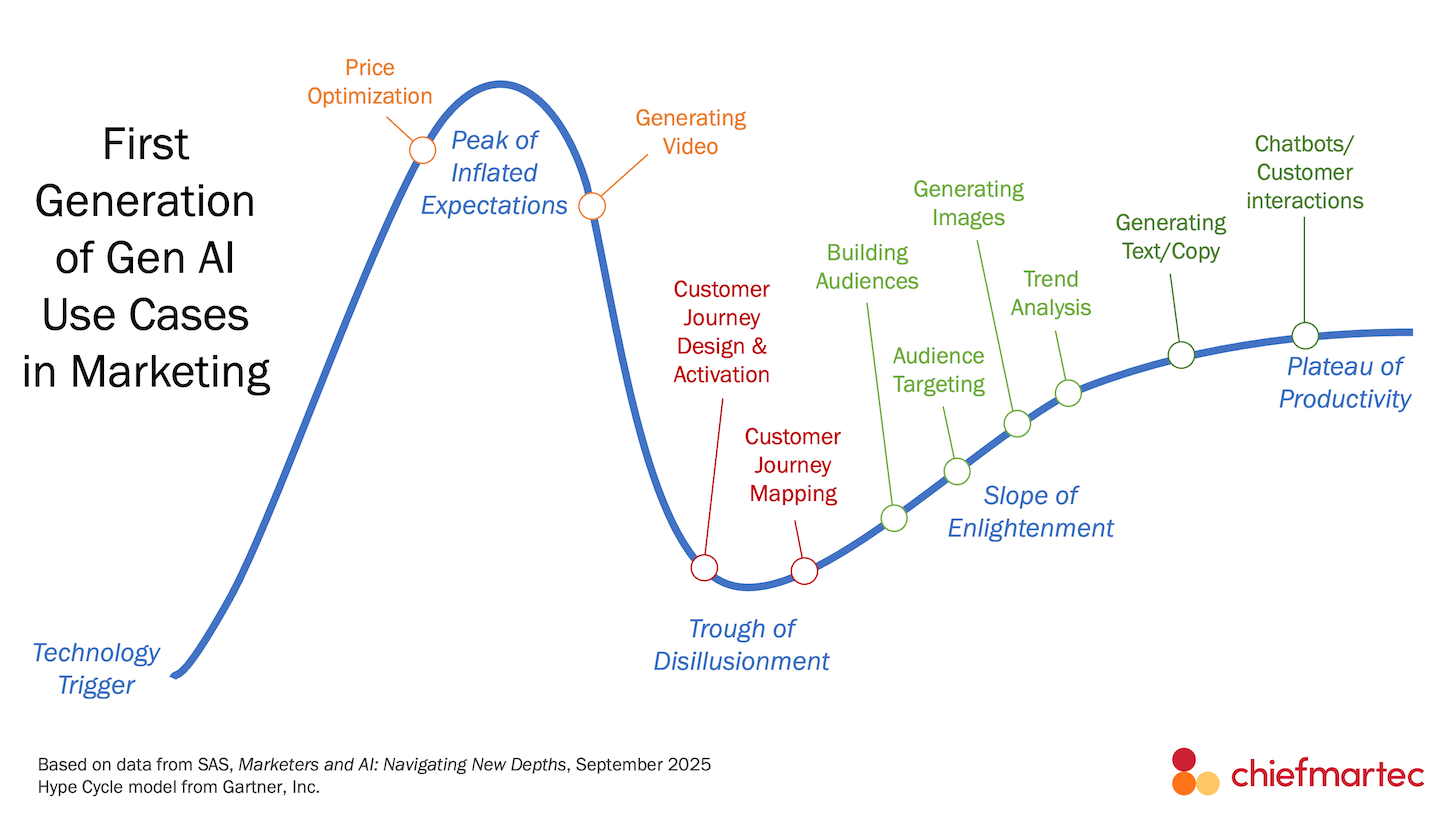
The first wave of gen AI in marketing is not a single technology climbing one Hype Cycle; it is a portfolio of applications, each with its own adoption curve. Current data from SAS show fast uptake in chatbots, text creation and trend analysis, while video and journey mapping cooled, signaling a split between plateau, trough and new peak positions.
Why should leaders read gen AI as several curves instead of one?
Because the phrase “gen AI” hides very different products, budgets and risk profiles behind one label. In an enterprise stack, a customer-service assistant, a campaign-copy generator and a video creation tool can be at different maturity points even if they share the same underlying capability class. The useful question is not whether the technology is at its peak or trough, but where each workflow sits.
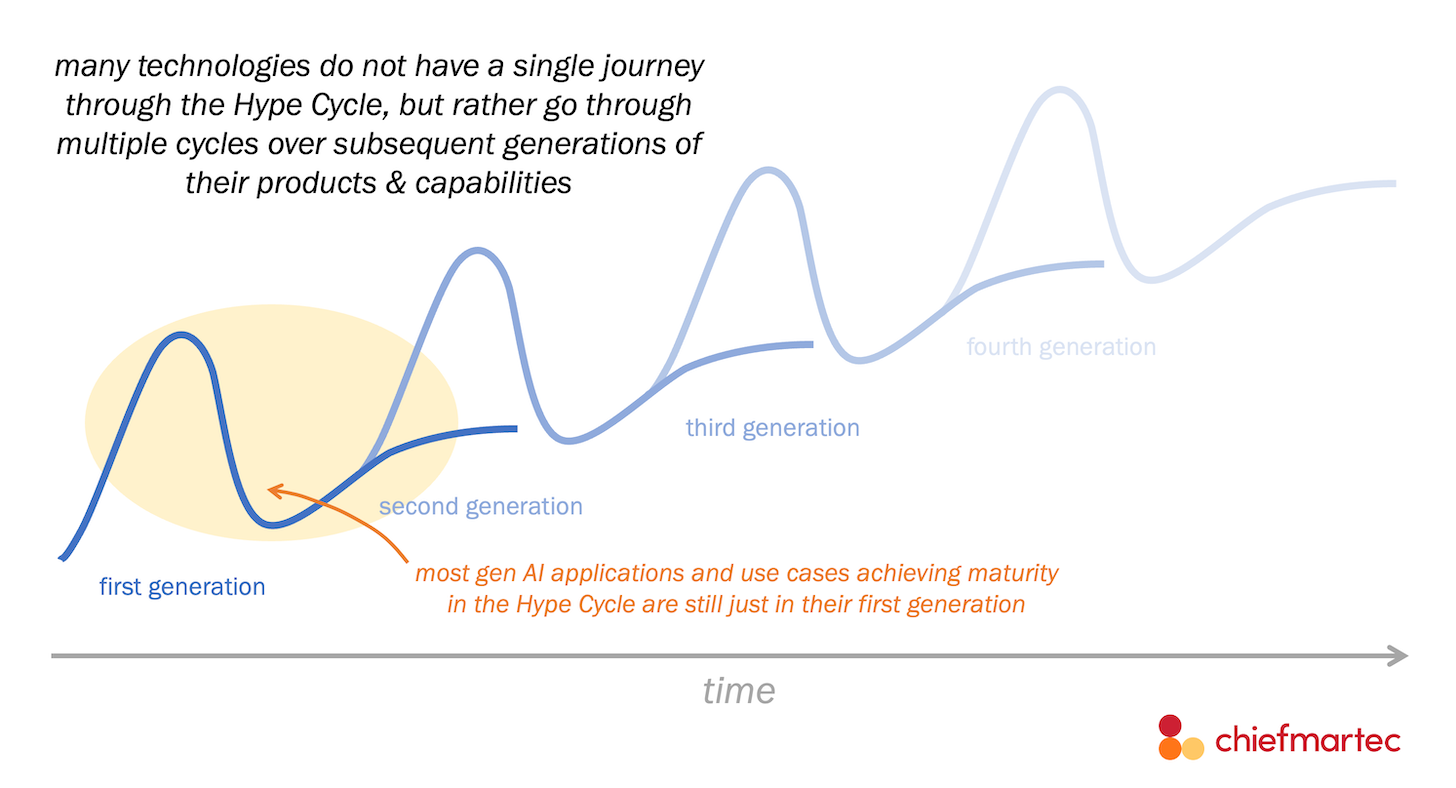
That distinction matters more than it first appears. The first-generation version of a chatbot can already be productive. A later version may do much more, and it may trigger a new expectation cycle before the first one has fully stabilized. This is the F. Scott Fitzgerald tension that leaders need to hold: the same application family can look mature and immature at once.
What does “first generation” mean for marketing teams?
It means current expectations should be anchored to what the tool can do today, not what a future agent might do. A strong customer-service bot can answer clear, bounded questions, route requests and reduce handling time. The next generation may take actions, cross-sell, navigate policy exceptions and coordinate across systems. Those are not small upgrades; they are new products with new failure modes.
When teams project tomorrow’s autonomy into current procurement, they underprice change management and overprice proof-of-concept results. A practical rule is to evaluate each use case on a 2 years, 5 years and 10 years horizon: what is deliverable now, what becomes credible soon, and what should remain a research roadmap until governance catches up.
What did the SAS 2024-2025 comparison show?
The new report released by SAS this week, Marketers and AI: Navigating New Depths, compares adoption and planning across 10 gen AI applications in 2024 and 2025 for n=300. The most important signal is not that every category grew. It is that some categories accelerated while others reversed.
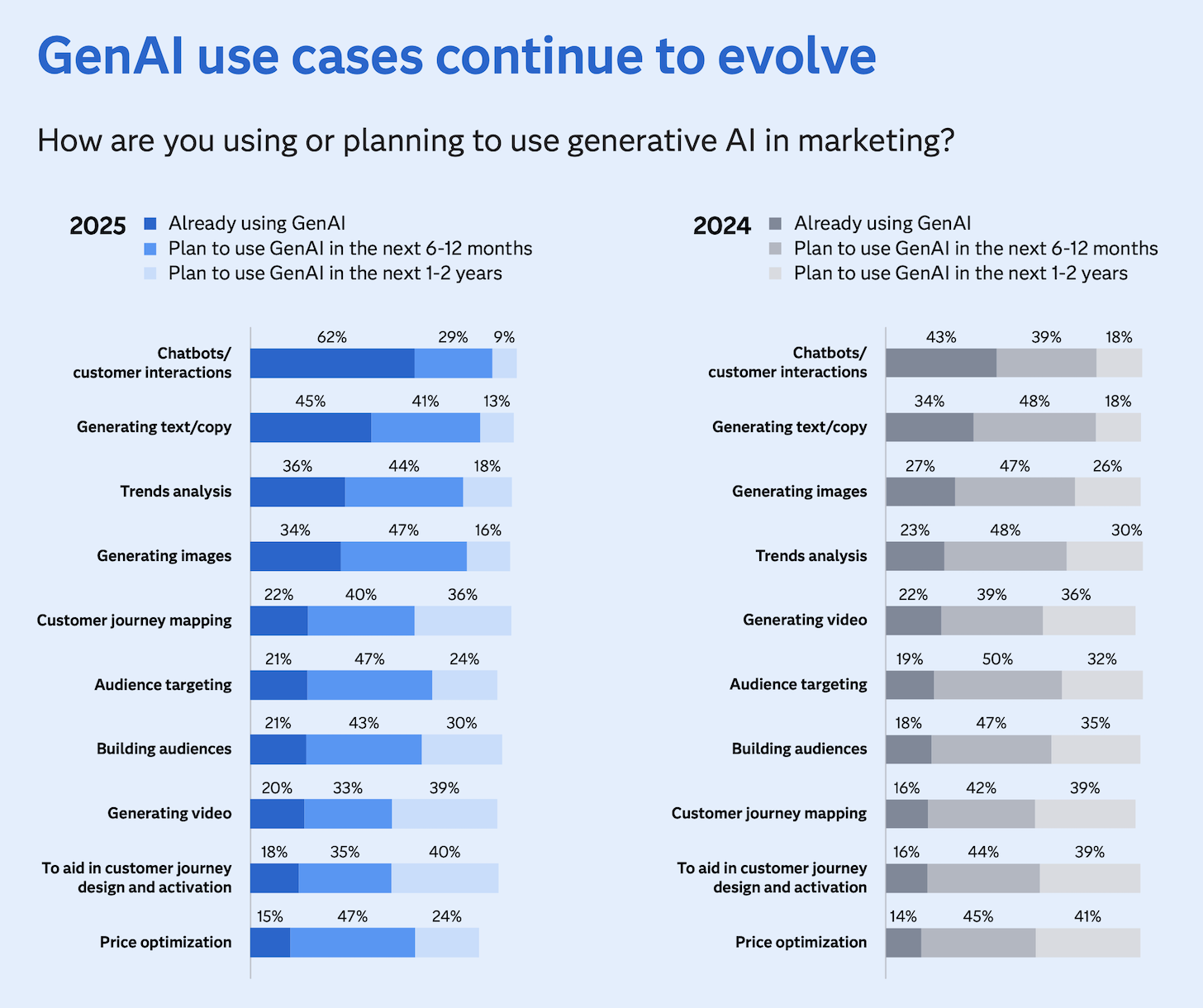
The 12-month gains were concentrated in workflows that are narrow, measurable and already embedded in daily operations:
- Trends analysis: +56.5%
- Chatbots/customer interactions: +44.2%
- Generating text/copy: +32.4%
The same workflows also appear as the most adopted over this past year, though in a slightly different order:
- Chatbots/customer interactions: 62%
- Generating text/copy: 45%
- Trends analysis: 36%
Two categories moved in the opposite direction:
| Use case | Change in adoption |
|---|---|
| Generating video | -9.1% |
| Customer journey mapping | -4.3% |
The decline is not proof that video or journey mapping have failed. It is a sign that initial hype ran ahead of workflow fit. Generating video still requires cost controls, brand review and media placement. Customer journey mapping still requires clean identity, trigger logic and measurement ownership. Those needs were not solved simply because a model could produce a diagram or a clip.
How can the SAS data be mapped onto a Hype Cycle?
The placement is interpretive, with a little hand-waving, and it is based on the SAS report plus practitioner anecdotes. Gartner did not publish this map; it should not be read as an official Gartner position. The aim is not to crown a single winner, but to help buyers avoid one-size-fits-all procurement.
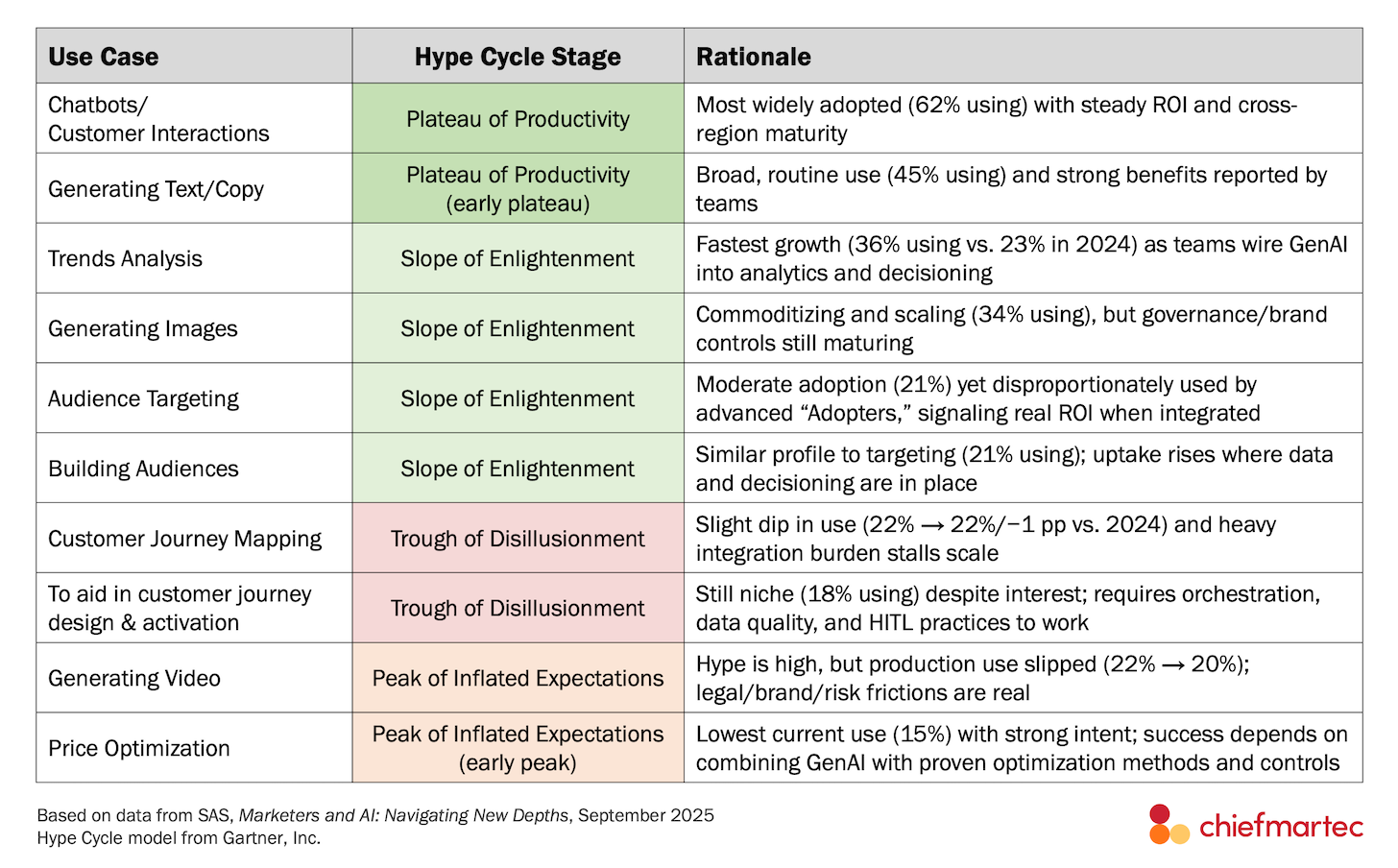
For readers in AIapplications, the map is more useful as a decision filter than as a chart:
| Cycle position | What the data suggests | What buyers should do |
|---|---|---|
| Plateau | Chatbots, text generation and trend analysis have reached stable adoption | Standardize service levels, integrate with CRM or CDP systems, measure deflection and conversion |
| Trough | Video and journey mapping cooled after early excitement | Rebuild requirements around cost per approved asset, attribution and human review |
| Emerging peak | Agentic workflows and autonomous journey execution attract attention | Pilot only inside guardrails, with audit trails and clear rollback |
Why did some use cases mature faster than expected?
One reason is that the SAS comparison captured adoption inside existing workflows, not isolated model benchmarks. The study’s press materials also point to strong returns: 93% of CMOs using the technology reported positive ROI, while 83% of marketing teams using the tools reported returns, according to the SAS press release. Another reason is tool supply. In 2024, Martech’s landscape analysis counted 2,324 generative-AI tools accounting for 77% of growth in the marketing technology landscape, making plug-in adoption easier than deep transformation.
McKinsey captured the practical pattern in an interview with Salesforce’s Ariel Kelman: early gen AI value is concentrated in summarization, generative search and retrieval across large document sets. The clearest first-wave case is retrieval-heavy service work. Kelman describes a situation where a customer asks a question against 500 product manuals and gen AI can find and summarize the answer quickly. That example maps neatly onto the SAS leaders: the work is bounded, the data source is known and the human owner can still approve any consequential action.
What does this mean for AIapplication implementation?
Marketing teams should build around a three-lane portfolio rather than a single AI budget. The first lane is proven workflow automation: answer accuracy, content drafts, trend summaries and assistive messaging. The second lane is controlled experimentation: video, customer journey, segmentation and campaign orchestration. The third lane is capability discovery: agentic actions, digital twins, synthetic data and quantum-assisted analytics, each treated as a research spend until a business owner accepts a measurable threshold.
Implementation checklist
- Choose one workflow where the old baseline is measurable: handle time, brief turnaround, report cycle or approved-asset cost.
- Classify the use case as first-generation, second-generation or research; do not buy against future capability claims.
- Define a human review point for brand, compliance and factual accuracy before external publication.
- Connect the model to governed data sources and log every decision input.
- Set a kill criterion for pilots that cannot beat the human baseline on quality, cost or speed.
- Recheck the cycle position every quarter, because the next generation can arrive before the current one has been fully standardized.
What risks are most common in first-wave AI marketing?
- Attribution blindness: teams measure output volume but cannot connect AI-assisted assets to pipeline, retention or margin.
- Prompt sprawl: individual teams use unmanaged tools, creating compliance and data-exposure gaps.
- Quality theater: drafts look finished, but factuality and brand fit require expensive review.
- Vendor lock-in by default: a chatbot becomes a CRM dependency before integration ownership is resolved.
- Cycle mispricing: a trough-stage category is treated as a plateau, or an emerging peak is bought at enterprise scale.
FAQ: what should marketing leaders do next?
Is gen AI in marketing still hype?
Some applications are still hype, some are productive and some are disillusioned. The first wave is uneven, so leaders need use-case-level reporting rather than one organization-wide maturity label.
Which applications should receive budget first?
Start with the three categories showing the fastest 12-month adoption gains: chatbots, text generation and trend analysis. They have the clearest workflow anchors, the broadest vendor supply and the easiest measurement path.
Should teams abandon video or journey mapping?
No. The drop in adoption after much of the earlier fanfare a year ago is a correction, not a verdict. Rebuild around approved workflow, cost per usable asset and measurable customer-outcome linkage.
Are future generations already on the same curve?
They will have separate expectations and separate failures. The current chatbot plateau does not guarantee a smooth path for autonomous customer agents that may act on behalf of users.
Action recommendations
For the next budget cycle, treat gen AI as an application portfolio problem. Keep the proven workflows at scale, pause or redesign weak categories with explicit requirements, and allocate limited spend to agentic pilots that can produce auditable evidence. That is how a team can benefit from adoption speed without mistaking a first-generation tool for a finished operating model.
Reference sources
- SAS press release, “New study: GenAI hype is over as 93% of CMOs see strong ROI” (September 2025): sas.com
- McKinsey & Company, “A new tech-driven era of impactful marketing and sales” (August 2025): mckinsey.com
- Martech, “The top 50 genAI use cases in marketing” (February 2025): martech.org