
ItInsightsWorld AI Applications Review: Fine-Tuned Inception v3 Beat GPT-6 Astra and Claude Fable 5.1
For teams embedding AI applications into clinical or operational workflows, the useful question is not which foundation model wins a general benchmark. The useful question is which model gives dependable answers on a narrow, image-driven task. In October 2026, one evaluation compared two large language models and one smaller specialist classifier. The specialist was a fine-tuned Inception v3 convolutional neural network first published by Google in 2015. After fine-tuning for about twenty minutes, it named the correct diagnosis in 125 of 200 biopsy-proven skin lesions, or 62%. GPT-6 Astra and Claude Fable 5.1 reached 84 and 85 cases, or 42% each.
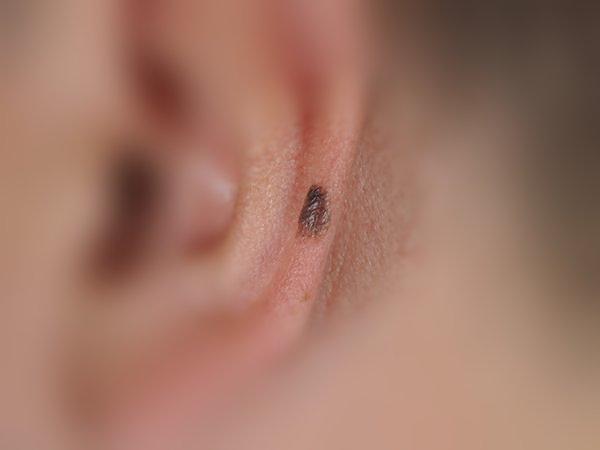
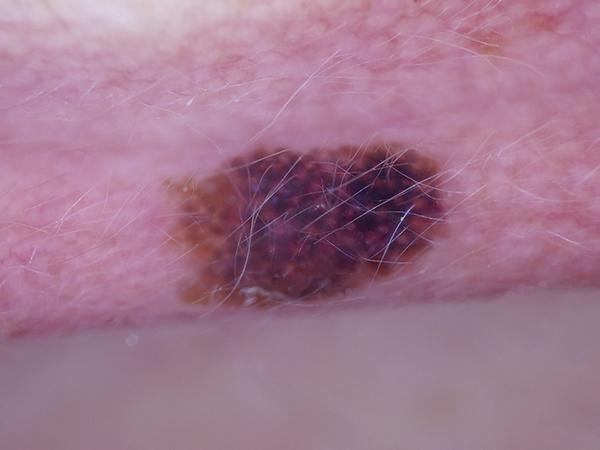
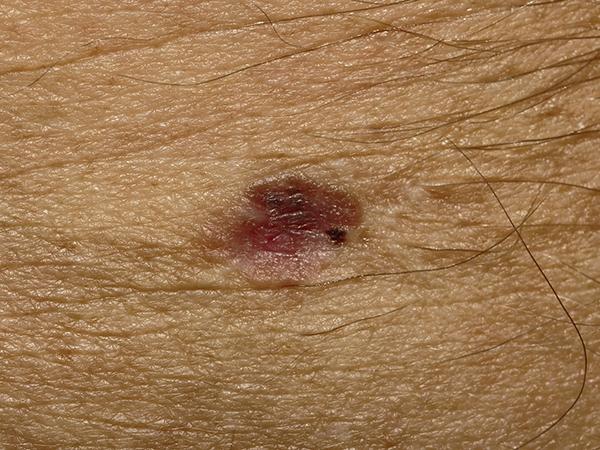
Example image: an invasive melanoma on the ear, below 0.8 mm. The two LLMs returned seborrhoeic keratosis and suggested that the patient could be discharged; the CNN returned melanoma. The clinical photograph is on the left, and the dermoscopic image is on the right. Images: MILK10k, MILK study team, CC BY-NC.
Test setup and data discipline
The lesion set came from MILK10k, a public dataset released through the International Skin Imaging Collaboration in 2025. Each case is photographed twice, once as a clinical close-up and once as a dermoscopic view taken through the magnifying lens used by dermatologists. The 200 sampled cases were biopsy-proven and split into 100 that should not be discharged and 100 that may be safe to discharge. The unsafe group contained 30 melanomas, 25 basal cell carcinomas, 25 squamous cell carcinomas, including Bowen’s disease, and 20 actinic keratoses. The safe group contained 50 benign naevi and 50 seborrhoeic keratoses.
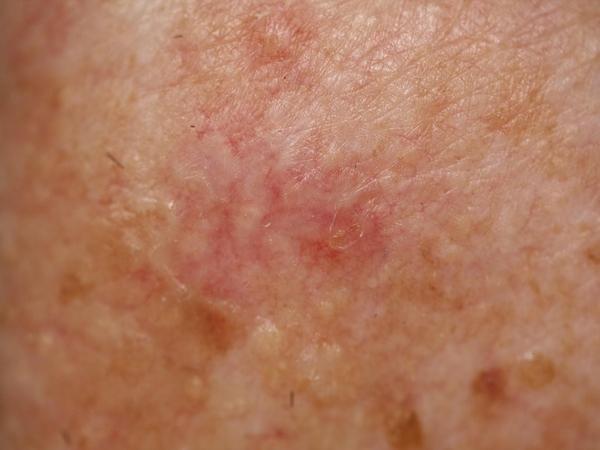
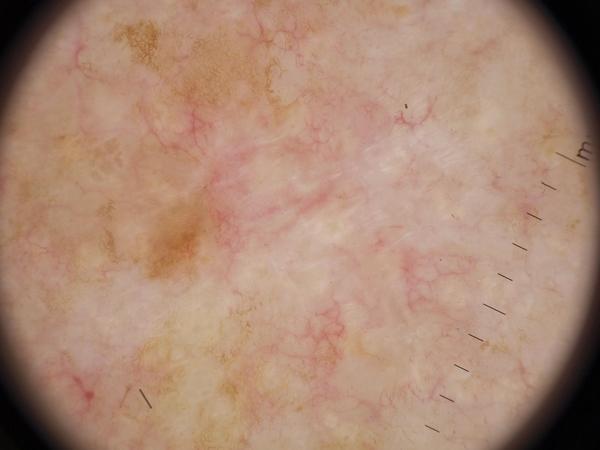
A basal cell carcinoma on the trunk of a 75-year-old man; all three models answered correctly.
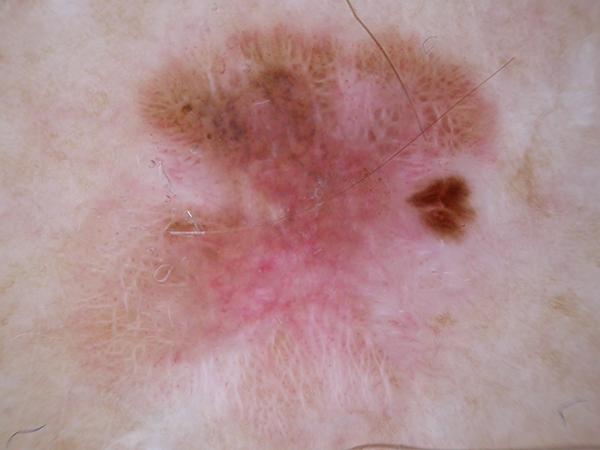
An invasive melanoma under 0.8 mm thick, with very little pigment. GPT-6 Astra called it a basal cell carcinoma with 95% confidence, while Claude Fable 5.1 and the CNN called it a melanoma.
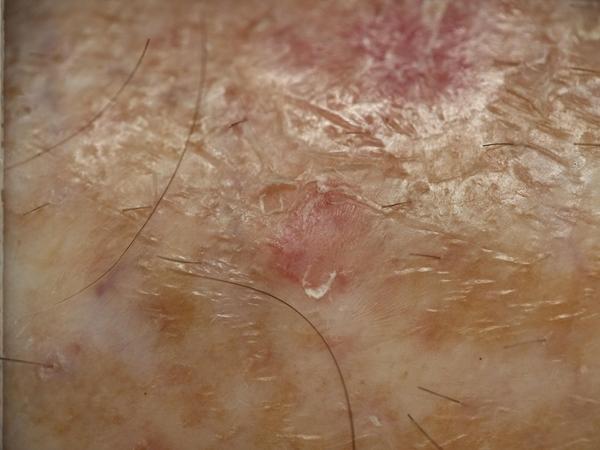
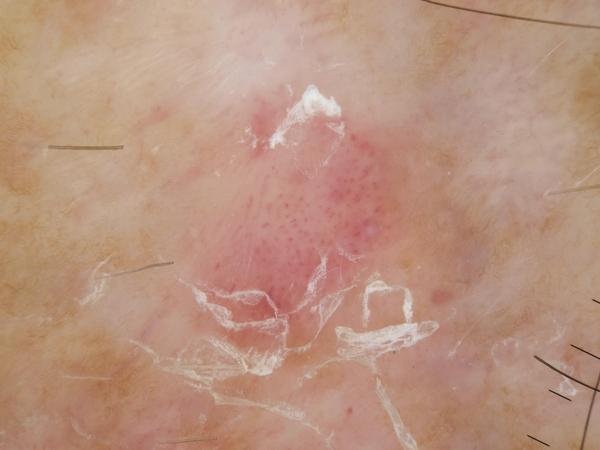
A seborrhoeic keratosis on the leg. Both LLMs called it an actinic keratosis, and the CNN called it a squamous cell carcinoma; all three were wrong, though all three would have kept it rather than discharge it.
Additional cases from the 200 test lesions. The left panel is the clinical photograph, and the right panel is the dermoscopic image. Images: MILK10k, MILK study team, CC BY-NC.
Prompt design for the LLMs
The LLMs received both images and no other context. They were asked to select the most likely answer among 6 diagnoses, or unsure, then provide a confidence value, a second choice, and a discharge recommendation. The same prompt was used for both models at default settings, and neither refused a case. The six diagnostic options were aligned with the task, so the comparison is not a free-text chat exercise.
Model construction and limits
The CNN was intentionally selected as a baseline, not as a frontier architecture. Inception v3 was pretrained on everyday photographs, then all layers were fine-tuned on 68,011 dermoscopic and clinical images from the ISIC Archive on a single H100 GPU. Before training, the 200 test lesions and every other photograph of the same lesion or patient were removed from its training and validation data. Those held-out cases did not choose the model or set the threshold. The network scored both images, used the dermoscopic view with greater weight, and selected from the same six labels.
A practical detail for application teams is that the classifier is small enough to run entirely in a phone browser using WebGPU. Nothing is uploaded, and its random sample button draws from these same 200 lesions. This makes it easy to inspect as a prototype, though it should not be mistaken for a regulated product.
Accuracy results and failure patterns
Across the full set, the CNN was right more often and led on most diagnosis types. If either first or second choice counted, it was correct in 173 cases, versus 134 for GPT-6 Astra and 138 for Claude Fable 5.1. On melanoma, the CNN named 13 of 30 as its first choice, while the LLMs named 8 and 11.
The largest separation appeared on lesions that are often safe to discharge. The CNN recognised 37 of 50 moles and 26 of 50 seborrhoeic keratoses. GPT-6 Astra recognised 16 moles and 13 seborrhoeic keratoses. Claude Fable 5.1 recognised 33 moles and 6 seborrhoeic keratoses. The CNN was one case short of GPT-6 Astra on basal cell carcinoma and trailed both LLMs on actinic keratosis.
Error style also changed. GPT-6 Astra called 75 lesions basal cell carcinoma although only 25 were, including 14 of the 30 melanomas. Claude Fable 5.1 called 53 lesions actinic keratosis although only 20 were. The CNN missed 17 melanomas; among those errors, it called 8 a naevus and 6 a seborrhoeic keratosis.
The result should not be read as a model-architecture argument. A ten-year-old network, fine-tuned for about twenty minutes, outperformed two frontier LLMs on this specific set, scoring 125 against 84 and 85.
Comparison table
| Question | GPT-6 Astra | Claude Fable 5.1 | CNN (Inception v3) |
|---|---|---|---|
| Correct diagnosis out of 200 | 84 (42%) | 85 (42%) | 125 (62%) |
| Correct in first or second choice | 134 | 138 | 173 |
| Melanoma as first choice out of 30 | 8 | 11 | 13 |
| Unsafe lesions kept out of 100 | 97 | 96 | 77 at preset threshold; 98 or 99 when matched |
| Safe lesions discharged out of 100 | 32 | 22 | 76 at preset threshold |
| Melanomas discharged out of 30 | 3 | 4 | 18 at preset threshold; 2 or 1 when matched |
Risk boundaries, caveats, and data hygiene
- Small numbers: Two hundred lesions can show a direction, but close scores are not a reliable ranking. There were only 30 melanomas, so the most consequential figure has wide uncertainty. Each LLM case was run once, and answers may change between runs.
- Hard cases: every lesion was biopsied, so benign lesions in this sample were already concerning to a clinician. On ordinary archive images, the CNN separated lesions that should and should not be discharged better, with an area under the ROC curve of 0.96 rather than 0.86 here.
- Contamination: MILK10k was public in 2025, so the LLMs may have seen it during training. If that happened, it would probably help the LLMs. The CNN was explicitly kept from these lesions.
- Baseline status: Inception v3 is not state of the art. Leading skin diagnosis AI uses ensembles of image transformers trained on larger data, and regulated products built around them perform better.
Patient mode and professional mode
The study also changed the question frame. When the models were approached as a patient interface, using only the clinical photograph and asking “do I need to see a doctor?”, both LLMs advised seeing a doctor in nearly every case, including harmless lesions. Across a further 100 biopsy-proven melanomas, they advised seeing a doctor in 99 and 98 cases.
Method note
The test design and clinical rulings were produced by the study author. Claude Code, a coding tool from Anthropic that runs on a Claude model, generated the analysis and first drafts, and one of the two LLMs tested is also from Anthropic. Scoring was script-based against histology.
Implementation checklist for AI applications
- Confirm that the business problem is narrow enough for a specialist model, such as image classification with a fixed label set.
- Use verified ground truth, not user feedback or model self-assessment, as the scoring source.
- Track first-choice accuracy, second-choice coverage, and critical subtype detection separately.
- Measure discharge behavior, not only diagnostic wording, because unsafe releases are the main operational risk.
- Check calibration: a 95% confidence statement is not a substitute for error-rate evidence.
- Review prompt changes as if they were configuration changes, because they can alter clinical decisions.
- Document data contamination, sample size, difficulty distribution, and whether the model is a baseline.
Step-by-step evaluation tutorial
- Start with a bounded task: six possible answers, a defined image input, and a clear decision such as discharge or keep.
- Split the evaluation into unsafe and safe populations, because a single overall score can hide opposite failure modes.
- Remove duplicate lesion and patient photographs from model development data, then evaluate on held-out biopsy-proven cases.
- Score first choice, second choice, and critical disease detection as separate indicators.
- Compare the specialist CNN against the LLMs under the same prompt, same images, and same label space.
- Run a patient-facing test separately, for example by asking “do I need to see a doctor?” instead of requesting a diagnosis.
- Record caveats before publishing, including 200 cases, 30 melanomas, and single-run variation.
Common misconceptions
- Assuming a newer model must win on every specialized visual task.
- Treating one model output as stable evidence when the case was run once.
- Confusing helpful consumer advice with a triage rule that can safely discharge a lesion.
- Reading 42% versus 62% as a simple model ranking without considering 200 hard, biopsied cases.
- Forgetting that public datasets released in 2025 may appear in model training data, while the CNN was deliberately isolated.
FAQ
Which model had the strongest first-choice accuracy?
The fine-tuned Inception v3 CNN named the correct diagnosis for 125 of 200 lesions, or 62%, while GPT-6 Astra and Claude Fable 5.1 scored 84 and 85, or 42%.
Did the CNN also perform better when second choices were counted?
Yes. It was correct in 173 cases using first or second choice, compared with 134 and 138 for the two LLMs.
What was the main risk boundary?
The study used 200 difficult biopsy-proven cases and only 30 melanomas. Two hundred cases can reveal a pattern, but they are not enough to rank close scores with confidence.
Why does prompt framing matter?
The same models behaved differently when asked as a patient interface. With the question “do I need to see a doctor?”, they recommended doctor visits in nearly every case, including 99 and 98 of a further 100 biopsy-proven melanomas.
Action advice
- Use specialist classifiers for fixed-label image tasks where verified training data and held-out testing are available.
- Use general LLMs for explanation, routing, or intake, but validate their answers against domain evidence before operational use.
- Compare unsafe-kept and safe-discharged outcomes separately, then repeat the comparison when thresholds change.
- Do not present a baseline model, including this Inception v3 test, as a production or regulated alternative without additional evidence.
- Record model age, training time, data source, and error patterns; in this case, a ten-year-old architecture fine-tuned for about twenty minutes changed the conclusion.
For application owners, the value of the October 2026 result is not that an old network defeated two modern systems. The value is the evaluation discipline it exposes: task fit, clean data isolation, decision-specific scoring, and honest risk boundaries are more important than model size alone.