
ItInsightsWorld AIapplications: Building Checkable Statutory History for Legal AI Workflows
By James Hartley, IT Insights
For an AI product that answers legal questions, the first test is not grammar but lineage. A codebase can reveal who changed a line and when; a statute normally cannot unless the researcher decodes the notes under the section. That asymmetry has become an application problem because language models now handle much first-pass legal research. If they cannot consume the proper lineage of a law, their interpretations are handcuffed. The answer is a statutory history asset that carries text, effective dates, and reach-back scope, tested across 365 changes since 2017.
Application framing: what legal AI needs from a source record
For AIapplications in legal services, compliance research, contract review, or policy analysis, a record needs three fields. First, the text of the provision at a chosen moment. Second, the date each change took force. Third, the scope of any law that reaches back. Those fields turn a document view into a workflow asset: search by date, compare versions, flag changed defined terms, and give users a source to audit.
Checklist: minimum requirements before linking a model to statute answers
- Release points can be selected by effective date.
- Amending instructions are stored as machine-readable text, not only as prose notes.
- Default effective dates are distinguished from explicit effective-date notes.
- Reach-back changes are visible for pending cases.
- Defined-term updates list every provision that uses the term.
- Each change links to the law’s own words.
- Model output can be compared with the authoritative text.
Why the US Code is hard to version in practice
Except for the titles Congress has enacted as positive law, the code is only prima facie evidence of the law; where the code and the Statutes at Large differ, the Statutes at Large govern. The Office of the Law Revision Counsel publishes the code as a series of release points, each current through a named public law, and keeps reorganising it. A bill to enact title 41 as positive law was introduced in September 2025. Prose amendment notes record which public law wrote a sentence. The effective date is often placed in a separate effective-date note. Where Congress said nothing, the default rule is that a law takes effect on the day it is enacted.
Case walkthrough: the small business debtor definition in 11 USC § 1182(1)
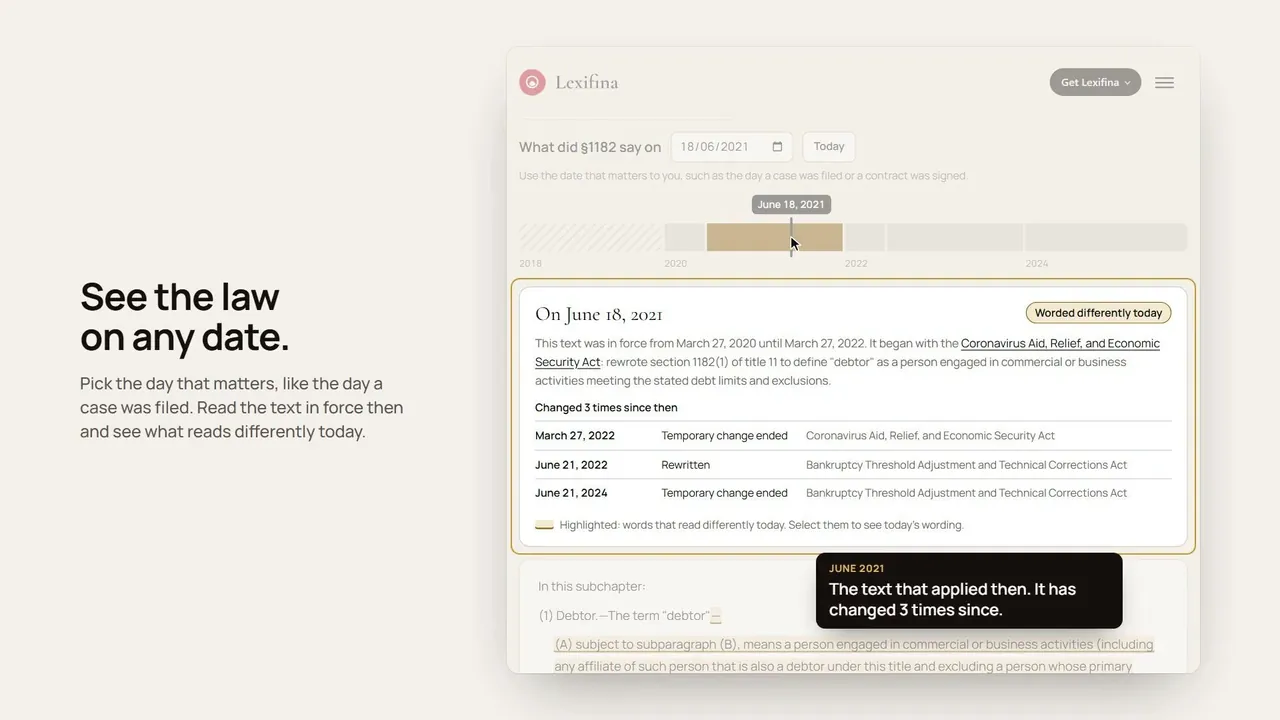
The definition of a small business debtor in 11 USC § 1182(1) shows how far apart those answers can be. The definition was created in 2019 with the existing small business debt limit. As a temporary measure, the CARES Act raised the limit to $7.5 million in March 2020, and it was later extended to March 2022. The increase lapsed on 27 March 2022. Then, on 21 June 2022, Congress restored it for two more years for cases commenced on or after 27 March 2020 and still pending, which reached back over the gap. The higher limit expired again in June 2024. After the triennial adjustment in April 2025, it stands at $3,424,000. For a case filed in May 2022, the release point printed at the time gives the lower limit; only a later Act changes the answer.
| Workflow question | Record behavior | Application implication |
|---|---|---|
| What limit applied on a filing date? | For May 2022, the printed release point gives the lower limit. | Answers must be pinned to the date in force, not current text. |
| Does a later law change the result? | The June 2022 restoration reached back over the gap. | Pending cases need reach-back visibility. |
| How is each change justified? | Each change carries the law and the date it took effect. | Users can audit the basis for an AI answer. |
A history useful to a lawyer must carry the text, the date each change took force, and the scope of any law that reaches back.
What the research says about model failures
A study from the Technical University of Munich found two failures in models answering questions on German statutes. The models apply rules that were superseded after their training cutoff, and they prefer the newer provision even when an older one governs the facts. One model answered 24% of post-cutoff questions correctly on its own and 87% when the relevant statutory text was retrieved for it. The authors conclude that temporal validity has to be treated as a hard constraint. Other recent work trains search agents to respect the date a question is about, with large gains in consistency.
Why generating old text is not enough
Asking a model to produce the old text does not solve this. When the same Munich group had a model apply German amending laws to earlier versions, the output looked 93–99% similar to the official text. However, only half of single amendments and a fifth of chains of amendments matched exactly, and experts found legally significant errors in the near misses. The history has to be checkable.
Step tutorial: turning release points into a checkable history
- Start with each pair of release points from 2017 onward.
- Take the public laws enacted in between.
- Carry out their amending instructions on the older text in date order.
- Compare the result with the newer version.
- Across the nine titles, examine 365 changes; confirm that 361 reproduced the next release point exactly.
- Label the other four to show how far they can be confirmed.
- Attach the law and the date to each change: 261 took effect on enactment by default, 72 by an effective-date note, and 29 by a date in the amendment itself.
- Exclude one that depends on an agency determination that may never come, rather than guess.
Product layer: what readers can do with the record
The record lets readers answer the questions lawyers ask. A date can be chosen to retrieve the text in force then, marking words that read differently today. The Act that wrote each phrase colours it. When a defined term changes, every other provision that uses it is listed, and a section can be followed to see what has changed since the last visit.
Comparison table: how to support a legal AI workflow
| Approach | What it answers | Known weakness | When it fits |
|---|---|---|---|
| Current text only | Shows today’s wording. | Can miss a later law’s reach back; a May 2022 filing may look lower. | General drafting, not dated compliance. |
| Model-generated consolidation | Recreates older text from amending instructions. | Looks 93–99% similar, but only half single amendments and a fifth chains matched exactly. | Draft exploration, not checked output. |
| Checkable release-point history | Retrieves the text in force at a date and exposes effective dates. | Still limited where reach-back is not shown; original law should be read. | Legal AI, audit, compliance, product workflows. |
Common misconceptions
- A model that sounds current is not necessarily temporally valid.
- A release point printed at the time is not always the final answer for pending cases.
- 93–99% similarity does not equal legal correctness, because only half and a fifth of exact matches were found in the tested settings.
- Prose amendment notes are not enough if the workflow needs dates and reach-back.
- Retrieval is not optional in high-stakes legal answers; the Munich evidence shows the gap between 24% and 87%.
Known limits of the rebuilt record
- The record does not yet show a later law’s reach back on the earlier dates it covers. For a case filed in the 2022 gap, it shows the lower limit without warning that the June 2022 Act changed the answer.
- Effective-date notes are read by pattern. Unusual wording falls back to the date of enactment.
- Each change links to the law’s own words. For anything that matters, the original should be read.
- Teams still need to decide the right form factor this should take.
FAQ
Does the code always govern?
Except for the titles Congress has enacted as positive law, the code is only prima facie evidence; where the code and the Statutes at Large differ, the Statutes at Large govern.
What happens when Congress says nothing?
The default rule is that a law takes effect on the day it is enacted.
Can a later Act change the answer?
Yes. For a case filed in May 2022, the release point printed at the time gives the lower limit; only the later June 2022 Act changes the answer by reaching back.
Is high textual similarity enough?
No. Output looked 93–99% similar to official text, but only half of single amendments and a fifth of chains of amendments matched exactly.
What did the rebuilt record test?
Starting with each pair of release points from 2017 onward, it examined 365 changes across the nine titles; 361 reproduced the next release point exactly, and four are labeled by how far they can be confirmed.
Action recommendations
- Before deploying legal AI, require a history service that can return text by date and expose effective-date metadata.
- Use retrieval of the relevant statutory text rather than relying on parametric memory alone; the Munich evidence shows the gap between 24% and 87%.
- Treat temporal validity as a hard constraint in evaluation, routing, and user interface design.
- Track defined-term cross-references and reach-back legislation, not only amendment wording.
- Make the law’s own words reachable from every AI answer, and compare model output with authoritative text before release.
References
- 1 USC § 204(a) www.law.cornell.edu/uscode/text/1/204
- Office of the Law Revision Counsel, ‘Positive Law Codification: Title 41’ (H.R. 5185, 119th Congress, introduced 8 September 2025) uscode.house.gov/codification/t41/index.html
- Gozlon-Peretz v United States 498 US 395, 404 (1991) www.law.cornell.edu/supremecourt/text/498/395
- Small Business Reorganization Act of 2019, Pub L 116-54 www.govinfo.gov/content/pkg/PLAW-116publ54/html/PLAW-116publ54.htm
- Coronavirus Aid, Relief, and Economic Security Act, Pub L 116-136, s 1113 www.govinfo.gov/content/pkg/PLAW-116publ136/html/PLAW-116publ136.htm
- COVID-19 Bankruptcy Relief Extension Act of 2021, Pub L 117-5 www.govinfo.gov/content/pkg/PLAW-117publ5/html/PLAW-117publ5.htm
- Bankruptcy Threshold Adjustment and Technical Corrections Act, Pub L 117-151, s 2(h)–(i) www.govinfo.gov/content/pkg/PLAW-117publ151/html/PLAW-117publ151.htm
- Judicial Conference of the United States, ‘Adjustment of Certain Dollar Amounts Applicable to Bankruptcy Cases’ 90 Fed Reg 8941 (4 February 2025) www.govinfo.gov/content/pkg/FR-2025-02-04/html/2025-02207.htm
- US Trustee Program, ‘Subchapter V’ (US Department of Justice) www.justice.gov/ust/subchapter-v
- Max Prior, Andreas Schultz and Matthias Grabmair, ‘Asking For An Old Friend: Diagnosing and Mitigating Temporal Failure Modes in LLM-based Statutory Question Answering’ (arXiv:2605.23497, 22 May 2026) arxiv.org/abs/2605.23497
- Wei Fan and others, ‘Can LLMs Time Travel? Enhancing Temporal Consistency in Legal Agentic Search through Reinforcement Learning’ (arXiv:2605.25920, revised 19 September 2026) arxiv.org/abs/2605.25920
- Max Prior, Adrian Hof, Niklas Wais and Matthias Grabmair, ‘Risks and Limits of Automatic Consolidation of Statutes’ in Proceedings of the Natural Legal Language Processing Workshop 2025 (ACL, November 2025) 396 aclanthology.org/2025.nllp-1.29/