
The 2026 AI Deployment Playbook for B2B Go-to-Market: Steps, Checklists and Traps to Avoid
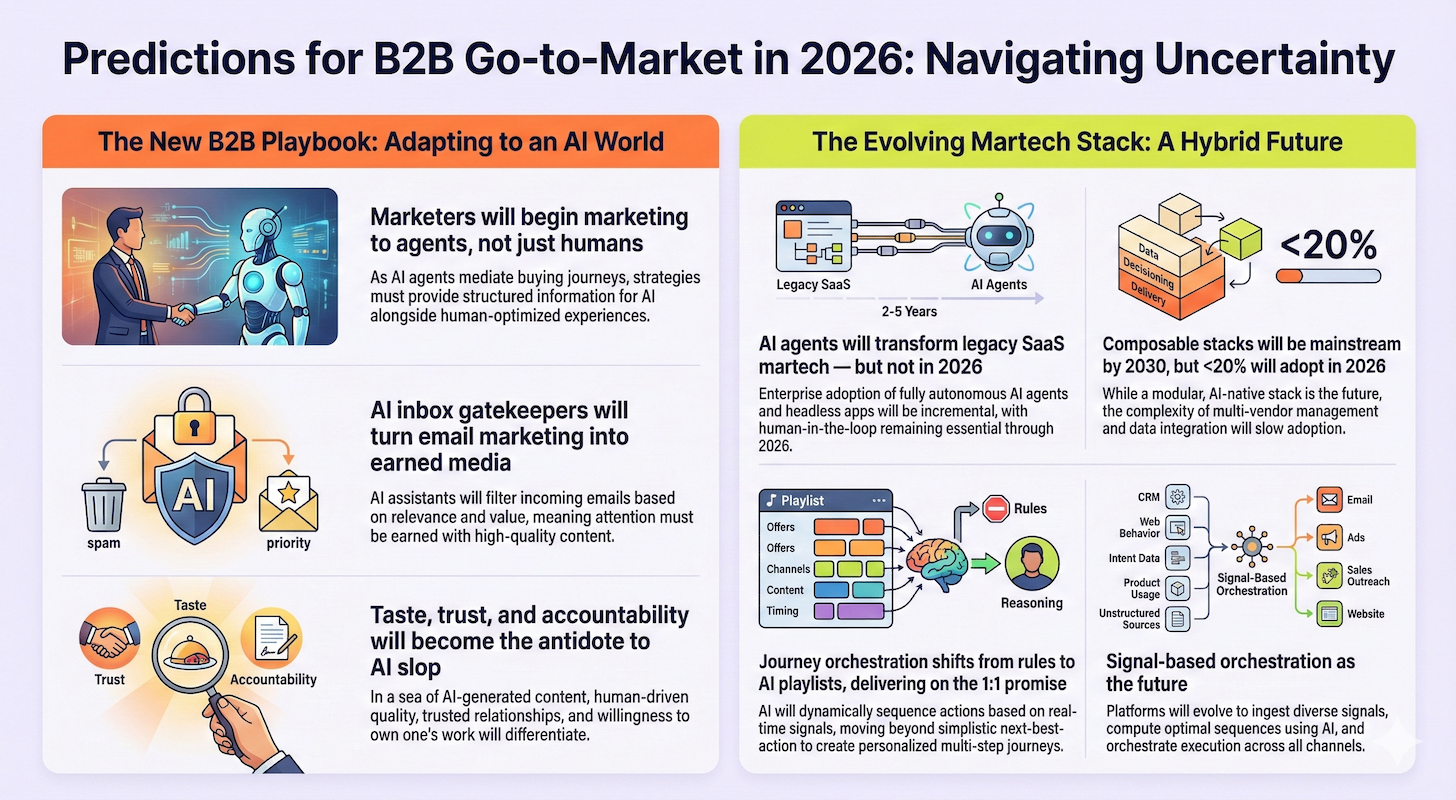
Short answer: in 2026, deploy AI as SaaS with intelligence built in, not as unsupervised agents. Ship assistants that draft, segment, score and route while a named human approves each step; connect systems through the Model Context Protocol, or MCP; and invest first in context engineering, because the binding constraint in real accounts is operational knowledge, not model quality.
This field guide converts Jon Miller’s fourth annual B2B go-to-market forecast into an implementation plan. Miller — co-founder and original CMO of Marketo, widely credited as an architect of modern B2B marketing and ABM, now co-founder and CEO of a stealth AI startup — has published editions for 2023, 2024 and 2025 and grades himself publicly every year. His 2026 thesis: the AI-powered marketing vision sharpens, as agents join buying committees, reasoning systems displace brittle rules and orchestration finally delivers the decades-old 1:1 personalization promise, while enterprise adoption stays incremental. That gap between direction and yearly reality is exactly where operators have to work.
Why a playbook instead of another prediction list? Because most AI deployments still do not pay back. MIT’s Project NANDA report, "The GenAI Divide: State of AI in Business 2025", concluded that roughly 95% of enterprise generative AI pilots delivered no measurable return despite $30-40 billion invested, and that buying from specialized vendors or partnering succeeded about 67% of the time versus roughly one-third for internal builds (Fortune, August 2025). Gartner added, in June 2025, that over 40% of agentic AI projects will be canceled by the end of 2027 because of escalating costs, unclear business value or inadequate risk controls. For a GTM team, the operational reading is blunt: scope narrowly, instrument everything, keep humans in the loop.
What is actually changing in B2B go-to-market in 2026?
Conclusion first: the predictions are real, but only a handful are executable inside one fiscal year. The table below is the full prediction map from the forecast, translated into what an AI application team can act on. Columns two and three are this desk’s application-layer reading, not the author’s wording.
| Prediction | Application-layer meaning | Move to make in 2026 |
|---|---|---|
| Marketing starts addressing agents, not only humans | Software joins the evaluation panel alongside people | Serve two audiences from one content and services foundation; instrument agent traffic |
| Legacy SaaS martech is completely transformed by AI, but not in 2026 | Interfaces thin out before they vanish | Budget across 2-5 years; buy bridges, not moonshots |
| Composable stacks mainstream by 2030, but <20% will adopt in 2026 | Modularity transfers work to your team rather than removing it | Run composable lite: data-first, decision-first |
| Context engineering becomes a recognized practice across GTM teams | The scarce input is business knowledge, not compute | Turn tribal rules into documented, versioned skills |
| Reasoning AI starts replacing rules-based automation | Decision logic moves from if/then lists to model calls | Keep deterministic fallbacks where compliance applies |
| Journey orchestration moves from rules to AI playlists and delivers on the 1:1 promise | Next-best-action across channels, not campaign-by-campaign | Close the feedback loop before expanding channels |
| AI inbox gatekeepers make email marketing feel like earned media | Relevance is enforced before your message is seen | Raise value density per send; cut volume |
| Taste, trust and accountability counter AI slop | Named human owners become a differentiator | Add editorial sign-off and attribution to workflows |
| Public intent signals commoditize while proprietary signals generate "alpha" | Everyone buys the same data; nobody wins with it | Mine product usage, support tickets, community and agent visits |
| Where martech is heading after 2026 | Digital workers sold as outcomes | Track pricing-model shifts as a leading indicator |
| Rapid-fire mini-predictions | Micro-shifts outrun annual planning cycles | Review tooling and tactics quarterly, not yearly |
| AI-driven uncertainty intensifies in 2026, and preparation is the only answer | Forecasting beats optimizing in a volatile market | Buy optionality: shorter terms, exit clauses, portable data |
How do you market to AI agents that join the buying committee?
Conclusion first: publish one foundation of structured facts and services, then let two distribution paths read it. Scott Brinker frames the shift as "from martech to marketing to tech", treating AI agents as part of the buying committee rather than as a traffic anomaly.
The evidence that 2025 already moved
2025 was the year of Answer Engine Optimization (AEO). The TrustRadius 2025 report says 90% of B2B buyers used tools like ChatGPT for research and 72% encountered Google AI Overviews during vendor evaluation. That helps explain why 63% of marketers now publish AI-optimized content such as structured FAQs and schema markup, per the Martech for 2026 report from Chiefmartec and MartechTribe, and why they build presence on platforms where LLMs source answers, including Reddit and G2. Digital Bloom reports 51% of companies plan to increase AEO investment, against 14% for traditional SEO.
Six steps to an agent-ready presence
- Make "how AI describes us" a product marketing KPI. AI becomes the new analyst briefing: executive teams will watch how models position them against competitors, the way they once watched Google rankings. Run a monthly answer audit across the assistants your buyers use, and log the claims, omissions and competitor pairings.
- Tag agent requests as first-party intent. When an AI agent asks your site for pricing or product specs, that is a buying signal, and it should feed scoring and buying-stage prediction. Agent visitors will contribute to Marketing Qualified Accounts (MQAs) just like human visitors.
- Solve identification before scoring. This requires "agent deanonymization": an unknown startup’s agent researching your category is noise, while a Fortune 500 company’s agent comparing your capabilities against competitors could be pipeline. Practically, the plumbing now exists: agent traffic can be verified through cryptographic request signing (Web Bot Auth, exposed commercially as Cloudflare’s Signed Agents in August 2025), and site owners can allow, charge or block crawlers through Cloudflare’s pay per crawl, launched in private beta on July 1, 2025. Treat signed-agent requests as a distinct audience segment rather than folding them into "bots excluded".
- Build the headless layer. Marketing to both humans and agents means a foundation layer of core data, content and services with two distribution paths: branded web experiences optimized for emotional engagement for people, and direct access to services for machines — pricing APIs that return dynamic quotes, knowledge bases that answer detailed product questions. Both paths personalize by role and buying stage. This requires infrastructure that fields detailed queries accurately; chat vendors like Qualified have been building it, which likely contributed to their acquisition by Salesforce.
- Watch paid AEO without betting the plan on it. Early adoption of ads inside AI results is appearing: Perplexity already sells sponsored follow-up questions, and Google shows search and shopping ads in AI-generated summaries, especially for complex or commercial queries. OpenAI has plans to monetize free users with ads, though those were temporarily deprioritized after December’s "code red" to refocus on core product quality. Audience targeting in paid AEO is exciting but likely post-2026; the future prize is bidding more for known contacts and accounts, as paid search already allows.
- Prepare, without over-investing, for agent nurturing. This is Miller’s explicit speculation: regularly pinging a company for updates may be computationally expensive for an agent, so agents might "register" or "opt-in" to proactive updates from vendors their humans care about. If that lands, "agent nurturing" becomes a channel — the minimum 2026 task is a subscription endpoint and a machine-readable update feed.
What will not change
AI agents optimize for objective criteria — capabilities, pricing, compliance requirements — and they do not care about your brand story. But humans still make the final decision, at least for now: the 6sense Buyer Experience Report for 2025 showed human buyers averaged 16 vendor interactions, unchanged from 2024. Complex purchases still need human validation, relationship building and trust. Agents compress research time; people sign contracts.
Trap: AEO tactics are probably temporary
Optimizing static content for AI engines — special markup, structured FAQs, machine-readable formatting — resembles early SEO, when practitioners stuffed keywords and gamed algorithms. Google has long advised creating for humans, not machines, and its current AI documentation confirms: "You don’t need to create new machine-readable files, AI text files, or markup to appear in these features." The durable asset is the headless service infrastructure; the markup tricks will likely go unnecessary as models read human-optimized content better. Miller predicts we will stop needing to optimize content for AI, exactly as happened in search. Budget accordingly: services over markup.
Why 2026 is the year of hybrid AI, not autonomous martech
Conclusion first: "SaaS is dead." is the loudest claim on LinkedIn and the least executable this year. Anyone who spends time there has seen the proclamation, and as Scott Brinker notes, following only techno-optimist influencers who claim to run entire departments with vibe-coded agents will make you feel desperately behind. Miller’s prediction: AI will reshape marketing technology, but over the next 2-5 years. 2026 is a year of hybrid experimentation, in which SaaS platforms old and new coexist with agentic AI, and human-in-the-loop remains essential across nearly all implementations.
The vision being sold looks like this: you describe a goal and AI orchestrates everything across channels, with no campaign builder. "Promote our Q4 launch to enterprise accounts in financial services" becomes a single request that an AI translates into personalized content, coordinated timing, channel selection and budget optimization.
The three disruption fronts
1. From software tools to autonomous agents
When you can hire digital workers who never sleep, never quit and scale infinitely, why pay for licenses? Many of the fastest-growing AI companies, including Cursor and Harvey, are not about helping humans work better; they are about replacing labor entirely. Brendan Short argues the next major GTM company will "sell labor" rather than software, most likely as AI agents managed by GTM operators. You stop buying software that helps people do work and start hiring AI to do the work: paying for outcomes, not seats.
2. From user interfaces to headless applications
Instead of logging into individual platforms, many people will work inside their chatbot of choice. Functionality exists, but the interface layer disappears. Analytics is the clean use case: a CMO asks an AI assistant "which campaigns performed best this quarter". Yet chat is not always better than clicks — for experienced users doing repetitive tasks, a familiar UI usually beats describing intent and waiting for an agent to interpret it. This is why the Model Context Protocol matters: rather than custom connectors between every AI application and every tool, one standardized protocol lets each side build one connection and interoperate. Adoption data supports the durability of that bet: MCP was introduced by Anthropic in November 2024, adopted by OpenAI in March 2025, and by December 2025 Anthropic reported more than 10,000 active public MCP servers and moved the specification to a foundation body.
3. From monolithic platforms to composable apps
AI can code mini-applications for specific problems, often unprompted, and users can "vibe code" simple solutions themselves. Over time this shrinks the number of lower-value apps in various app stores. There are limits. "Martech for 2026" offered a useful framework: simple apps such as dashboards and internal tracking tools work fine for non-engineers, anything handling sensitive data needs qualified developers, and complex enterprise platforms such as CRM and marketing automation should still be bought from commercial vendors. The likely shape: core platforms from trusted vendors surrounded by bespoke mini-apps filling company-specific needs.
Four brakes that keep 2026 incremental
- Adoption is assist-heavy. In 2025, 81% of AI usage is "assist-only", while less than 10% lets agents act autonomously.
- Organizations absorb slower than technology changes. Brinker’s Martec’s Law holds: compare mainframe-to-enterprise-software and enterprise-software-to-SaaS transitions, or how long MQLs persisted despite better options like MQAs. This is measured in years, not quarters.
- Enterprise requirements persist. SaaS platforms are valued for infrastructure built over years: compliance and security, governance and auditability, scalability and integrations. An AI layer does not remove those needs.
- Technical complexity and hallucinations remain. Dynamic orchestration for millions of contacts, bidirectional sync with Salesforce, complex data models and edge cases are hard engineering problems. Confident-but-wrong output is still a barrier to autonomy: you cannot let agents unilaterally decide whether to honor CAN-SPAM opt-outs or GDPR deletion requests, so human-in-the-loop stays.
The pricing model tells the real story. If SaaS were truly dead, outcome-based pricing would be widespread. Instead, Salesforce recently introduced its Agentic Enterprise License Agreement, which uses credits but is seat-based at the core; as CFO Amy Weaver explained, customers want seat-based pricing because "it gives you predictability." The unit economics behind the credits are public: Salesforce’s Flex Credits were announced on May 15, 2025 at $500 per 100,000 credits, with one agent action consuming 20 credits, about $0.10 per action, and its Help Agent is billed only when an inquiry is successfully resolved. Consumption and even outcome billing exist — they are simply additive line items on top of seats, not a replacement for them.
What to actually buy and ship in 2026
2026 will not look like autonomous agents running headless applications; it will look like SaaS with AI built in. The self-driving analogy fits: not full autonomy, but advanced driver assistance where the human stays alert, in control and ready to take over. Enterprise marketers want a better Marketo, not a wholesale re-architecture: AI-assisted campaign creation that still shows the workflow before it executes, intelligent audience segmentation they can review and adjust, and AI providing "air traffic control" between campaigns to prevent message conflicts, all with traditional interfaces and human approval loops. That is what gets adopted. It also explains why new AI-native platforms should get more traction than add-ons bolted onto legacy systems: the credible ones are architected agentic, API-driven and MCP-enabled at their core while still supporting UI-based workflows and oversight patterns today — the bridge, functional now and agentic later.
How to run a 2026 AI pilot that beats the failure statistics
Conclusion first: pilots die from undefined gates, unmeasured baselines and hidden review labor, not from weak models. Here is a sequence that works in mid-market B2B teams.
- Pick one workflow where speed matters and errors are cheap. Internal candidates that fit: campaign brief drafting, audience segment proposals, webinar follow-up sequencing, enrichment QA. Candidates that do not fit yet: suppression list edits, legal-reviewed outbound, pricing exceptions.
- Buy or partner before you build. The MIT NANDA finding — roughly 67% success for purchased vendor solutions and partnerships versus about one-third for internal builds — is the cheapest insurance available in 2026, and it matches the "Martech for 2026" split between vibe-coded simple apps and vendor-supplied core platforms.
- Write the gate matrix before the first demo. Class every action: read-only draft (auto), write to CRM (review queue), outbound send (named approver), compliance or consent decision (human only). If a vendor cannot describe how its agent behaves in each class, that is a scoping answer, not a technical one.
- Instrument before scaling. Log prompt, inputs, retrieved sources, output, human edits and downstream outcome; track override rate as your primary quality signal; separate verified agent traffic from human sessions so intent scoring is not polluted.
- Model the full cost stack, including labor. Seats, consumption credits (for example about $0.10 per agent action), integration and MCP server maintenance, data movement, human review time, and the unglamorous context-engineering hours. Review time is the line item most often missing from the business case, and Gartner’s cancellation causes — escalating costs, unclear business value, inadequate risk controls — map directly onto it.
- Set a 90-day tripwire. Pre-register the metric (cycle time, coverage, lift in meeting-qualified accounts, override rate), the baseline and the decision rule. Shrink scope deliberately when value is unclear; do not let an unused pilot drift into permanent spend.
Illustrative scenario, our analysis rather than a reported case: a mid-market vendor running the financial-services motion above with two named approvers, AI-drafted segments and human-approved sends. The measurable claim is not "AI wrote the copy" but a change in cycle time from brief to live campaign, and a drop in message conflicts between overlapping programs — the operational version of "air traffic control". Frame your business case in those terms and it survives an executive review.
Should you assemble a composable martech stack in 2026?
Conclusion first: plan composable, implement composable lite. A composable stack is built from modular layers instead of a single vendor suite:
- A Data layer as source of truth, combining customer data from multiple sources into actionable inputs
- A Decisioning layer for intelligence such as audience selection and journey orchestration
- Various Delivery tools executing messages across channels via APIs
The appeal is choosing the best tool for each job, swapping components when better options emerge and avoiding lock-in. Movement is real but slow: The Digital Bloom’s analysis of martech stacks shows marketing automation platforms losing ground as the "center" of B2B stacks, from ~31% to ~26% of respondents year over year, while custom platforms — a proxy for composable — grew from 2% to 10%. Most mid-market B2B firms still prefer integrated platforms such as Marketo or HubSpot over assembling a complex stack. Miller’s call: by 2030 a modular, AI-native, signal-driven stack is the norm, but fewer than 20% of B2B teams will run a fully composable architecture in 2026 — the "<20%" figure in his list.
Why adoption lags
- Flexibility shifts complexity; it does not remove it. You trade vendor-managed convenience for control, and you own making the pieces work together. MCP will improve this slowly.
- Multi-vendor management is harder than it looks. Mike Lowndes, VP Analyst at Gartner, noted: "Especially in B2B, the challenges of adopting composable solutions are significant. Many organizations struggle to manage multiple vendors and contracts effectively, particularly if they lack the necessary digital maturity."
- Data warehouses are not built for marketers yet. These platforms are typically designed for engineers and analysts; legacy martech struggles to reach product or behavioral data stored there, producing silos, API-limit workarounds and manual extracts.
- Decisioning and Delivery are hard to separate. Your ESP may not support the dynamic personalization your model envisioned, and true optimization needs a closed feedback loop. As Real Story Group observed, "true orchestration requires closing the loop across data, decisioning, and content layers" — something few stacks achieve today.
Three architectures compared
| Dimension | Integrated suite | Composable lite | Fully composable |
|---|---|---|---|
| Who owns integration | Vendor | Vendor for execution, you for data | You |
| Where orchestration lives | Inside the MAP | Inside the MAP | Standalone decisioning layer |
| Where intelligence sits | Vendor defaults | Warehouse for scoring and segments | Warehouse plus model services |
| Talent requirement | MOPs operators | MOPs plus one data engineer | Platform engineering team |
| Lock-in risk | High | Moderate | Low |
| Time to first AI-assisted campaign | Weeks | One to two quarters | Multiple quarters |
| 2026 outlook | Default for most mid-market B2B | The realistic target | fewer than 20% of teams; mainstream by 2030 |
In the composable lite model, the warehouse becomes an important source of truth, but your MAP, website, chat tools, ad platforms and other execution channels are not dumb pipes. Final journey orchestration stays inside the MAP even as scoring, segmentation and some intelligence shift toward the warehouse: a stepping stone that captures benefits without dismantling everything at once.
What is context engineering, and how do you start it this quarter?
Conclusion first: this is the highest-leverage operations discipline a GTM team can stand up in 2026. Poor data quality is consistently cited as the biggest obstacle teams face with AI systems, but "data quality" undersells the problem. The real gap is giving AI the operational context it needs to act like someone who understands your business. Miller’s prediction: in 2026, context engineering — systematically capturing and structuring the knowledge that makes AI useful rather than generic — becomes a recognized practice across GTM operations teams. Anthropic’s engineering guidance defines the analogous practice for builders as curating and maintaining the optimal set of information available to a model at each step of an agent’s run; in GTM terms, that is your rules, vocabulary and rationale, not just your rows.
What counts as context
- Connections to the sources your team already uses: CRM, data warehouse, call recordings, marketing platforms, internal documentation
- An enablement layer that explains what the data means and why: campaign naming conventions, which segments to include or exclude and the reasoning behind those rules
- Operational definitions: what a "webinar campaign" means at your company — which tactics to create, what the follow-up sequence looks like, how leads get routed
- Institutional archaeology: the reasoning behind a Salesforce schema after ten years of accumulated customization
That knowledge is not formally captured anywhere. It lives in Slack threads, in tribal knowledge and in the heads of senior team members; when your best MOPs person leaves, it walks out the door with them. Legacy platforms do not help: they can tell you which campaign a lead is in, but not why that campaign exists, what strategy sat behind it, or which approaches were tried and abandoned. They store outcomes, not decision logic. Forrester described the same inversion on the discovery side in October 2025, arguing AI-powered search moves B2B buyers from keywords toward context.
A first-sprint checklist
- Inventory every system an agent will be allowed to read, and name a human owner for each.
- Interview operators for the three most-repeated workflows and record the actual sequence, not the documented one.
- Encode each workflow as a reusable "skill": trigger, inputs, guardrails, output format, escalation condition.
- Attach the rationale next to each rule, so the model can reason instead of overfitting.
- Version the context like code, with change history and an owner, and re-test after each model or platform update.
- Measure lift against a pre-AI baseline on override rate and cycle time, not on volume produced.
Ops teams will spend real time teaching platforms skills: how to interpret a data schema, how to build a webinar campaign, which segments to use and when. It looks like onboarding a new hire, except the knowledge becomes durable and reusable rather than trapped in someone’s head. Unlike AEO markup, this asset compounds.
Which risks and traps kill GTM AI projects?
- Autonomy where consent is decided. Letting agents dynamically interpret CAN-SPAM opt-outs or GDPR deletion requests is not a 2026 feature; it is an incident.
- Confusing a thin wrapper with a bridge. Add-ons retrofitted onto legacy systems rarely ship the agentic, API-driven, MCP-enabled core that the transition requires.
- Chat everywhere. For repetitive expert tasks, a familiar UI often beats an agent round-trip; route headless only where it saves time.
- Over-buying markup. Static AEO tactics may be temporary, while the service layer underneath is durable.
- Unmanaged multi-vendor sprawl. Contracts, roadmaps and support across five vendors require digital maturity most mid-market teams do not have yet.
- Agent traffic scored as human intent. Without agent deanonymization, MQA models fill up with research noise.
- Outcome-washed pricing. Credits sold as outcomes still ride on seat agreements; read the invoice structure, not the marketing.
- Untracked review labor. Human-in-the-loop is a staffing decision and a cost line.
FAQ: what operators ask before shipping AI
Should we rewrite our content for AI engines in 2026?
Partially, and modestly. Buyers already use ChatGPT in 90% of research workflows per TrustRadius, so machine-legible facts matter, but Miller expects static markup tactics to decay, and Google’s own documentation says no special files are required. Prioritize a service layer your agents and assistants can query over schema experiments.
What is the realistic autonomy level for marketing agents this year?
Assist-first. With 81% of usage assist-only and less than 10% granting agents autonomy, plan for drafted-and-approved work, not unsupervised sends.
Do we need a composable stack to use AI well?
No. You need a trustworthy data layer and documented decision rules. Composable lite gives you warehouse-based scoring and segmentation while orchestration stays in your platform — the route that fits the fewer than 20% reality.
How do we prove ROI to a CFO?
Register the metric and baseline before launch, cost the full stack including review time, and compare against the MIT finding that purchased and partnered solutions succeed roughly twice as often as internal builds.
What happens to email when AI gatekeepers filter the inbox?
It behaves more like earned media: relevance and value density decide delivery, so send fewer, sharper programs and measure engagement quality rather than raw volume.
Your next 90 days: an action checklist
- Audit how the top five assistants describe your company versus competitors; assign an owner and a monthly cadence.
- Add verified-agent segmentation to web analytics and start feeding those signals into intent scoring.
- Ship one MCP-connected service: a pricing or spec endpoint that answers detailed queries reliably.
- Publish the gate matrix for AI actions and get compliance sign-off on it.
- Document three workflows as versioned skills, including the reasoning behind the rules.
- Baseline cycle time, override rate and cost per action, then set a 90-day tripwire for scope decisions.
Sources and further reading
- Jon Miller, "11 Predictions for B2B Go-To-Market in 2026" — jonmiller.com/blog/2026/1/18/11-predictions-for-b2b-go-to-market-in-2026
- Gartner, "Gartner Predicts Over 40% of Agentic AI Projects Will Be Canceled by End of 2027", 25 June 2025 — gartner.com/en/newsroom/press-releases/2025-06-25
- Fortune on MIT Project NANDA, "The GenAI Divide: State of AI in Business 2025", 18 August 2025 — fortune.com
- Anthropic, "Donating the Model Context Protocol and establishing of the Agentic AI Foundation", December 2025 — anthropic.com/news
- Anthropic engineering guidance, "Effective context engineering for AI agents", 29 September 2025 — anthropic.com/research
- Cloudflare, "Introducing pay per crawl" (1 July 2025) and "The age of agents: cryptographically recognizing agent traffic" (28 August 2025) — blog.cloudflare.com
- Salesforce, flexible Agentforce Flex Credits pricing announcement, 15 May 2025, and Salesforce Help on Flex Credits billable usage — salesforce.com/news; help.salesforce.com
- Forrester, "From Keywords To Context: Impact And Opportunity For AI-Powered Search in B2B Marketing", 2 October 2025 — forrester.com/blogs
- Referenced in the forecast: TrustRadius 2025 buyer research; "Martech for 2026" (Chiefmartec and MartechTribe); Digital Bloom; 6sense Buyer Experience Report 2025; Real Story Group; Gartner commentary by Mike Lowndes
Prepared by James Hartley for the AIapplications desk at ItInsightsWorld. Editorial queries: contact@itinsights.com. Figures quoted from third-party research belong to their respective publishers and are reproduced here for context, not as endorsements.