
ItInsightsWorld AI Applications Case Analysis: Arrowspace S1 Brings On-Device Screw Recognition Into Repair Workflows
For ItInsightsWorld's AIapplications column, a practical AI signal is not a larger model, but a narrow recognition task embedded in a physical workflow. Arrowspace S1 is interesting because it places a camera, a trained classifier, a mobile application, and tool-dispensing hardware into the same repair loop. The key question is not whether screw-head image recognition is technically possible; it is whether the result can reduce searching time, improve tool selection, and limit torque-related damage for technicians, makers, and device-repair users.
Case snapshot: where AI enters the business process
The Arrowspace S1 application begins when the user aligns the device's rear probe with a screw head. A high-definition camera captures the head features at the optimum focusing distance. Arrowmax's self-trained AI model then analyzes the image and determines the screw specification. The identification result is synchronized locally to a companion mobile app, which presents the live image, recommended bit, torque setting, and gear.
Because the synchronization path is local, the workflow does not require network connectivity for the core operation. This is an important deployment detail for AIapplications: in a workshop, electronics bench, or store counter, an edge-assisted tool must remain usable when the network is slow, restricted, or simply unavailable.
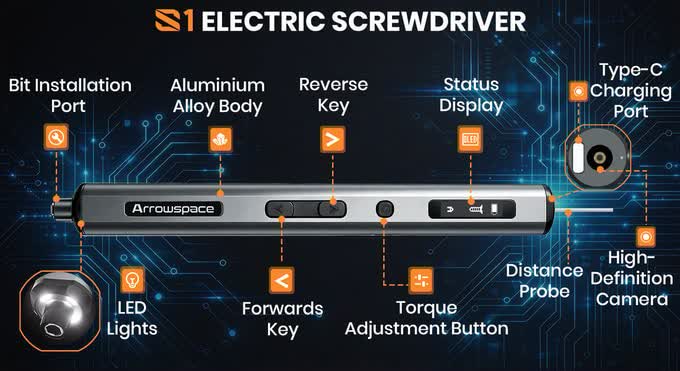
Implementation path from recognition to action
- Position the Arrowspace S1 rear probe close to the screw surface.
- Allow the camera to capture the screw head at its optimal focusing distance.
- Run the Arrowmax-trained model locally to classify the screw specification.
- Use the companion mobile app to review the real-time image, recommended bit, torque setting, and gear.
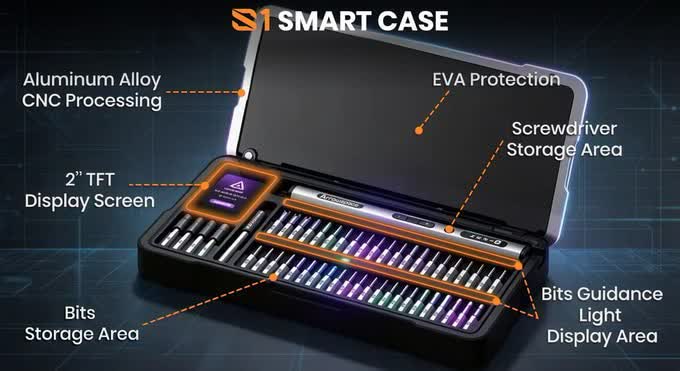
- If a Smart Case is attached, identify the bit position through the corresponding LED indicator.
- Apply the device's recommended torque to help prevent cam-out, thread damage, or over-tightening.
Data collection: controlled training material rather than external datasets
The stated training basis is tens of thousands of real screw photographs. Arrowmax explains that all training samples were collected by its engineering team, not obtained from external datasets. The intended effect is two-fold: better recognition accuracy and more controlled data provenance. From an application perspective, the lesson is that narrow AI features often depend less on generic model scale and more on domain-specific images that reflect the objects, lighting, and failure modes users will encounter.
Smart Case: closing the loop between digital recommendation and physical picking
The Smart Case holds 52 bits. Each bit location has an LED indicator. When the AI determines the required specification, the relevant location lights up, allowing the user to find the matching tool faster. This matters because recommendation systems often fail at the handoff: the software says what should be used, but the operator still must search for it. The Smart Case changes the AI output from a screen prompt into a physical pick instruction.
Risk boundary: torque control, precision, and accuracy dependency
Beyond recognition, Arrowspace S1 can automatically set recommended torque based on the screw specification. The purpose is to reduce risks such as screw head stripping, thread damage, or over-tightening. These risks are especially relevant when repairing small devices such as computers, phones, and eyeglasses.
The risk boundary is also clear: the system's value depends on whether recognition accuracy meets expectations. If the classifier misidentifies a screw size or recommends the wrong bit and torque, the automation could increase damage risk rather than reduce it. For AI application teams, that means model evaluation should be tied to actual maintenance outcomes, not only image-label accuracy.
Hardware specifications for product managers and operations teams
The product specifications also frame how the AI feature must live inside a portable device:
| Specification | Stated value |
|---|---|
| Display | OLED display shows battery level, torque setting, and rotation direction. |
| Battery | 600mAh lithium polymer battery. |
| Runtime | About 90 minutes of continuous use, or about 900 screws. |
| Charging | USB-C charging; full charging takes about 70 minutes. |
| Torque range | 1 to 10 kgf/cm. |
Cost, launch signal, and accessories
At the current stage, Arrowmax has launched a crowdfunding campaign on the Kickstarter platform. The electric screwdriver alone has an early-bird price of about 80 USD. The bundle that includes the Smart Case and 52 bits has an early-bird price of about 129 USD. The campaign went live on October 20 and reached its funding target within 24 hours. The amount raised has since exceeded the initial target by more than ten times.
Additional accessories mentioned include an angle adapter, a bit conversion kit, and a mini vise, supporting different repair and assembly scenarios.
Common misconceptions about this kind of AI application
- It is not merely a gadget demo: the valuable part is the closed loop from vision recognition to bit selection and torque setting.
- It is not safe to assume every AI feature needs cloud connectivity: Arrowspace S1 synchronizes data locally to the mobile app.
- It is not enough to train only on clean catalog images: Arrowmax says its model was trained on tens of thousands of real screw photographs collected by its engineering team.
- It is not a pure hardware story: the AI function creates the bridge between screw identification and recommended parameters.
Checklist for teams evaluating similar AI-assisted tools
- Define the narrow recognition target before selecting a model: here, screw-head specification.
- Ensure data provenance is explicit, especially for domain-specific images.
- Design the local-first path for environments where connectivity is unreliable.
- Connect model output to an action: bit recommendation, LED prompt, torque setting.
- Measure business risk, including stripping, thread damage, and over-tightening.
- Validate price and accessory ecosystem against expected repair scenarios.
FAQ
Does Arrowspace S1 need internet for screw recognition?
For the described core workflow, the identification data is synchronized locally to the mobile app; the flow can be completed without network connection.
What does Smart Case add?
The Smart Case stores 52 bits and uses an LED indicator at each bit position to point to the matching bit after the AI result is generated.
Why does automatic torque matter?
Automatic recommended torque can help reduce screw head stripping, thread damage, and over-tightening, especially when repairing computers, phones, and eyeglasses.
What pricing and launch facts are stated?
The Kickstarter campaign was live on October 20, reached target in 24 hours, and raised more than ten times the initial target. The early-bird price is about 80 USD for the screwdriver alone and about 129 USD for the Smart Case bundle with 52 bits.
Action advice
For ItInsightsWorld readers assessing AI application deployment, Arrowspace S1 is a useful example of a bounded AI product: vision input, local inference result, mobile presentation, and hardware action. The practical next step for teams is not to replicate the screwdriver, but to replicate the decision pattern: identify one repeated manual lookup problem, use controlled domain data, keep the output local where needed, connect the result to a physical action, and evaluate failure risk in units of work rather than model score alone. If recognition accuracy meets expectations, the niche tool can become a reference point for broader smart tool design.