
ItInsightsWorld AIapplications Playbook: Preparing Your Martech Stack for Agentic 2026
How can marketing teams put AI agents into real production work without breaking a martech stack? On ItInsightsWorld, the answer is simple: convert the agentic trend into three governed use cases, instrument every action, and keep humans responsible for policy, brand, and customer outcomes. The practical path begins with the annual assessment released in December by Frans Riemersma and collaborators.
Why the 2026 reset matters before teams deploy agents
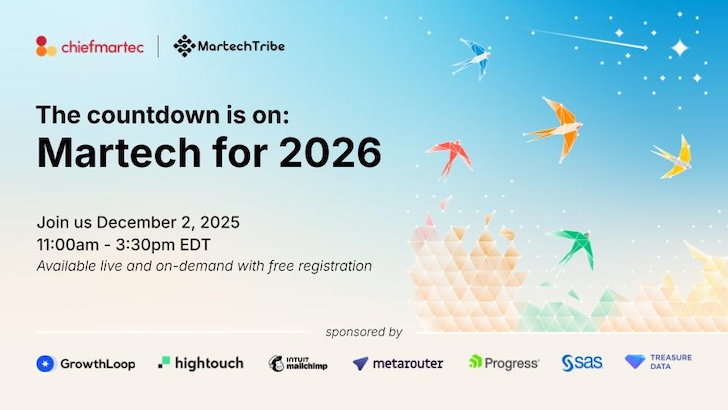
Every December for the past few years, Frans Riemersma and his regular collaborator publish a review of what is actually happening in martech as the New Year approaches. The current edition, Martech for 2026, is scheduled for Tuesday, December 2, and it is built on a deliberately unglamorous method: it extrapolates existing, real-world patterns over 6-12 months rather than chasing end-of-year prophecy. For an AIapplications audience, that makes it more useful than a hype forecast because it asks what is already moving through production workflows.
Advance registration for the free online event puts readers at the front of the line for the material. The package includes a 100+ page report and an hour-long presentation covering the best findings. Frans and the co-author promise a fun delivery, because humor makes dense operational evidence easier to absorb. Sessions can be watched live or on-demand anytime during December.
The report and seminar are free because sponsors support the research: GrowthLoop, Hightouch, Intuit Mailchimp, MetaRouter, Progress, SAS, and Treasure Data. The bonus segment after the keynote interviews senior product and marketing leaders from sponsor companies, with no sales pitches, only candid observations about what AI agents are doing inside their own organizations and customer bases.
Which three agent domains should operations teams track?
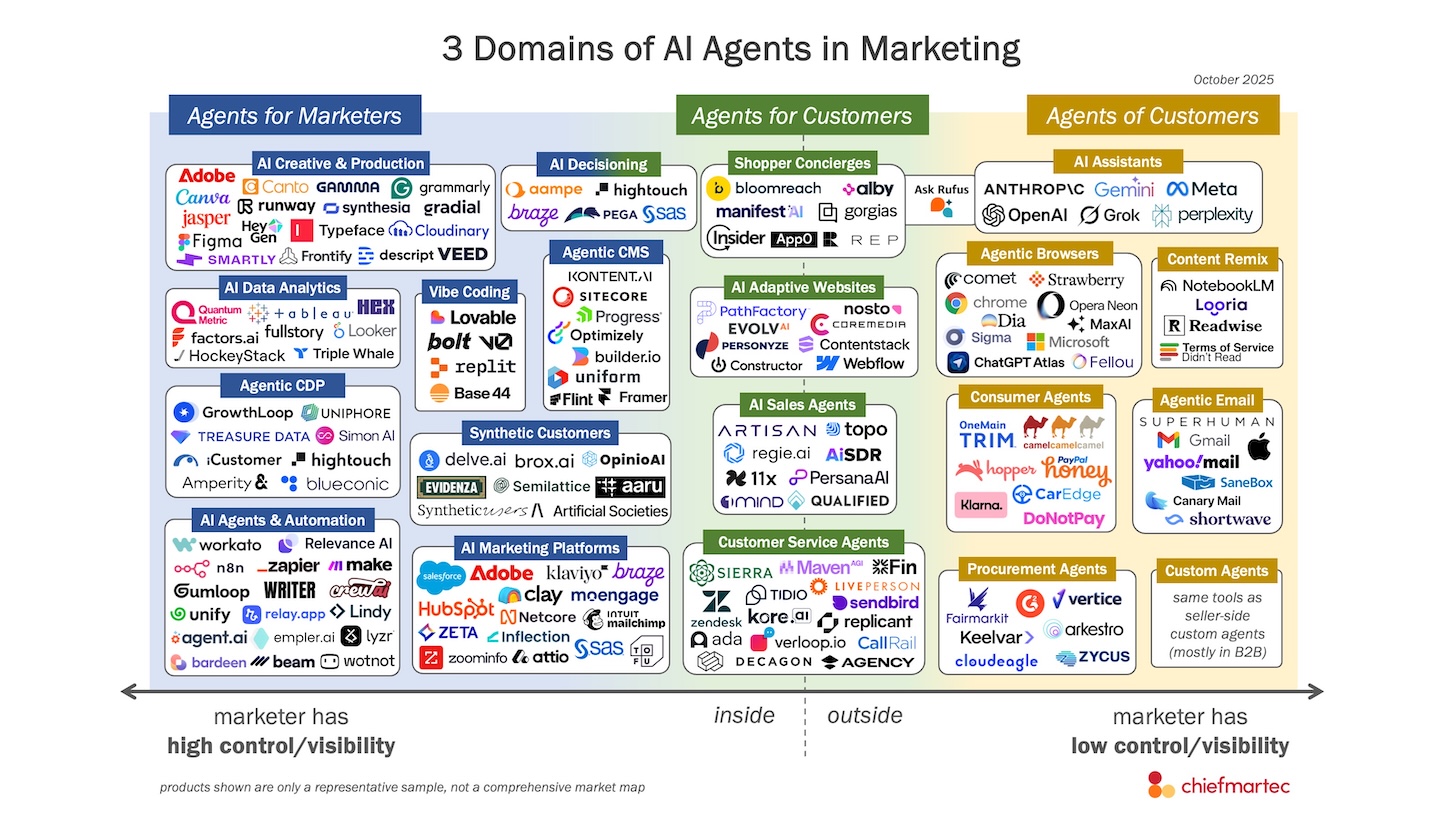
The core framing separates AI agents in marketing's orbit across three domains. They are not just three vendor labels; they describe where decision authority sits, what data is exposed, and how success should be measured.
| Domain | Business job | Safe first pilot | Risk boundary |
|---|---|---|---|
| Agents for Marketers | Behind-the-scenes help to design, produce, and analyze campaigns, programs, and experiences | Brief-to-variant drafting, campaign diagnostics, or reporting summaries with human review | Do not let the agent set budget, publish, or claim attribution without stable measurement inputs |
| Agents for Customers | Marketer-controlled interactions such as service agents, AI SDRs, and website concierges | bounded self-service answers with escalation, consent capture, and brand tone controls | Customer trust fails fastest when promises, privacy handling, or handoff rules are unclear |
| Agents of Customers | Buyer-side AI used to research, evaluate, negotiate, and purchase outside marketing's control | monitor how answers describe products, pricing, competitors, and proof points | Marketing cannot own this channel directly; influence depends on better evidence structure |
AEO, or answer-engine optimization, is only the visible tip of the disruption created by buyer-side agents. The larger operational question is whether a company's product claims, offers, and support content are consistent enough for an autonomous buyer agent to trust.
What separates production-ready agents from science-fair demos?
The full results from the AI & Data in Marketing survey are useful because they split the noise into practical adoption states. Some agents are scaling in production, while others remain early experiments that look impressive in a sandbox but collapse when exposed to permission boundaries, dirty data, service-level agreements, and customer consequences.
The analysis also digs into context engineering: how the right product facts, campaign history, customer record, policy rules, and retrieval sources are assembled before the agent acts. This is where many marketing teams underestimate effort. The report includes statistics about the full spectrum of data sources connected to agents, which helps readers see whether they are wiring a workflow to trusted systems or simply dressing up a guess.
Market movement reinforces the need for a practical filter. In an August 2025 press release, Gartner predicted that up to 40% of enterprise applications would feature integrated task-specific AI agents by 2026, up from less than 5% at the time of the release. For martech owners, the implication is not to deploy agents everywhere, but to distinguish workflows where probabilistic behavior is acceptable from workflows that need deterministic controls. As Martech.org framed the architectural challenge in February 2026, "AI agents introduce probabilistic decision-making into deterministic stacks. Define intent, enforce guardrails and architect agents that scale."
How should teams build a 6-step pilot plan?
- Choose one of the three agent domains and define the business intent in a single sentence: who is helped, what job is done, and what action the agent may take.
- Map the minimum data context required, including product, customer, campaign, policy, and historical performance sources. Avoid a context dump and prefer governed retrieval.
- Set guardrails: permitted tools, prohibited actions, brand-tone constraints, escalation triggers, logging, and a kill switch. Customer-facing agents also need disclosure, consent, and privacy review.
- Run a shadow mode first. The agent observes real inputs and proposes actions, but humans execute and score the suggestions against accuracy, tone, and cycle time.
- Launch one bounded workflow. For marketer-facing agents, that might be campaign analysis or content drafting. For customer-facing agents, that might be website concierge or AI SDR triage with human follow-up.
- Evaluate whether the agent augments existing SaaS platforms, replaces a niche app, or creates an entirely new use case before expanding budget and scope.
What KPIs prove value rather than novelty?
| KPI | What to capture | Why it matters |
|---|---|---|
| Production ratio | agent actions completed with human review versus suggestions rejected | separates usable workflow capability from demo theater |
| Context reliability | source coverage, retrieval success, stale-product-fact incidents, and unsupported claims | context engineering is the difference between a useful agent and a confident error machine |
| Time-to-decision | cycle time for brief-to-variant, campaign diagnostics, service routing, or lead triage | shows whether the agent reduces operational friction, not just chat volume |
| Customer impact | deflection quality, escalation rate, CSAT, privacy incidents, and handoff success | Agents for Customers need experience metrics because bad agent behavior transfers directly to brand damage |
| Buyer-side visibility | mentions, factual accuracy, competitor comparisons, and answer-source coverage in AI shopping assistants | helps marketers respond to Agents of Customers without pretending to control them |
What are the most common pitfalls and how do teams avoid them?
- Tool-first thinking. Teams buy an agent because a vendor says it is agentic, not because a workflow owner has a measurable bottleneck. Start with the job, not the software.
- Unmanaged context. The agent receives product, pricing, campaign, and customer facts without versioning. The result is not just error risk, but untraceable error risk.
- Missing deterministic rails. A probabilistic agent should not have unlimited access to send, refund, discount, publish, or alter CRM records unless those actions are approved by policy.
- Assuming all SaaS will be replaced. The report's operational framing is more careful: some apps will be augmented, some replaced, and some used for entirely new cases. The decision should be made workflow by workflow.
- Overlooking the data plumbing. Databricks' recent martech architecture material argues that rigid stacks struggle when agents, humans, and applications need to reason and act together. The practical response is a governed core with a fluid frontier, not a new pile of disconnected tools.
FAQ: practical questions before adopting AI agents in martech
Do teams need a new martech stack for agents?
Not necessarily. The more useful move is to identify which existing platforms provide the deterministic records of truth and which new use cases require agent interfaces. The stack changes shape when agents need permissioned context, action logs, and cross-system reasoning.
Which of the three domains is safest for a first pilot?
Agents for Marketers usually create the shortest learning loop because the human remains the publisher and decision maker. Agents for Customers deserve more caution because the customer experiences the agent directly. Agents of Customers cannot be piloted by marketing alone; they need monitoring, evidence improvement, and answer consistency.
What does scaling in production actually require?
It requires more than prompts. It needs reliable data sources, role-based permissions, evaluation metrics, escalation paths, and a review of whether the agent is augmenting, replacing, or creating a new workflow.
Is the Martech for 2026 material worth registering for?
If your team needs an evidence base rather than a sales pitch, yes. The free registration gives access to the 100+ page report, the hour-long presentation, sponsor interviews, and live or on-demand sessions during December.
Action checklist for the next 90 days
- Before your holiday break, register for the free Martech for 2026 event to secure early access to the report and December sessions.
- Select one marketer-facing and one customer-facing agent candidate from the three domains.
- Build a one-page context inventory for each candidate: required data sources, access rights, update cadence, and prohibited facts.
- Run shadow mode for two weeks and score suggested actions by accuracy, customer safety, and time saved.
- Decide whether to augment an existing platform, replace one, or fund a new agent use case only after the evidence is collected.
Reference sources
- Chief Martec, "Here's your copy of our Martech for 2026 report, free and ungated," https://chiefmartec.com/2025/12/heres-your-copy-of-our-martech-for-2026-report-free-and-ungated/.
- Gartner, "Gartner Predicts 40% of Enterprise Apps Will Feature Task-Specific AI Agents by 2026, Up from Less Than 5% in 2025," https://www.gartner.com/en/newsroom/press-releases/2025-08-26-gartner-predicts-40-percent-of-enterprise-apps-will-feature-task-specific-ai-agents-by-2026-up-from-less-than-5-percent-in-2025.
- Martech.org, "How to architect AI agents in your martech stack," https://martech.org/how-to-architect-ai-agents-in-your-martech-stack/.
- Databricks, "The New Martech Stack for the AI Age," https://www.databricks.com/resources/ebook/new-martech-stack-ai-age.
- McKinsey, "The State of AI: Global Survey," https://www.mckinsey.com/capabilities/quantumblack/our-insights/the-state-of-ai.