
ABB's Robotic Inspection Bet: What AI Does Before an Engineer Opens the Switchgear Room
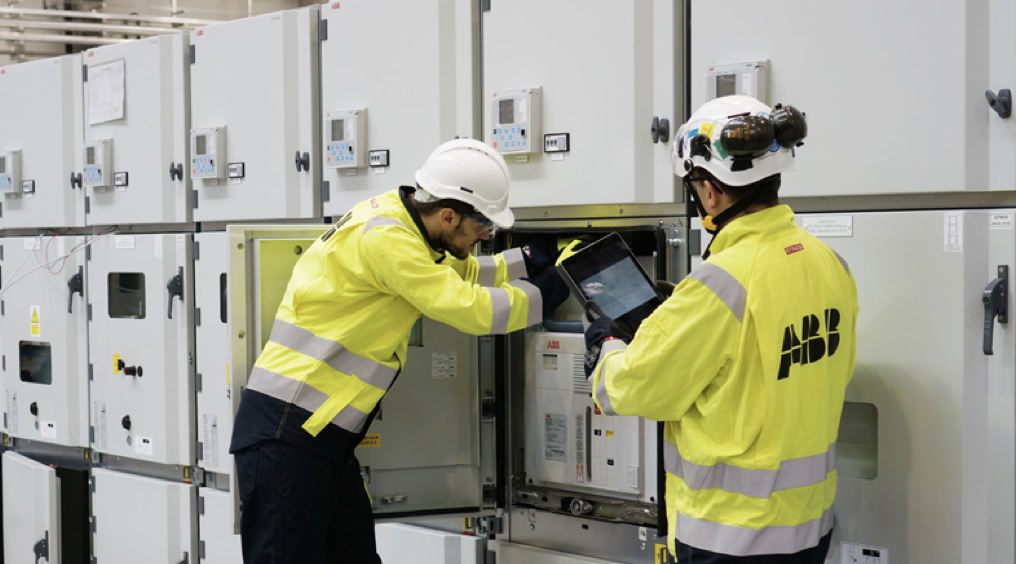
Access is the most expensive sensor in the electrical service business. Every entry into an energised room purchases information in the only currency that appears on a site safety plan: human exposure. That trade-off, not the robot itself, is what ABB has placed at the centre of its case for automated inspection — and it is why this channel reads the announcement as a deployment question rather than a robotics demo. The interesting engineering is in the software layer that decides what a crew does with the data before anyone walks in.
The short version for busy readers
- Automated inspection shifts the cost of reconnaissance from people on site to machines that can enter a hazardous electrical environment first, capturing thermal, acoustic and visual signals remotely.
- Hardware is not the bottleneck: suitable robotic platforms are already commercially available. The scarce work is the application layer that adapts them to safety-critical switchgear and connects findings into asset management systems.
- AI is the enabling ingredient that converts raw inspection volume into prioritised, actionable recommendations — earlier detection, better sequencing, more preparation.
- The realistic near-term value metric is exposure avoided and rework prevented, not headcount reduction. ABB frames the future of field service as engineers kept firmly in control, armed with richer information.
- Most of this capability is still at prototype stage, so any organisation treating it as a buy-and-deploy line item today is misreading the maturity curve.
Why the periodic-entry model is suddenly under review
For decades the inspection loop looked the same everywhere: a fault is reported, a qualified team travels to site, an engineer assesses conditions with incomplete information and commits to a course of action. The work is highly skilled and routinely performed in difficult physical conditions. ABB's argument is that today's technology makes it worth interrogating a default we stopped noticing — must a field service engineer always be the first person inside a potentially hazardous space?
The safety arithmetic gives the question weight. Analysis by the National Fire Protection Association of the US Bureau of Labor Statistics Census of Fatal Occupational Injuries records 142 workers who died from exposure to electricity in 2023 alone (nfpa.org, 'Fatal Occupational Injuries in 2023 Caused by Exposure to Electricity or Arc Flash'). That is an annual tally of worst cases, and it says nothing about the far larger volume of close calls absorbed by inspection routines in live substations and industrial switchrooms. Reducing the number of human-hours spent in an unfamiliar energised environment is a legitimate safety objective in its own right, independent of any efficiency claim.
Market conditions explain the timing. ABB's description of electrical infrastructure as an asset critical to business operations now carries commercial force: electrification of transport, industry and heating is raising utilisation on grid assets whose renewal is slow and capital-heavy. Meanwhile the enabling tooling is becoming ordinary procurement rather than research budget — the global machine vision market is projected to move from USD 15.83 billion in 2025 to USD 23.63 billion by 2030, an 8.3% compound rate, according to MarketsandMarkets. Cost curves falling across cameras, thermal modules, edge inference and batteries are what make 'send the machine first' a financeable idea instead of an exhibition stand.
The application layer is the actual product
Two things in ABB's account deserve emphasis for anyone evaluating this space. First, the company is candid that platforms capable of the physical work already exist and are improving rapidly; its research and development effort targets adapting them to the specialised requirements of electrical service. Second, the deliverable being assembled is described as an application layer, built by combining service expertise, software development and engineering knowledge, so that robotic platforms operate effectively inside complex, safety-critical electrical environments and integrate seamlessly with broader asset management systems.
Read as a technology-deployment problem, that framing is the honest one. The hard constraints in a live switchroom are mundane and unforgiving: radio propagation in a metal enclosure, a robot that must survive proximity to busbars without breaching clearance, battery endurance across a full aisle of cabinets, sensor contamination from dust and moisture, and the requirement that nothing in the retrofit interrupts production. Those are integration specs, not model specs. A team that buys a mobile platform and a vision model still has to solve them, which is why much of the field remains at prototype stage.
Case in point: earlier detection replaces periodic entry
The clearest public example of the same logic applied to grid assets is ABB's AI fault-prediction pilot with Ørsted A/S, Denmark's largest utility, at Avedøre Power Station, reported by ABB in June 2026. The stated premise is that most electrical faults build up over time but are discovered late, leaving little room to respond; the pilot is designed to give operators earlier warning and therefore more time to act. ABB's Søren Bagge Skou framed it in terms of grid automation moving operators from periodic inspection toward earlier detection, faster diagnosis and more informed maintenance decisions, and the vendor will support the utility throughout the first year of the pilot so that the insights prove relevant and actionable.
Two operational lessons travel from that project to any inspection pilot. One: value depends on continuity of vendor engagement after go-live, not on the demonstration. Two: the model is only as good as the decision loop it feeds — an alert nobody triages is a notification, not an outcome. The same pattern shows up in ABB's integration of AI-assisted diagnostics into Remote Condition Monitoring for emissions analyzers, where around-the-clock visibility into system performance replaces periodic manual checking (new.abb.com). Trade coverage of ABB's grid-automation work, including anomaly detection on data substations already generate rather than on newly installed sensing, points the same way: the cheapest AI win in electrical assets usually comes from re-reading existing signals.
Four ways to inspect the same asset, compared
The practical question for a reliability lead is not whether automated inspection is good, but which modality beats which for a given risk profile. The following comparison is editorial, built around the sensing modes ABB describes — thermal imaging, acoustic monitoring and visual inspection — and the deployment realities around them.
| Approach | What it captures | Human exposure | Speed to insight | Where it wins / where it stalls |
|---|---|---|---|---|
| Manual walk-down | Everything a trained engineer can see, hear and touch; judgment applied in real time | Highest — a qualified person enters first, with limited prior information | Days to schedule; findings depend on who attended | Wins on ambiguity and rare faults; stalls on frequency, cost per event and safety risk |
| Fixed online sensing | Continuous temperature, partial discharge, current and gas signals at selected points | Low once installed | Real time, machine-speed | Wins on trending and early warning; stalls on coverage gaps and the capital cost of retrofitting an installed base |
| Robotic or crawler platform | Thermal, acoustic and visual data from hard-to-reach and elevated locations | Materially reduced — people stay outside the hazard zone during reconnaissance | Minutes to hours per pass; analysis accelerated by AI | Wins on reach and repeatability in confined, energised spaces; stalls on integration specs and unproven long-term robustness |
| Drone plus AI vision | Wide-area visual and thermal sweeps of yards, outdoor substations, structures | Low, but flight permissions and weather gate it | Fast per site, batched analysis | Wins on large footprints and tall structures; struggles indoors, in metallic enclosures and near live conductors |
A five-point readiness checklist before you approve a pilot
- Baseline the exposure you are trying to remove. Log person-hours inside energised or confined spaces, by asset class, for the previous 12 months. Without it there is no defensible before-and-after.
- Name the decision the output must serve. Inspection data earns its keep only when it changes a work order — scope, spare parts, crew composition, outage window.
- Audit the integration path to your asset system. If findings cannot be written into a maintenance record with evidence attached, the pilot will stall at demo quality.
- Specify the environment, not the robot. Clearance envelopes, electromagnetic conditions, communications loss recovery, contamination, and whether work must proceed without interrupting production.
- Define who signs off on an AI recommendation. Accountability for the maintenance decision remains with a named engineer; document that rule before the first alert arrives.
Implementation path: six steps from scope to steady state
- Pick the hazard, not the asset. Choose one inspection class where entry risk is high and repeat frequency is meaningful — a live switchgear aisle, an elevated cable run, a confined electrical room.
- Instrument the current process first. Record what a manual inspection yields today: findings, blind spots, missed anomalies, and how often rework follows.
- Run a data-quality trial before a hardware trial. Capture thermal, acoustic and visual samples on the target environment and check that anomalies are actually distinguishable from normal variation.
- Deploy the platform as an observer, not an actor. For the first phase, the system reports; a qualified engineer decides. Measure agreement between machine findings and human verification.
- Wire output into the asset management loop. Convert accepted findings into prioritised inspection activities and prepared work packs, and track preparation quality as a metric.
- Escalate scope only after the alert load is survivable. Add assets once false-positive rates and review capacity are both stable.
How to quantify the benefit without over-claiming
ABB is explicit that this technology should not be read as a cost-cutting measure; the stated intent is to help service teams achieve more with the same resources — better tools, better information, better support — so they work more safely and effectively. That reframing matters when you build the business case, because the primary return is avoided exposure and avoided unplanned disruption, not avoided labour.
For the secondary effect, anchor expectations in published benchmarks rather than vendor promises. A synthesis of study-level figures compiled by ReliaMag reports McKinsey estimates that well-run predictive maintenance reduces machine downtime by 30% to 50% and extends machine life by 20% to 40%; Deloitte analysis cited in the same body of roundups points to 10% to 20% uptime improvement. Those ranges describe mature, well-implemented programmes, which is exactly why the honest first-year claim for an inspection pilot is narrower: fewer unplanned entries, shorter preparation cycles, higher share of work packs arriving on site complete.
Four misconceptions this category keeps generating
- 'Automation in service means fewer engineers.' The direction of travel in electrical field service runs the other way: human judgment stays irreplaceable because of environmental complexity and the stakes of each decision. Engineers remain the ones who decide what should be inspected, interpret findings and recommend action.
- 'Robots are the innovation.' Adopting robotics for its own sake is explicitly not the objective; meaningful improvement comes from solving real service problems, and much of that work is software and integration.
- 'The pilot proved the model, so scale it.' Prototype robustness under supervised conditions is not operational robustness across a fleet of sites, technicians and seasons.
- 'More sensors equal more insight.' Volume without analytical capacity creates backlogs. AI's role here is to compress the time between collection and recommendation, not to justify more collection.
The risk boundary: where these systems fail first
Failure in this category is rarely dramatic; it is quiet and administrative. Anomaly detection tuned to a handful of reference conditions produces alerts that technicians learn to discount, and alert fatigue converts a visibility investment into noise. Thermal and acoustic signatures drift with load, ambient temperature and season, so a model calibrated in one year degrades unnoticed. Retrofit hardware introduces its own risk into a safety-critical space if clearance and isolation are not engineered properly. And because ABB's own positioning ties this to integration with asset management systems, the quality of the maintenance data the platform inherits — naming conventions, history completeness, evidence linkage — sets the ceiling on what any model can say.
Governance is the unglamorous fix. The NIST AI Risk Management Framework, organised around the functions Govern, Map, Measure and Manage, gives industrial teams a defensible structure for exactly the questions raised above: who owns the risk of a system that advises on live electrical assets, how its decisions are traced, and what evidence is required before its recommendations carry weight. Applying a recognised framework is also the cheapest way to pre-empt the audit that any safety-critical deployment eventually faces.
FAQ
Is this available to buy today?
Suitable robotic platforms are commercially available, but the electrical-service application layer described here is still largely at prototype stage. Expect integrator-led engagements rather than catalogue purchases.
Does it remove the need for qualified engineers?
No. The premise is that the qualified person decides what to inspect and what to do about the findings; the machine takes the reconnaissance task that currently requires a human to enter first.
What should we measure in year one?
Exposure-hours avoided, share of work packs arriving on site complete and correct, agreement between automated findings and human verification, and unplanned-to-planned conversion rate on the assets under observation.
Where do most pilots stall?
At integration: evidence cannot reach the asset management record, alert volumes exceed review capacity, or nobody owns model accuracy after go-live. All three are process gaps, not algorithm gaps.
What to do in the next 90 days
- Calculate your current exposure baseline from permit-to-work and inspection records; treat it as a safety KPI with a named owner.
- Run a two-week observation-only pilot on one switchgear asset, comparing remote thermal, acoustic and visual capture against the last manual inspection of the same asset.
- Write the human-in-the-loop rule down before the pilot starts: no automated finding closes or opens a work order without qualified sign-off.
- Map your inspection outputs to the fields in your asset management system, and fix the taxonomy now, while the volume is small.
- Put a governance reference such as the NIST AI RMF against the pilot charter, with a quarterly review of false positives and drift.
Nothing in the current evidence base supports the idea that machines will take over electrical field service. What does support is narrower and more useful: the reconnaissance step, the one that today consumes the most skill and the most risk, can increasingly be performed by something else. If the pilot is scoped around exposure and preparation quality rather than headcount, the technology does what ABB says it is for — engineers walk in less exposed than ever, and they walk in already knowing what they are looking at. That is the version of automated inspection worth budgeting for.
Analysis prepared for the ItInsightsWorld AIapplications channel.